
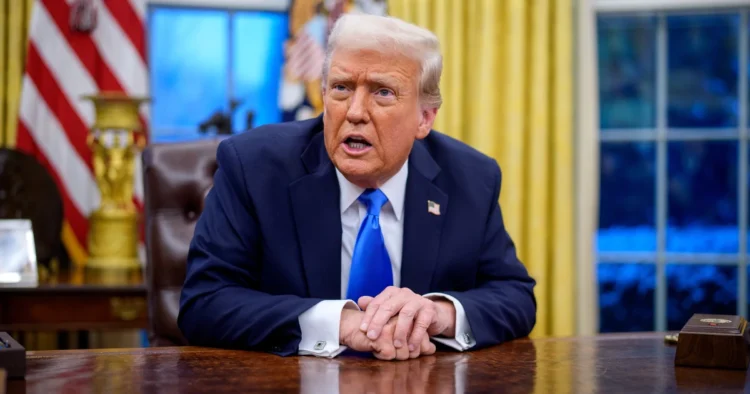
By Theodore Brown-
The United States Treasury Department announced Thursday that President Donald J. Trump’s signature will appear on newly printed U.S. paper currency, marking the first time in American history that a sitting president’s autograph will adorn legal tender. The announcement, aimed to coincide with the nation’s 250th anniversary celebrations, breaks a tradition of more than 165 years and has ignited debate over presidential legacy, historical norms, and the symbolic role of money in American life.
In a statement accompanying the plan, Treasury Secretary Scott Bessent said Trump’s signature on the dollar bills will honour “historic achievements of our great country” at a time of national celebration and economic strength, framing the initiative as fitting for the nation’s semiquincentennial.

AD: Capeesh Restaurant
The first redesigned $100 notes featuring both Trump’s signature and that of Bessent are expected to be printed as early as June, with other denominations to follow in the coming months.
Traditionally, U.S. currency has borne the signatures of the Treasury secretary and the Treasurer of the United States, a practice that dates back to the 19th century. This framework ensured currency reflected the constitutional authority vested in the Treasury Department rather than the office of the presidency itself.
The shift toward including a sitting president’s signature effectively eliminates the placement of the Treasurer’s signature on federal banknotes, ending a long‑standing tradition first established in the 1860s. Critics and supporters alike have seized upon the news. On social and political forums, commentators have debated the move’s historical implications. Some see it as a bold mark of presidential legacy, while others argue it blurs the line between state representation and individual aggrandisement.

AD: Oysterian Sea Food Restaurant And Bar
Despite tradition, the Treasury maintains that legal authority to modify currency designs rests with statutory powers granted under federal law, and that the change does not violate existing guidelines governing paper bills. The currency is more than everyday money; it is a potent symbol of national identity, history, and values. Placing a current president’s signature on paper bills during a milestone anniversary unavoidably carries political resonance especially under a highly polarising administration.
The move comes amid broader efforts by the Trump administration and its allies to imprint his influence across multiple federal institutions and public commemorations, from renamed landmarks to proposed coins and program titles.
Treasury officials underline that the change honours the Semiquincentennial the 250th anniversary of the nation’s founding with the Declaration of Independence in 1776 and reflects America’s continued economic resilience and global influence. Currency redesigns have happened before in U.S. history, often tied to major national events or security enhancements, but never with the inclusion of a sitting president’s signature.
Opposition voices have raised historical and legal concerns. Legal scholars note that U.S. law historically prohibited the portrayal of living individuals on currency to avoid perceptions of monarchical or autocratic influence. While this prohibition specifically addressed images on coins and notes, it underscored longstanding norms that kept political figures off money norms now unsettled by the Treasury’s move to replace traditional signatures with that of a sitting president.
The political context surrounding the announcement is inseparable from the broader narrative of Trump’s presidency. His administration has already secured approval for a commemorative gold coin with his image, also tied to the semiquincentennial celebrations yet another departure from tradition that has sparked its own controversies.
These efforts reflect a deliberate strategy to weave the president’s legacy into the fabric of national symbolism during a once‑in‑a‑generation milestone year.
Still, Treasury officials have been careful to emphasise that the new currency will adhere to all legal requirements for design and production, including maintaining mandated elements such as denomination, “In God We Trust,” and distinctive security markers.
The inclusion of a signature while historically significant does not alter the fundamental legal status of the notes as Federal Reserve Notes and legal tender for all debts.
While collectors and everyday Americans watch for the first redesigned $100 bills in circulation, economists and historians alike will likely continue dissecting what this shift says about presidential influence, national identity, and the evolving story of American symbols.
To a nation nearing its 250th anniversary, the timing of this change underscores how anniversaries often serve as moments of reflection and reinvention for institutions old and new.
The emergence of currency bearing the signature of a sitting president marks a chapter in U.S. history that blends tradition with transformation, prompting questions about how far national symbols should be reshaped in times of political prominence.
The semiquincentennial approaches and the nation prepares to mark 250 years since the Declaration of Independence, the humble dollar bill is poised to take on a significance far beyond its everyday function as a medium of exchange.
Traditionally a symbol of stability and continuity, the currency has long represented the enduring institutions of the United States, from the Federal Reserve to the Treasury Department. With the unprecedented addition of a sitting president’s signature, the dollar transforms into a tangible artifact of history, carrying not only its customary purchasing power but also a direct link to the current political moment.
This intersection of monetary policy, national identity, and personal legacy is unprecedented, prompting debate over the ways in which symbols of government are used to commemorate leadership while preserving the democratic ideals underpinning them. Economists and historians are watching closely as these notes enter circulation, cognisant of the fact that each transaction will now carry a subtle, almost ceremonial, reminder of the office of the presidency. Donald Trump has become one of the most powerful American presidents in history, making controversial decisions.
A defining factor behind the enduring power of Donald Trump is his willingness to blur the line between institutional authority and personal branding. This dynamic is newly illustrated by the unprecedented decision to place his signature on U.S. currency—ending a 165-year tradition and signaling a highly personalized use of executive influence.
Supporters argue that such moves reflect decisive leadership. Trump’s broader agenda—including aggressive tariffs, crypto initiatives like a national bitcoin reserve, and sweeping executive orders—demonstrates a readiness to act unilaterally in pursuit of economic dominance. This assertiveness, allies say, strengthens presidential authority and reinforces national identity, especially during symbolic moments like the U.S. 250th anniversary.
Many critics, however, see a different picture. They argue that placing a sitting president’s name on currency—and approving coins bearing his image—echoes autocratic traditions and undermines democratic norms designed to separate individuals from enduring institutions. It has been described as a dangerous precedent. but his supporters say it is a mark of his historical achievements.
Concerns extend to his economic interventions, which some analysts warn risk destabilizing global markets or concentrating power excessively in the executive branch. Trump’s power lies not just in formal authority, but in his ability to reshape political norms. Whether viewed as strong leadership or institutional overreach, the currency decision encapsulates a presidency defined by bold, controversial assertions of control.

AD: Heritage And Restaurant Lounge Bar