
By Aaron MIller-
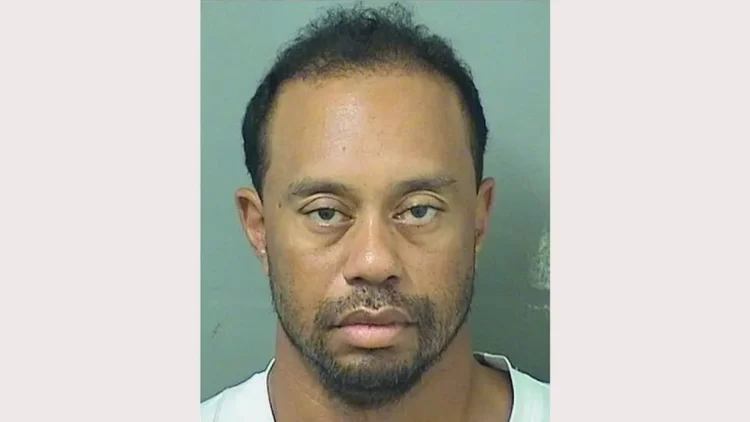
Tiger Woods has been charged on suspicion of driving under the influence has once again cast a shadow over one of the most extraordinary and complicated careers in modern sport, raising fresh questions about the enduring tension between greatness and vulnerability in elite athletes.
The 50-year-old golfer, whose name has long been synonymous with dominance, discipline, and historic achievement, now finds himself at the centre of a new controversy following a dramatic rollover crash on a Florida roadway that led to his detention and formal charges.

AD: Capeesh Restaurant
Authorities in Martin County confirmed that Woods was taken into custody on Friday after his vehicle overturned during what officials described as a high-speed manoeuvre to overtake another vehicle on a narrow two-lane road near his home on Jupiter Island. According to law enforcement statements,
Woods’ Land Rover clipped a trailer attached to a truck as he attempted to pass, causing the SUV to veer off course and flip onto its side. Remarkably, despite the severity of the crash, no serious injuries were reported, and Woods was able to exit the vehicle unaided through the passenger door.

AD: Oysterian Sea Food Restaurant And Bar
What followed, however, has reignited long-standing concerns about Woods’ history with driving incidents and substance-related impairment. Officers at the scene observed what they described as signs of impairment and conducted roadside assessments before placing him under arrest. A breathalyser test later showed no presence of alcohol in his system, but investigators suspect that drugs or prescription medication may have played a role.
Woods also refused to submit to a urinalysis test, a decision that constitutes a separate offence under Florida law and has further complicated the legal proceedings he now faces.
The charges brought against Woods include driving under the influence, property damage, and refusal to comply with lawful testing procedures. Under Florida statutes, individuals arrested on DUI charges are required to remain in custody for a minimum period, meaning Woods was held for several hours following the incident. While the legal process is still unfolding, the immediate consequences for Woods extend beyond the courtroom.
The incident has cast uncertainty over his future participation in professional golf events, including the upcoming Masters Tournament, and has prompted renewed scrutiny of his personal conduct at a stage in life when many expected his legacy to be firmly secured.
This latest episode is not an isolated event but rather part of a troubling pattern that has intermittently disrupted Woods’ life off the course. The golfing genius needs to cultivate a lot of discipline, to effectively manage his fame and money.
In 2017, he was arrested under similar circumstances after being found asleep in his car with multiple substances in his system, an incident he later attributed to the unintended effects of prescribed medications.
That case ultimately resulted in a plea agreement, probation, and mandatory treatment. Years earlier, in 2009, a separate car crash near his Florida home became the catalyst for a personal scandal that would temporarily derail his career and fundamentally alter his public image.
More recently, Woods survived a near-fatal crash in 2021 that left him with severe injuries to his right leg, requiring multiple surgeries and extensive rehabilitation. That accident was widely seen as a turning point, not only in terms of his physical capabilities but also in shaping public perception of his resilience. His subsequent return to competitive golf, though limited, was framed as yet another chapter in a career defined by comebacks.
Yet the events of this week suggest that the narrative of redemption remains incomplete. The image of Woods as an indomitable competitor has always coexisted uneasily with episodes of personal difficulty, and the latest arrest underscores the fragility of that balance. For a figure who once appeared almost superhuman in his command of the game, the recurring nature of such incidents invites a more nuanced appraisal of his legacy—one that acknowledges both his unparalleled achievements and the persistent challenges he has faced away from the fairways.
in order to fully grasp fully grasp the significance of this moment, it is necessary to revisit the scale of Woods’ accomplishments in golf, achievements that fundamentally reshaped the sport and elevated it to new global prominence. Since turning professional in 1996, Woods has amassed 15 major championship titles, placing him second only to Jack Nicklaus in the all-time rankings. He has also recorded 82 victories on the PGA Tour, a figure that ties him for the most wins in the history of the tour. These milestones alone would secure his place among the greatest athletes of any era, but they tell only part of the story.
Woods’ impact extends beyond statistics. His emergence in the late 1990s transformed golf into a more dynamic, athletic, and commercially vibrant sport. His dominance during the early 2000s, including the period known as the “Tiger Slam” when he simultaneously held all four major titles, redefined expectations of what a golfer could achieve.
He brought a level of physical conditioning, mental intensity, and global appeal that expanded the sport’s audience and inspired a new generation of players.
His 2019 victory at the Masters Tournament stands as perhaps the most emblematic moment of his career, a triumph widely celebrated as one of the greatest comebacks in sports history. After years of injury, personal turmoil, and doubts about his ability to compete at the highest level,
Woods defied expectations to secure his fifth green jacket, an achievement that resonated far beyond the confines of Augusta National. It was a reminder of his enduring capacity for excellence and a testament to his resilience.
And yet, even as that victory seemed to close one chapter of adversity, it did not eliminate the underlying complexities that have continued to shape his life. The physical toll of repeated surgeries has limited his ability to compete regularly, while his off-course struggles have periodically resurfaced, challenging the narrative of a complete and lasting redemption.
The current situation presents a stark contrast to the disciplined image that defined Woods during his peak years. Known for his meticulous preparation and unwavering focus, he once set a standard for professionalism that few could match. That reputation, however, has been complicated by a series of personal and legal issues that have periodically overshadowed his sporting achievements.
Public reaction to the latest arrest has been mixed, reflecting the duality of Woods’ legacy. For some, the incident represents a disappointing recurrence of past behaviour, raising concerns about accountability and the responsibilities that come with his status as a global icon. For others, it is viewed through a more sympathetic lens, acknowledging the physical pain and medical treatments that have been part of his life for years and may have contributed to the circumstances surrounding the incident.
What remains undeniable is the enduring fascination with Woods as both an athlete and an individual. Few figures in sport have commanded such sustained attention, and fewer still have experienced such dramatic fluctuations in fortune. His career has been marked by extraordinary highs and deeply publicised lows, creating a narrative that continues to captivate audiences around the world.
The immediate implications for Woods’ professional future are uncertain. Participation in upcoming tournaments is now in doubt, and sponsors and governing bodies may be forced to reassess their relationships with him depending on the outcome of theT case. The broader question, however, is how this incident will shape the final assessment of his legacy.
In many respects, Woods’ story has always been about more than golf. It is a story of ambition, achievement, and the pressures of living under constant scrutiny. It is also a story of resilience, marked by repeated attempts to overcome adversity and reclaim a position at the pinnacle of his sport. The latest developments add another layer to that narrative, one that is still unfolding and whose ultimate conclusion remains uncertain.
The image of Tiger Woods is once again divided between past and present: the champion who redefined golf and the individual confronting the consequences of his actions.. The legacy of one of sport’s greatest figures is being shaped not only by what he achieved on the course but also by how he navigates the challenges that arise beyond it.
A conviction will greatly tarnish his image, but Woods will always be in the history books as one of the finest golfers ever in history. All eyes will now be on how the court handles his case.

AD: Heritage And Restaurant Lounge Bar
-
Share On
- Categories
- Date