
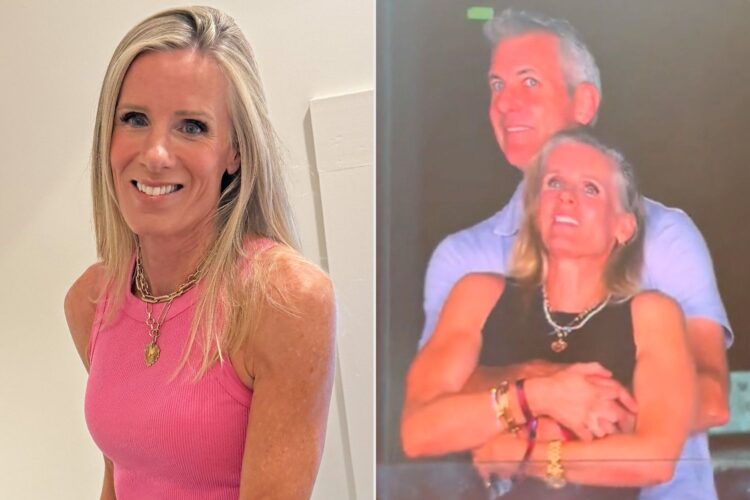
By Isabelle Wilson-
In an age where reputations can be built—or dismantled—in seconds, the long afterlife of a single public moment has taken on new meaning. Nearly a year after a fleeting image from a Coldplay concert spiralled into one of the most dissected viral episodes of 2025, the woman at the centre of it has stepped forward to reclaim her narrative. Kristin Cabot, once known primarily as the head of human resources at the tech firm Astronomer, is now speaking publicly about the personal and professional consequences of that moment—and the deeper corporate dynamics she says it exposed.
Her re-emergence, through a widely watched appearance on The Oprah Podcast and a string of high-profile interviews, marks a turning point in what had previously been treated as internet spectacle. What began as a seemingly innocuous “kiss cam” clip—captured on a giant stadium screen and shared millions of times within hours—has evolved into something far more consequential: a case study in workplace power, gendered scrutiny, and the volatile intersection between private lives and public visibility.

AD: Capeesh Restaurant
The original moment, by now etched into the collective memory of internet culture, was brief. During a Coldplay concert, a camera sweep across the crowd landed on Cabot and her then-colleague, Andy Byron, who at the time served as Astronomer’s chief executive. Their reaction—awkward, evasive, and instantly memeable—sparked speculation that quickly outpaced the facts. Within hours, online forums, social media platforms, and gossip sites had constructed an entire narrative around the clip, one that blurred the line between workplace relationships and personal conduct.
At the time, neither Cabot nor Byron publicly addressed the incident in detail. The company issued a brief statement emphasizing professionalism and privacy, but the vacuum of information only intensified public curiosity. Amateur sleuths dissected body language, pieced together corporate hierarchies, and debated the ethics of workplace relationships. What might once have remained a fleeting embarrassment became a sustained digital phenomenon, amplified by algorithms that reward controversy and speculation.
The consequences were immediate and severe. As the head of human resources, she occupied a role inherently tied to questions of workplace ethics and accountability. The viral narrative cast her not only as a participant in a personal moment, but as a symbol of perceived corporate hypocrisy. The scrutiny she faced was relentless, and, as she now describes, deeply unequal.

AD: Oysterian Sea Food Restaurant And Bar
In her interview on The Oprah Podcast, Cabot spoke candidly about the experience of becoming a public figure overnight—without consent and without preparation. She described the disorientation of watching her professional identity collapse into a single, endlessly replayed clip. “It was as though years of work disappeared in an instant,” she said, reflecting on the speed with which the narrative took hold. “I became a headline, not a person.”
Nevertheless, it is her account of what happened behind the scenes that has added a new dimension to the story. Cabot now alleges that Byron, her former CEO, misrepresented key aspects of their relationship and failed to take responsibility in the aftermath of the incident. While she stops short of detailing every allegation, her claims centre on what she characterizes as a pattern of deception and deflection—one that, she argues, left her disproportionately exposed to public criticism.
The accusation introduces a layer of complexity that challenges the original framing of the saga. What was initially perceived as a mutual moment of awkwardness is now being recast, at least in part, as a reflection of internal power dynamics. As CEO, Byron occupied a position of authority within Astronomer, while Cabot’s role in HR placed her in a structurally different, if still influential, position. The interplay between those roles—and the expectations attached to them—has become a focal point of renewed analysis.
Observers of corporate governance note that the case highlights a broader issue: the difficulty of navigating personal relationships within hierarchical organizations. While such relationships are not inherently unethical, they can raise questions about transparency, consent, and the potential for conflicts of interest. In this instance, the viral nature of the exposure amplified those questions, turning what might have been an internal matter into a global spectacle.
Cabot’s decision to speak out now, nearly a year after the incident, appears to be both strategic and personal. In her interviews, she frames her silence over the past year as a period of reflection, during which she grappled with the emotional toll of the experience and the implications for her career. By choosing to break that silence through a platform associated with thoughtful, in-depth conversation, she signals an intention to shift the narrative from sensationalism to substance.
The choice of The Oprah Podcast is itself significant. Known for its focus on personal storytelling and introspection, the platform provides a context in which complex experiences can be explored with nuance. Cabot’s appearance there contrasts sharply with the environment in which her story first unfolded—a digital landscape characterized by speed, brevity, and often unforgiving judgment.
Her account has reignited debate about the role of social media in shaping public perception. The kiss cam clip, in isolation, offered limited information. Yet its interpretation was quickly solidified through repetition and commentary, illustrating how narratives can become entrenched even in the absence of verified facts. For Cabot, this process was not merely abstract; it had tangible consequences for her professional trajectory and personal well-being.
The response to her recent interviews has been notably more measured than the initial reaction to the viral clip. While some commentators remain critical, others have expressed sympathy for the challenges she describes. There is a growing recognition that the original discourse may have overlooked important contextual factors, focusing instead on easily digestible assumptions.
This shift in tone reflects a broader evolution in how viral incidents are understood. Increasingly, there is an awareness that such moments often involve real people navigating complex circumstances, rather than characters in a simplified narrative. Cabot’s story, in this sense, serves as a reminder of the human cost of digital amplification.
At the same time, her allegations against Byron have prompted renewed scrutiny of corporate accountability. While Byron has not publicly responded in detail to her claims, the situation raises questions about how organizations handle internal crises that spill into the public domain. The balance between protecting individual privacy and maintaining transparency is a delicate one, and missteps can have lasting repercussions.
The episode represents a reputational challenge for astronomer that extends beyond the individuals involved. As a company operating in the competitive tech sector, its public image is closely tied to perceptions of integrity and leadership. The prolonged visibility of the kiss cam saga—and its recent resurgence—underscores the difficulty of containing narratives once they enter the public sphere.
The story’s significance extends beyond a single company or incident. It speaks to a cultural moment in which the boundaries between public and private life are increasingly porous. Events that might once have been confined to a specific context can now be broadcast to a global audience within seconds, subject to interpretation by millions of viewers. In such an environment, the stakes of even seemingly minor moments are dramatically heightened.
Cabot’s experience also highlights the gendered dimensions of public scrutiny. In her interviews, she suggests that the criticism directed at her was more intense and more personal than that faced by Byron. This perception aligns with broader research indicating that women in public-facing roles often encounter harsher judgment, particularly in situations involving perceived breaches of professional norms.
The intersection of gender, power, and visibility is a recurring theme in her account. As a senior HR executive, Cabot was expected to embody the principles of fairness and ethical conduct. The viral narrative, however, reduced her to a single moment that was interpreted through a lens of suspicion. Her attempt to reassert her identity—as a professional, as an individual—forms a central thread of her recent public statements.
In revisiting the incident, Cabot is not merely recounting events; she is challenging the assumptions that shaped their interpretation. By introducing new information and perspectives, she invites a reassessment of a story that had seemed settled. Whether that reassessment will lead to a lasting shift in public perception remains to be seen.
What is clear, however, is that the kiss cam moment has transcended its origins to become a touchstone for discussions about modern life. It encapsulates the volatility of online culture, the complexities of workplace relationships, and the enduring impact of public exposure. In doing so, it raises questions that extend far beyond the individuals directly involved.
As the conversation continues, the story of Kristin Cabot serves as both a cautionary tale and a point of reflection. It illustrates how quickly narratives can form—and how difficult they can be to reshape once established. It also underscores the importance of context, empathy, and critical thinking in an environment where information is abundant but understanding is often in short supply.
In stepping forward now, Cabot is attempting to reclaim agency over her story, transforming a moment of public scrutiny into an opportunity for dialogue. Whether that effort will ultimately redefine how the saga is remembered remains uncertain. But in shifting the focus from spectacle to substance, she has already altered the terms of the conversation.
And in a world where a single camera angle can change the course of a career, that shift may be the most significant development of all.

The Clip that made viral of Kristin Cabot and Andy Byron filmed at the Coldplay concert
In her most recent remarks shared this week, Cabot reiterated that the connection between her and Byron was not a long‑term sexual relationship and that she had believed his marital situation was similar to her own.
She has insisted that the kiss cam night marked “the first time anything romantic happened” between them a claim that has fuelled renewed debate over why their reaction on camera appeared so panicked.
Perhaps most striking, Cabot now says she has cut all communication with Byron, accusing him of lying about key details of their personal contexts leading up to that moment. “We have no relationship now,” she told The Oprah Podcast, highlighting her disillusionment with a man she once saw as a professional mentor.