
By Tony O’Reilly-
In a discovery fit for a sci‑fi epic, astronomers have identified an exotic exoplanet that may be rich in carbon and potentially layered with diamonds a world that defies traditional planetary norms and opens new doors in our understanding of the cosmos.
The exoplanet, known as 55 Cancri e, resides roughly 40 light‑years from Earth in the constellation Cancer, orbiting its host star at a blistering pace of once every 18 hours. Classified as a super‑Earth a rocky planet larger than our own but smaller than Neptune 55 Cancri e challenges assumptions about how planets form and what they are made of.

AD: Capeesh Restaurant
What makes this distant world so remarkable is its carbon‑rich composition. Based on spectroscopic measurements and models of its size and mass, scientists including researchers led by Nikku Madhusudhan of Yale University proposed that its interior could contain large amounts of graphite and diamond beneath a crust unlike anything found in our own solar system.
“The surface of this planet is likely covered in graphite and diamond rather than water and granite,” Madhusudhan’s team noted when the findings were accepted for publication in The Astrophysical Journal Letters. The model suggests that at least a third of the planet’s mass could consist of carbon in crystalline form, making it one of the most extraordinary planetary compositions ever theorized.
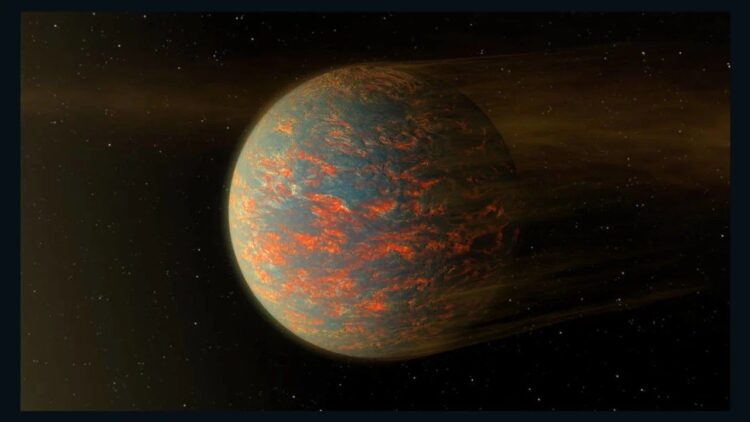
But this is no gem‑strewn paradise. 55 Cancri e orbits extremely close to its star about 0.015 astronomical units, or roughly 1.4 million miles meaning the planet is scorched by immense heat that creates a surface likely covered in magma oceans and molten rock.

AD: Oysterian Sea Food Restaurant And Bar
Data from NASA’s James Webb Space Telescope (JWST) hint that the planet may possess a thin volatile atmosphere rich in carbon‑based gases, like carbon dioxide or carbon monoxide, potentially outgassed from its fiery surface.
This would make it one of the first rocky exoplanets where astronomers might detect atmospheric components, even though the conditions are far too hostile for life as we know it.
While early 2010s studies with telescopes like Hubble and Spitzer suggested dry, hydrogen‑rich conditions, more recent evidence leans toward a secondary atmosphere shaped by conditions on the planet itself, an indication of how complex and variable exoplanetary environments can be.
Why This Discovery Matters
Beyond the headline‑grabbing idea of a “diamond planet,” 55 Cancri e represents a major scientific milestone: it highlights that planetary diversity in our galaxy is far richer than the silicate‑dominated worlds of our own neighbourhood. Planets with compositions driven by carbon rather than oxygen force astronomers to rethink theories of planet formation, interior structure, and thermal evolution.
It also underscores the power of modern telescopes and spectroscopy techniques to peer into the atmospheres and surfaces of worlds light‑years away, offering a glimpse into environments that were once purely theoretical. Just a few decades ago, planets like 55 Cancri e existed only in the imagination of astronomers and science fiction writers.
Observing a distant world’s composition, estimating the presence of molten surfaces, and detecting traces of exotic gases in its atmosphere were dreams deferred by the limits of technology.
Through analysing the light filtered through a planet’s atmosphere as it passes in front of its host star, scientists can identify chemical signatures, estimate surface conditions, and even predict weather patterns on worlds tens of light-years away. This capability has transformed our understanding of what planets can be, revealing a universe far more diverse and surprising than previously assumed.
55 Cancri e, in particular, exemplifies the frontier of these discoveries. Orbiting perilously close to its star at a distance of just 0.015 astronomical units, the planet is subjected to extreme temperatures that turn its surface into a seething ocean of molten rock. Yet, even amid such hostile conditions, spectroscopy reveals evidence of a carbon-rich composition.
Scientists estimate that up to a third of the planet’s mass could be diamond and graphite, making it not just a rocky super-Earth but a world of glittering mineral wealth. This has profound implications for our models of planetary formation.
Traditionally, planets in the inner regions of a star system are thought to be silicate-heavy, like Earth, with iron cores and metal-rich mantles. A carbon-dominated interior suggests a fundamentally different chemical evolution, one shaped by the abundance of elements in the parent star and the planet’s formation history.
These findings challenge the notion that all rocky planets share a similar blueprint and hint at a staggering diversity of planetary interiors waiting to be discovered across the galaxy.
Moreover, 55 Cancri e’s study highlights the importance of international collaboration in modern astronomy. Researchers from Yale University, the European Southern Observatory, NASA, and other institutions have pooled observational data, computational models, and theoretical frameworks to construct a comprehensive picture of the planet.
This collaborative approach allows scientists to cross-verify findings, refine models, and explore new hypotheses that a single team might overlook. It also exemplifies how the search for knowledge in space transcends national boundaries, with every new discovery offering insights that belong to all of humanity.
The implications of studying worlds like 55 Cancri e extend beyond academic curiosity. Understanding extreme environments, scientists can test theories of planetary physics and chemistry under conditions that are impossible to replicate on Earth.
This includes the behaviour of materials under extreme pressure, the dynamics of molten surfaces, and the interactions between a planet and its intense stellar radiation.
Each of these insights can inform our broader understanding of planets closer to home, including Earth, and help refine models predicting climate, tectonic activity, and geological evolution.
Furthermore, 55 Cancri e serves as a reminder of the limits of human perception. From our vantage point on Earth, the universe can seem uniform and predictable, dominated by the familiar planets and moons of our solar system.
But as telescopes peer deeper and with greater precision, we increasingly find that the cosmos defies these expectations. Planets may be entirely molten, composed of exotic elements, or possess atmospheres that shimmer with gases alien to terrestrial experience.
They may orbit stars in patterns that challenge classical orbital mechanics or exist in conditions that push the boundaries of chemistry and physics. Each discovery reshapes our understanding not just of distant worlds, but of the fundamental principles that govern matter, energy, and life in the universe.
While scientists continue to probe this extraordinary world, 55 Cancri e stands as a reminder that the universe still holds extraordinary surprises worlds built not just of rock and gas, but of elemental wonders we’ve barely begun to imagine.
It symbolises the boundless potential of human curiosity and technological ingenuity, demonstrating that the cosmos is far stranger, more beautiful, and more complex than our imagination alone could conceive.

AD: Heritage And Restaurant Lounge Bar