
By Charlotte Webster-
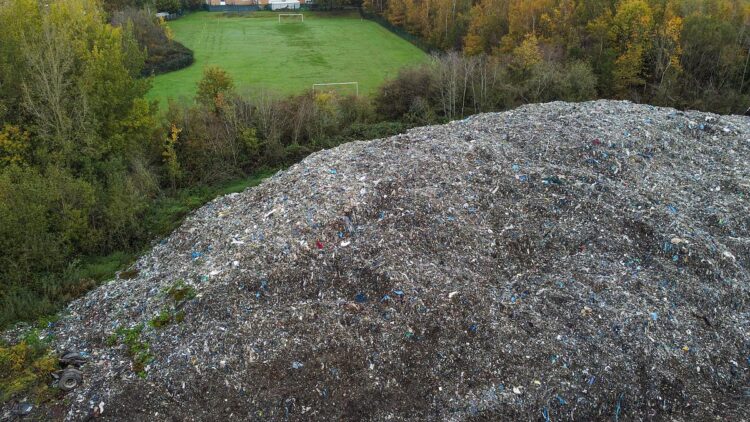
A colossal mound of illegally dumped rubbish in Bickershaw, Wigan, has become a source of “fumes, rats and maggots” for local residents, sparking urgent demands from a senior parliamentarian for the Environment Agency to remove 25,000 tonnes of waste now sitting beside homes and a primary school.
The site, located on Bolton House Road, has been described by campaigners as one of the worst illegal waste dumps in the country. It has been allowed to fester for more than a year, blighting the lives of people who daily contend with the stench of decomposing rubbish, infestations of vermin and insects, and the health risks posed by inhaling hazardous fumes.

AD: Capeesh Restaurant
The illegal waste site first began to draw serious attention in late 2024, when trucks were seen tipping loads of household and commercial refuse on a parcel of land adjacent to a playing field and a primary school. Over time, what began as scattered piles became a 25,000‑tonne mound of mixed rubbish, including plastics, organic waste, and potentially hazardous materials.
Local people say the scale of the dumping is staggering. Rats reportedly scurry across streets and through gardens, flies and maggots breed in the exposed waste, and a persistent, foul odour hangs in the air. “The rats have gone completely out of control. We’ve had rats in our cars, rats in our houses… they’re just always about,” one resident told reporters.

AD: Oysterian Sea Food Restaurant And Bar
The health and environmental implications have been striking. Last summer, the dump caught fire and burned for about 10 days, emitting plumes of smoke and forcing the nearby school to close temporarily while parents kept children indoors to avoid the toxic fumes.
The scale of the problem drew heightened scrutiny this week when Baroness Sheehan, chair of the House of Lords environment committee, wrote to ministers urging the government to direct the Environment Agency (EA) to clear the site immediately.
In her letter, she called the dump “a grave environmental hazard,” emphasising that its proximity to homes and a primary school made a cleanup an urgent public health priority.
“It is demonstrably not an inert facility,” she wrote, warning that as temperatures rise, infestations of rodents and flies will worsen, and the already strong stench will intensify.
Baroness Sheehan’s intervention reflects rising frustration in Parliament that some illegal waste sites are quietly left to deteriorate. She noted that the EA has intervened at other major dump sites such as in Kidlington, Oxfordshire where millions of pounds are being spent to remove illegal waste that poses significant environmental risk.
Yet, in the case of Wigan, the EA has reportedly drawn up plans to remove the waste “only if funds become available,” according to a response from Susan Hayman, parliamentary under‑secretary of state for environment, food and rural affairs.
The minister said the Bolton House Road site was not considered to carry the same level of risk as the Kidlington dump, a position that has angered local residents and elected officials alike.
The continued presence of the waste has exacted a high toll on families living nearby. One parent told Yahoo News UK that children are no longer able to play on the adjacent field because of the ongoing pest and pollution issues, and many residents say the smell and flies make being outside unbearable.
Determining who is legally responsible for dealing with the Bolton House Road dump has proved legally complex, compounding the frustration of residents and campaigners. Much of the site sits on land formerly owned by a now‑dissolved company, and under British common law specifically the principle of escheat the land has reverted to the ownership of the Duchy of Lancaster, a private estate of the King.
The Duchy has stated that it is committed to working with Wigan Council and other agencies to address the problem, but it also maintains that it is not automatically liable for removing the waste under existing legal frameworks.
Wigan Council has argued that the individuals or criminal networks who dumped the waste should be held responsible for its removal, and has called on the government to provide funding through the Environment Agency or another department to help with the cleanup, similar to other high‑profile illegal dump sites.
The cost of clearing such a large volume of waste is substantial. Estimates suggest that removing the dumped rubbish could cost around £4.5 million, a sum far beyond the ordinary budget of the local authority.
This situation reflects a broader national challenge around illegal waste dumping a form of waste crime that costs the taxpayer hundreds of millions of pounds each year and thrives on regulatory gaps that criminals exploit.
The Environment Agency has unique enforcement powers meant to prevent large‑scale waste crime, but recent analysis shows it has used these powers only a handful of times since they were introduced in 2018.
In the Bolton House Road case, the EA reportedly chose not to use some of its stronger enforcement tools, instead providing information to support a Closure Order intended to prevent unauthorised entry to the site. Critics argue that such measures are insufficient when waste is still being tipped and large volumes remain in place.
Local MP Josh Simons has been a vocal advocate for his constituents, urging the EA to act earlier and more decisively. He says he first raised concerns with the agency in early 2025, when reports emerged of lorries depositing rubbish at the site at up to 20 truckloads a day, yet no significant intervention was made to stop it.
Simons has described what he sees as bureaucratic “buck‑passing” between the EA, council and police, leaving residents to suffer while criminal enterprise benefits from weak enforcement.
The ongoing criminal investigation into the dump’s origins underscores the seriousness of the offence. Fly tipping defined as the illegal deposit of waste on land that has no authority to accept it is a criminal act that can result in fines of up to £50,000 and/or imprisonment, with even higher penalties at Crown Court.
Despite these legal penalties, however, residents and environmental campaigners say prosecutions are far too rare, and enforcement is too slow to prevent damage to local communities and ecosystems. The Bolton House Road hill of refuse has stood for months without decisive action to remove it, a situation some describe as a symbol of wider regulatory failure across England.
For residents of Bolton House Road, the issue is starkly local and deeply personal. Young families worry about their children’s health and safety, older residents complain that they can no longer enjoy their gardens without encountering rodents or fumes, and neighbours close to the dump speak of the psychological strain of living beside what feels like a toxic eyesore.
The environmental incident reporting service explains how people can report environmental problems including incidents at waste sites and suspected illegal dumping to the appropriate authorities, such as the Environment Agency’s incident hotline. It also lists waste crime categories and how to report them.
The refusal or inability of authorities to act swiftly on Bolton House Road, as other illegal dumps around the country are cleared with significant funds, raises questions about fairness, accountability, and how environmental law is applied across different communities.

AD: Heritage And Restaurant Lounge Bar