
By Ben Kerrigan-
In a rare moment of potential relief for the beleaguered population of the Gaza Strip, the Rafah border crossing with Egypt reopened on Monday, 2 February 2026, allowing limited movement of people after nearly two years of closure.

AD: Capeesh Restaurant
The border point critical as Gaza’s only entry and exit link that does not lead through Israel had been closed since May 2024, following Israel’s seizure of the crossing amid fierce combat in the ongoing war.
The reopening of the Rafah crossing has been highly controlled and limited in scope. According to a joint statement from Egyptian and Israeli officials, about 50 Palestinians are permitted to cross in each direction daily under the initial plan, with no goods allowed through for now a stark contrast to the bustling movement that once defined the terminal before the war.

AD: Oysterian Sea Food Restaurant And Bar
Passengers must undergo intense security vetting by Israeli authorities, coordinated with Egyptian officials and supervised by a European Union monitoring mission, before being allowed to transit on foot through the gate.
The crossing’s reopening is not only tightly managed but also deeply constrained by the conflict’s realities. With the movement of people tied to lists approved in advance and a cap on numbers, the passage does not yet represent a full restoration of freedom of movement.
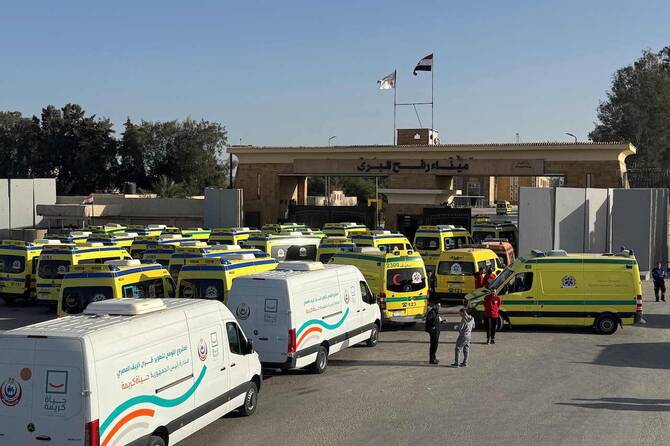
Ambulances were seen waiting on the Egyptian side of the border ahead of Monday’s operations, ready to transport people in need of urgent medical care one of the most pressing concerns driving demand for the reopening.
There are tens of thousands of Palestinians in need of treatment outside Gaza, including those with chronic illnesses and injuries, who have been unable to access care due to the long closure.
With many Gazans, the echoes of that isolation run deep: with food, medicine, construction materials and other supplies largely blocked, the economy and infrastructure have been devastated by prolonged conflict and blockade.
Even as limited movement of people is permitted, the lack of goods still passing through Rafah underscores the precariousness of life for civilians in the enclave.
Humanitarian agencies have long described conditions in Gaza as catastrophic, pointing to shortages of essential supplies and mounting pressures on health systems. The crossing’s reopening is thus a critical human story, not just a political or diplomatic footnote.
Many families, displaced within Gaza or separated from loved ones abroad, see it as a symbol of possibility as well as frustration hope tempered by the reality that the movement allowed is extremely limited.
Egypt has prepared to receive patients and other travellers, with hospitals and transit facilities readied across its Sinai provinces, but Cairo insists that the crossing operate only with strict conditions, particularly reciprocal movements an insistence that has at times complicated negotiations with Israel.
The reopening of Rafah has been one of the key benchmarks of the ceasefire agreement hammered out under U.S. mediation in late 2025.
The deal’s first phase called for a cessation of active fighting between Israel and Hamas, an exchange of hostages, and initial measures to ease Gaza’s isolation. Opening Rafah had long been stipulated as a priority by both humanitarian organisations and international mediators.
Yet, progress has been slow and fraught. Israel’s control of the crossing since May 2024, justified by its concerns about arms smuggling and militant activity, has meant that opening even a restricted facility required protracted negotiation and a degree of trust among parties that is still far from solid.
The ceasefire itself remains fragile. Despite the formal cease to large-scale hostilities, periodic violence has continued, and both sides have accused the other of violations. In the days before the reopening, intense airstrikes in Gaza killed dozens of people in fresh clashes, a stark reminder that the conflict’s embers have not fully cooled even as diplomatic efforts move forward.
From a broader geopolitical perspective, the Rafah crossing’s limited reopening feeds into larger discussions about the future of Gaza’s governance and security.
Under the ceasefire framework, plans call for a transition to Palestinian civilian control, disarmament of militant forces, and eventual reconstruction of the enclave yet none of these goals has fully taken shape, and debates over who will administer border crossings and checkpoints continue to simmer.
International actors particularly the European Union are playing a supervisory role at Rafah, providing a buffer designed to build confidence between parties and ensure compliance with agreed procedures.
Whether such oversight can withstand pressure from on-the-ground realities remains to be seen, but these mechanisms are seen by many diplomats as key to preventing a rollback of the limited progress achieved so far.
Critics of the reopening argue that without the flow of goods alongside people, Gaza’s economy and humanitarian situation will remain suffocated. Advocates counter that even the limited movement of people, especially those needing medical care, is a vital moral imperative in a territory where health infrastructure has been devastated.
Local voices reflect a similar mix of cautious hope and lingering despair. For families whose children require urgent surgery abroad, or whose relatives have been trapped for years without access to advanced care, Rafah’s partial reopening offers a rare window of possibility.
Yet the restrictions remind many Palestinians that the conflict’s impact is far from over, and that everyday survival let alone peace remains a struggle.
While Rafah resumed operations on this limited basis, the international community watched closely, aware that the crossing’s future and Gaza’s hinges on how well the fragile ceasefire holds and whether political will can translate into lasting change.
With a region long defined by violence and blockade, the modest opening at Rafah is not an end in itself but rather a tentative step on a long road toward mobility, dignity and, perhaps, peace.

AD: Heritage And Restaurant Lounge Bar