
By Aaron Miller-
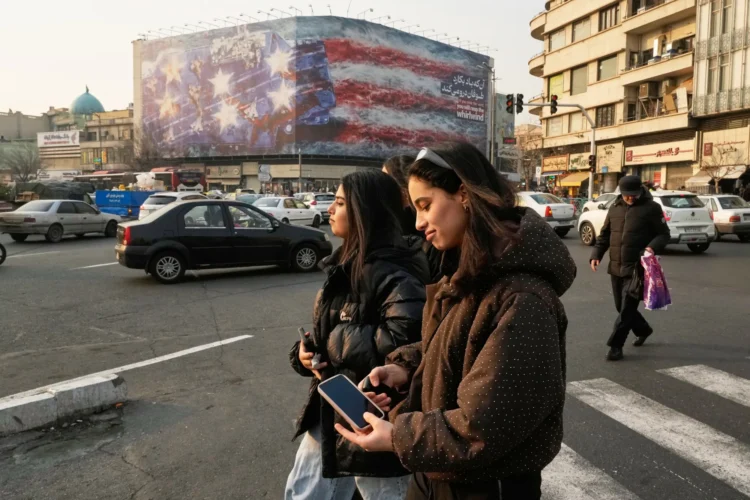
In a stark message to Washington amid escalating tensions, Iranian authorities have unveiled a giant mural in Enghelab (Islamic Revolution) Square in central Tehran that explicitly warns the United States against any military strike on Iranian soil.
The mural, vividly depicting a destroyed U.S. aircraft carrier and emblazoned with the slogan “If you sow the wind, you will reap the whirlwind,” signals Tehran’s defiant posture as U.S. warships approach the region under orders from President Donald Trump.

AD: Capeesh Restaurant
The unveiling took place on Sunday, 25 January 2026, on a massive billboard that transforms imagery into a provocative warning: any aggression directed at Iran would come with devastating consequences.
The explicit imagery red‑streaked blood resembling parts of the U.S. flag and fighter jets exploding amid carnage on a stricken aircraft carrier deck underscores the intensity of Iran’s message.
Iran’s move comes as Trump publicly confirmed that an U.S. “armada” of warships, including the USS Abraham Lincoln aircraft carrier and accompanying guided‑missile destroyers, are being repositioned toward the Middle East “just in case” he decides to take action. Officials in Tehran have responded to that rhetoric with visual and verbal warnings of their own.

AD: Oysterian Sea Food Restaurant And Bar
Analysts say the mural serves both as a domestic morale statement and an international deterrence message: Iran wants to demonstrate unity and resolve to its own population and to foreign governments watching the situation closely.
The mural, installed in one of Tehran’s most symbolic public spaces, conveys a highly charged visual message. The English and Persian slogan “If you sow the wind, you will reap the whirlwind” is a centuries‑old proverb denoting that actions have proportional consequences. In this context, Iranian authorities are signaling that any U.S. military move against Iran would result in severe retaliation.
The timing and location are significant. Enghelab Square has historically been the site of mass demonstrations and state ceremonies, making it a natural backdrop for a message meant to resonate widely at home. Beyond its symbolic value, the mural points to Tehran’s wider strategy of projecting defiance in the face of foreign pressure.
U.S. military buildup in the region particularly the movement of the Abraham Lincoln carrier strike group is seen as a clear signal that Washington is positioning forces in response to tensions with Iran that have intensified in recent weeks.
Trump has asserted that the presence of U.S. warships near Iranian waters is intended as a cautionary signal rather than a declaration of imminent offensive action. “We have a massive fleet heading in that direction and maybe we won’t have to use it,” Trump said earlier this week.
At the same time, Iran’s paramilitary Islamic Revolutionary Guard Corps (IRGC) has adopted equally stark rhetoric. A senior commander reportedly said that the IRGC is “more ready than ever, finger on the trigger,” underscoring the heightened alert among Iran’s security apparatus.
While the mural did not specify the exact nature of Iranian retaliation, the imagery suggests a willingness to strike back against U.S. naval assets or interests if attacked.
Some international analysts interpret the message as psychological warfare, leveraging cultural symbolism to bolster Iran’s negotiating position, while others view it as a tangible escalation in rhetoric likely to influence diplomatic engagements.
Domestic Turmoil and International Pressure
The mural’s unveiling also comes against a backdrop of severe domestic upheaval in Iran. National protests that began in late December over economic hardship sparked by a sharp devaluation of the Iranian rial have morphed into broader demonstrations against the state.
According to activist networks, thousands of people have been killed and tens of thousands arrested during an intense government crackdown figures significantly higher than official counts.
Iran has imposed one of the most extensive internet blackouts in its history in an attempt to control the flow of information and quell dissent. Yet, reports from human rights activists continue to pour out, underlining the severity of the unrest.
Internationally, Tehran’s defiance is feeding into broader geopolitical concerns. Trump and his administration have tied the possibility of military action in part to the crackdown on protesters, suggesting that continued violence and potential mass executions could trigger a response.
Though the president has indicated he hopes military engagement can be avoided, he has not ruled out direct action and has warned that any strike could dwarf previous U.S. attacks on Iranian nuclear infrastructure.
Indeed, Trump’s own rhetoric underscores the precarious nature of the standoff. Speaking on the possibility of military engagement, he suggested that any forceful U.S. action could make last June’s strikes widely regarded as significant “look like peanuts” in comparison.
Experts believe that Iran’s mural and accompanying warnings are designed to intimidate or at least complicate U.S. decision‑making. Such visual propaganda serves as a clear reminder that Tehran is prepared to frame any U.S. move as an existential threat, justifying robust reprisals.
Diplomats on both sides are closely watching developments. While Iran pushes its imagery and rhetoric, the U.S. has sought to temper military talk with assurances that movement of forces is defensive and precautionary.
Still, Trump continues to emphasise that military options remain on the table if what he perceives as threats to U.S. interests including aggressive suppression of domestic dissent continue unchecked.
Beyond warnings of retaliation, the mural highlights how culture and political messaging intersect in times of high tension. By placing the mural in a central, symbolic public venue, Tehran is asserting political authority and national resolve, while feeding a narrative of resistance to external pressure a message likely aimed as much at domestic audiences as at foreign powers.
The U.S. military’s repositioning including the deployment of F‑15E Strike Eagle fighters and allied assets underscores how seriously Washington is treating the situation, even as it stresses a defensive posture in the Middle East. These deployments are meant to ensure readiness, enhance regional security, and deter unplanned escalation, according to official statements.
Meanwhile, Iranian military doctrine has consistently emphasised deterrence and retaliation in the event of an attack. A senior Iranian official stated days earlier that any attack “will be treated as an all‑out war against us,” highlighting Tehran’s zero‑tolerance stance toward foreign military intervention.
In addition to the stark mural, hard‑line clerics and officials have entertained more aggressive rhetoric. One influential cleric warned that if Iran were attacked, it might target U.S. investments in the region, underscoring that economic and military targets could become part of a broader retaliatory strategy.

AD: Heritage And Restaurant Lounge Bar