
By Ben Kerrigan-
Denmark and its autonomous territory, Greenland, are gearing up for high‑level talks in Washington this week after a heated diplomatic exchange with U.S. President Donald Trump.
The controversy erupted after Greenland’s prime minister’s firm rejection of U.S. overtures was met with a dismissive belittlement from Trump, who said the stance could be “a big problem” for the leader a remark that has added urgency to what both European governments are describing as a critical moment in transatlantic relations.

AD: Capeesh Restaurant
Officials from Denmark and Greenland will meet Trump administration representatives including U.S. Vice President J.D. Vance and Secretary of State Marco Rubio in Washington on Wednesday in an effort to defuse tensions over the future of Greenland’s status and to reaffirm alliance priorities.
Greenland’s strategic importance has surged in recent years due to its location in the Arctic and the potential wealth of critical minerals beneath its ice. But the current standoff has raised difficult questions about sovereignty, alliance politics and how far U.S. policy may stretch when it comes to its Arctic neighbours.
Tensions between Washington and Copenhagen have escalated sharply this week following public comments by President Trump about Greenland’s future.

AD: Oysterian Sea Food Restaurant And Bar
After Greenlandic Prime Minister Jens‑Frederik Nielsen reiterated that his government has no intention of ceding control of the territory to the United States, Trump was quoted saying that the situation was “a big problem for him,” in reference to Nielsen’s position an unusual and direct challenge to a leader of a NATO ally.
Trump’s remarks came in the context of a broader push by his administration to revisit U.S. interest in Greenland an interest he has voiced repeatedly, citing the island’s strategic significance for national defence, particularly in relation to Russian and Chinese influence in the Arctic.
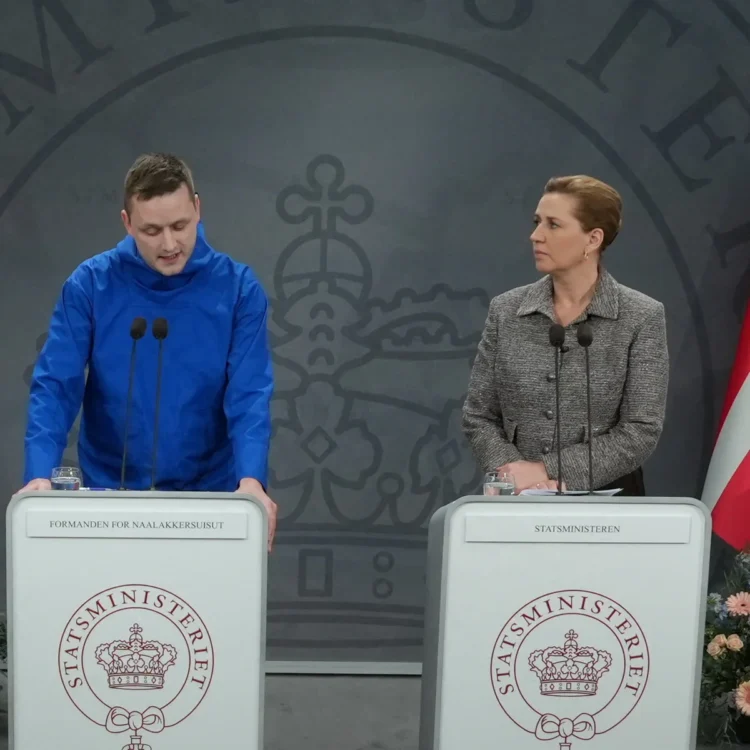
“We are now facing a geopolitical crisis,” Nielsen said alongside Denmark’s prime minister, Mette Frederiksen, at a press conference in Copenhagen. “If we have to choose between the United States and Denmark here and now, we choose Denmark,” he declared, a statement that underlined the unambiguous alignment of Greenland with Copenhagen and with NATO.
Frederiksen also criticised what she called “unacceptable pressure” from the U.S. leadership and emphasised the historic importance of alliance relations. Both leaders reaffirmed that Greenland is not for sale and that discussions about its future must respect democratic choice and international law.
The diplomatic strain has already rippled beyond rhetoric. Reports indicate that Danish tourism to the United States plummeted by nearly 50% in 2025, a sharp decline partly attributed to souring relations a stark illustration of how geopolitical disputes can spill over into economic and cultural exchanges.
Greenland’s government, while rejecting overtures of U.S. acquisition, has indicated that it remains open to cooperation on strategic issues, such as defence and mineral development, as long as such engagement respects Greenlandic autonomy and Denmark’s sovereignty.
The backdrop to these tensions is a rapidly transforming Arctic. With melting ice opening new shipping routes and increasing access to mineral resources, the U.S., Russia and China have intensified their focus on the region.
Trump administration officials argue U.S. involvement is necessary to counter Russian and Chinese influence but critics in Europe warn that heavy‑handed approaches risk undermining alliance unity.
Amid mounting friction, Danish and Greenlandic officials are preparing to sit down with senior U.S. policymakers in Washington a meeting that observers say could be pivotal in setting the tone for future Arctic cooperation.
Denmark’s Foreign Minister Lars Løkke Rasmussen and Greenland’s Foreign Minister Vivian Motzfeldt are scheduled to meet with Vice President Vance and Secretary Rubio at the White House on Wednesday.
Both Copenhagen and Nuuk have stressed that they want to maintain strong cooperation with Washington but on terms that respect self‑determination and alliance commitments.
Norwegian and other European officials have also weighed in, signalling that NATO’s collective security framework should inform all discussions about Greenland’s future.
Analysts note that an attempt to alter Greenland’s status outside established diplomatic channels could have far‑reaching consequences for the alliance, which has relied on trust and predictability among its members since World War II.
At home in Greenland, the prospect of U.S. acquisition has provoked anxiety and mobilised public opinion. Polling data from late 2025 showed a clear preference among Greenlanders to remain within the Kingdom of Denmark, with only a small minority supporting U.S. annexation.
Residents have expressed concerns about losing cultural autonomy and the potential for being caught between great power rivalries.
Local leaders have also sought to pause discussions about full independence from Denmark in favour of preserving stability and ensuring that any future shifts in governance are decided democratically. The immediate priority, they say, is to protect Greenland’s autonomy and avoid any scenario that could jeopardise social cohesion and economic development.
Beyond immediate political tensions, the Greenland issue highlights broader questions about how the U.S. and European allies manage competition in the Arctic.
With climate change accelerating environmental transformation, the region’s strategic value from rare earth minerals to new shipping lanes has brought renewed geopolitical contestation. How that competition is navigated will be watched closely not just in Copenhagen and Washington, but in capitals from Beijing to Brussels.
Greenland’s insistence on remaining tied to Denmark and NATO aligns with broader European concerns about shielding smaller states from coercion while maintaining collective security.
EU allies have voiced support for Denmark’s position and called for diplomacy that reinforces, rather than undermines, alliance unity even as they acknowledge the importance of Arctic cooperation.
U.S. officials, for their part, have framed their interest in Greenland not as territorial ambition but as a response to strategic imperatives. They point to increased Russian military activity in the Arctic and growing Chinese presence particularly in mineral exploration as reasons the U.S. cannot afford to be passive in the region.
However, many European policymakers argue that strategic cooperation can be bolstered without challenging the sovereignty of allies.
The talks in Washington represent a critical juncture: a chance to reinforce alliance cohesion, clarify mutual priorities and resolve a dispute that has raised eyebrows globally.
Denmark and Greenland have both made clear they seek stable, respectful engagement with the United States but they also insist that any future cooperation must respect democratic choice and international law.
The outcome of these talks and how Washington responds to Copenhagen’s determined stance could set a precedent for Arctic geopolitics for years to come, shaping how powerful nations engage with smaller states in a region undergoing swift and dramatic change.

AD: Heritage And Restaurant Lounge Bar