
By Theodore Brown-
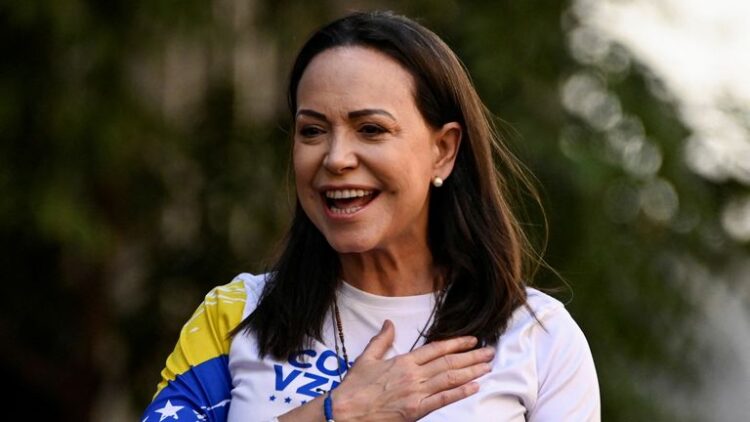
Amid a political earthquake shaking Venezuela, opposition leader María Corina Machado has declared that she should be in charge of the country, opening a new chapter in an already volatile transition.
Her comments arrive after a dramatic U.S. operation removed President Nicolás Maduro from power, leaving a leadership vacuum and intense debate over the future of Venezuela.

AD: Capeesh Restaurant
After years in exile and sustained resistance against Maduro’s government, the Nobel Peace Prize laureate has positioned herself at the centre of national and international discussions about how Venezuela should be governed in the coming months.
Her statements have injected urgency into a complex standoff where old regime loyalists, foreign governments, and civil society leaders all claim stakes in Venezuela’s destiny.

AD: Oysterian Sea Food Restaurant And Bar
Speaking in an interview with CBS News, Machado said she and her opposition coalition are “ready and willing to serve our people as we have been mandated.”
She pointed to what she asserts was a clear choice by Venezuelan voters in the contested 2024 election, where her coalition backed a proxy candidate after she was barred from running. Machado framed that result as evidence that the populace wanted change and that it was time for her movement to take the helm.
Machado expressed gratitude for international support, including that of U.S. President Donald Trump, praising his “leadership and courage” in the events that led to Maduro’s capture.
She described the removal of Maduro as a “major step toward restoring prosperity, rule of law and democracy” in her homeland. Despite her praise, Trump has publicly questioned whether she holds enough respect domestically to lead effectively, a position that has frustrated supporters of the opposition.
Her rejection of the interim administration led by Maduro’s former vice-president, Delcy Rodríguez, was resolute and pointed. Machado told CBS that Rodriguez was “one of the main architects of repression for innocent people” during the years of chavista dominance and insisted that she lacks the trust of the Venezuelan people.
Rodríguez, who assumed leadership after Maduro’s removal, has denied any foreign government is running Venezuela. Her remarks were issued in a televised address asserting Venezuelan sovereignty.
These competing claims surge against a backdrop of deep internal tensions and fractured public trust. Though the Trump administration has expressed a willingness to work with interim authorities in Caracas, it has stopped short of endorsing Machado as Venezuela’s leader.
That has left Machado’s supporters both emboldened and concerned about whether political and logistical hurdles could thwart her ambitions.
Her push for leadership comes as part of a broader narrative that Venezuela is at a crossroads. Machado has pledged that if given the chance, her leadership would focus on restoring democratic processes and reviving an economy battered by years of mismanagement, hyperinflation, and mass emigration.
Yet critics, including some within her own country and abroad, argue that rhetoric alone cannot resolve the deep institutional and social fractures now facing Venezuela.
In the midst of this, the international community remains on edge, watching events unfold in a nation long seen as a key battleground in Latin American politics.
Vision and Obstacles Ahead
Machado’s supporters see her as a beacon of democratic hope. She has vowed to return to Venezuela “as soon as possible,” rejecting the legitimacy of Rodriguez’s interim government and arguing that oppressive structures need to be dismantled before genuine national renewal can begin.
Critics within Venezuela, including political opponents and observers tracking public sentiment, point out that Machado’s popularity is uneven and that years of turmoil have made robust governance a tall order.
Despite that, Machado’s vision goes beyond political leadership. She has outlined ambitions to transform Venezuela into an energy hub of the Americas, targeting vast oil reserves as a foundation for economic recovery and regional influence.
She has also pledged to bring back millions of Venezuelan refugees who fled economic hardship and political repression in prior years, viewing their return as essential to national reconstruction.
Her critics, however, raise caution. Independent analysts point to mixed polling and reports of limited popular support for Machado inside the country, alongside the formidable presence of Maduro loyalists and entrenched interests within the military.
Some international voices argue that any transition must be inclusive and negotiated, rather than resting on the ambitions of a single figure.
The legitimacy of any leadership claim whether Machado’s or Rodríguez’s is tied to how it is received both among Venezuelans and within global diplomatic circles.
Another layer complicating her bid emerges from the fact that Machado has been outside Venezuela for months, having travelled to accept her Nobel Peace Prize and remained abroad amid concerns over security and political persecution.
While she asserts her physical return is imminent, the logistical and political hurdles are significant. How Rodríguez’s provisional authorities and international actors will respond to her reentry and claims to leadership remains uncertain.
The timing of her call reflects a broader regional moment. Latin America is watching as Venezuela grapples with a power transition made more volatile through external interventions and rushed political calculations.
Neighbouring countries fear instability could spill across borders, while economic partners worry about oil market disruptions tied to Venezuelan output. Machado’s emphasis on democratic rule and fair elections resonates with activists and diaspora communities, even as sceptics caution against myths of simple solutions.

AD: Heritage And Restaurant Lounge Bar