
By James Simons-
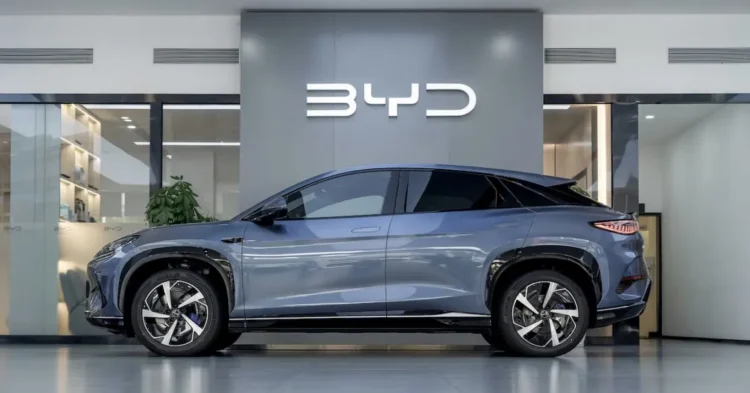
China’s electric vehicle industry is on the brink of a historic shift, with BYD poised to overtake Tesla as the world’s top EV seller on annual sales in 2025.
After years of fierce competition, rapid technological growth and bold expansion into overseas markets, the Shenzhen-based automaker’s rise reflects broader changes reshaping the global automotive industry and the redrawing of leadership in electric mobility.

AD: Capeesh Restaurant
Analysts, market data and industry observers point to sales growth that has brought BYD ahead of its long-time rival, a transformation with implications that reach into manufacturing, consumer choice and international trade.
Recent figures indicate that BYD’s electric vehicle sales jumped 28 percent in 2025, with the company selling an estimated 2.25 million units during the year, a performance that positions it ahead of Tesla’s projected 1.64 million sales.
The figures come from company disclosures and estimates that have circulated in business reporting and industry newsletters. If confirmed in full annual tallies, the achievement would mark the first time a Chinese EV manufacturer has claimed the top spot in global annual units sold.

AD: Oysterian Sea Food Restaurant And Bar
The data on quarterly performance throughout 2025 lends further weight to the projection. In the first nine months of the year, BYD had already delivered more than 1.61 million electric vehicles, significantly outpacing Tesla’s sales of roughly 1.22 million units over the same period.
That put BYD ahead by roughly 388 000 vehicles, suggesting the company’s trajectory toward the top of the sales league was well established long before year end.
The rise of BYD comes amid a broader growth in electric vehicle adoption in many regions, but its ascent also highlights the increasingly competitive dynamics of the global EV market. In recent years, Tesla had enjoyed a widely recognised lead as the most visible electric vehicle maker, known for its innovation focus, large battery factory investments and strong brand presence.
Yet a range of factors has helped level the playing field. BYD’s strategy combines a broader model range with competitive pricing and a strong domestic market in China the world’s largest EV market which has underpinned its rapid scaling.
In addition, BYD’s sales figures reflect not only strong domestic demand but also a growing footprint overseas. The company has aggressively expanded into markets in Europe, Southeast Asia and other regions, offering a lineup that includes compact cars, family sedans and utility vehicles with features tailored to diverse consumer needs.
Observers note that BYD’s range covers a wider spectrum of electric vehicles, sometimes blending fully electric models with plug-in hybrids, which has helped it attract customers who are seeking transition options from traditional petrol or diesel engines.
While BYD’s ascent has been remarkable, the story of the EV market’s evolution is rich with context. In 2024, BYD had already sold over 4.2 million electrified vehicles, including both battery electric and plug-in hybrid models, and experienced a year-on-year sales increase of more than 40 percent.
That performance spurred industry projections that an eventual sales lead over Tesla was imminent. Though Tesla maintained a narrow lead in pure EV sales in earlier years, BYD’s consistent growth in deliveries and production helped lay the foundation for overtaking its rival in 2025.
The global landscape of electric vehicle manufacturing is also shifting due to broader market conditions. Some legacy automakers have accelerated the transition from internal combustion engines to electric mobility, while emerging Chinese competitors such as Leapmotor and Xiaomi-backed ventures are also intensifying competition.
Yet none have achieved the same global breadth as BYD, which holds a strong position in its home market and is increasingly recognised as a major exporter of EVs overseas.
Reports indicate that Chinese automakers together are projected to represent a rising proportion of total EV sales in markets such as the UK, where Chinese brands may reach nearly 10 percent of new car sales in coming years.
Global Shift in EV Leadership
The broader implications of BYD’s rise extend beyond simple annual sales numbers. If it finishes 2025 at the top of the global sales rankings, the achievement could reshape perceptions about leadership in automotive innovation and industrial capability.
Tesla has long been associated with cutting-edge battery technology, autonomous driving research and an outsized cultural impact that helped mainstream the idea of electric vehicles in many markets.
Yet market success measured in units sold speaks to a different set of priorities: reach, affordability, production capacity and the ability to scale globally. BYD’s performance reflects strength across each of these dimensions, positioning it as a powerful competitor in the global industry.
Global analysts have further noted the rising influence of Chinese policy in shaping the EV sector. Government incentives, support for battery supply chains and coordination across national industries have collectively fostered an environment in which domestic manufacturers like BYD can thrive.
The scale of China’s internal market, coupled with targeted export-oriented strategies, gives Chinese automakers a competitive edge that influences global sales distribution. While Tesla has a significant presence in the United States, Europe and parts of Asia, BYD’s balance of quantity and diversity has helped it close the gap in volume sales.
Tesla’s own performance in 2025 has been a factor in the shifting rankings. The company’s sales volumes have not grown as rapidly as some investors expected, and forecasts released late in the year pointed to a decline in deliveries compared with previous annual performance.
Meanwhile, the firm’s emphasis on future technologies including artificial intelligence systems and autonomous driving features reflects a strategic focus that differs from the pure volume growth strategy pursued by BYD.
Despite the shifting leadership in sales, both companies remain foundational in shaping the direction of the electric vehicle era. Tesla’s influence on EV culture, investment trends and technological ambition cannot be understated, even as BYD gains traction in sales and global market footprint. Both companies contribute to the accelerating transition away from internal combustion engines and toward cleaner mobility, with each offering different visions of electric transportation’s future.
The potential dethroning of Tesla as world EV sales leader reflects not only competitive dynamics but also the evolution of consumer preferences, industrial capabilities and global supply chains in an increasingly electrified automotive world.

AD: Heritage And Restaurant Lounge Bar