
By Theodore Brown-
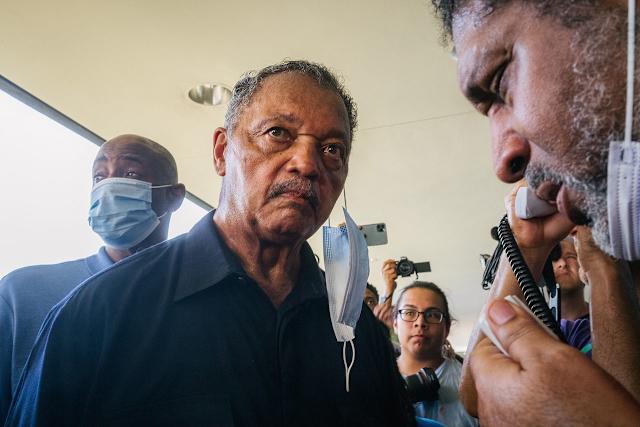
Reverend Jesse Jackson, the towering figure of the American civil rights movement whose activism spanned more than six decades, has died at the age of 84, his family announced on Tuesday.
Widely admired as a tireless champion for equality, voting rights, economic justice and political participation, Jackson passed away peacefully surrounded by loved ones on February 17, 2026, according to multiple reports.

AD: Capeesh Restaurant
Jackson’s death marks the end of an era for a generation of activists and political leaders whose work reshaped American society from the 1960s onward. From his early days as a young organiser with the Southern Christian Leadership Conference (SCLC) alongside Dr. Martin Luther King Jr. to his later work as a national political figure and humanitarian negotiator, Jackson’s impact was profound and wide‑ranging.
He is survived by his wife, Jacqueline Jackson, and their six children, and he leaves behind a legacy of activism that reverberates across the United States and beyond.
Born Jesse Louis Burns on October 8, 1941, in Greenville, South Carolina, Jackson grew up in the segregated South and experienced the brutal realities of racial discrimination firsthand. His early life unfolded against the backdrop of Jim Crow laws and systemic inequality, experiences that helped ignite his lifelong commitment to justice.

AD: Oysterian Sea Food Restaurant And Bar
Jackson first rose to prominence in the 1960s as a protégé of Dr. King, participating in some of the movement’s most defining campaigns, including voter registration efforts and protests designed to dismantle segregation. He was present in Memphis, Tennessee, at the time of King’s assassination in 1968, a watershed moment that tested him personally and politically.
After King’s death, Jackson continued to lead with energetic determination. In 1971 he founded Operation PUSH (People United to Save Humanity) in Chicago, an organisation dedicated to economic empowerment for African Americans through education, employment and grassroots organisation.
Over time, Operation PUSH evolved into the Rainbow PUSH Coalition, a major civil rights and social justice organisation that broadened its mission to embrace diverse communities and issues.
Jackson’s activism extended into electoral politics. In 1984 and again in 1988, he conducted historic campaigns for the Democratic presidential nomination, becoming one of the first African Americans to mount serious bids for the White House.
Though he did not secure the nomination, his campaigns broke significant barriers and helped energise new voting blocs, particularly among Black, Latino, and progressive constituencies.
His role as a national political figure contributed to expanding African American representation in politics and inspired future leaders, including Barack Obama. Jackson famously wept with emotion on election night in 2008 as Obama became the first African American president a moment that underscored how far the nation had come since the height of the civil rights era.
Global Advocate and Moral Voice
Beyond the United States, Jackson became an international symbol of moral courage and diplomatic negotiation. Throughout his career, he engaged with foreign leaders and worked to secure the release of hostages and prisoners abroad, often stepping in where traditional diplomacy faltered.
He negotiated the release of Americans held in Syria, and in other conflicts, he liaised with leaders in the Middle East and Africa to mediate humanitarian outcomes.
In 2000, Jackson was awarded the Presidential Medal of Freedom the nation’s highest civilian honour by President Bill Clinton, recognising his decades of service on behalf of marginalised communities and his contributions to civil rights, voting rights, and social justice. Over the years he also received numerous honorary degrees and accolades from academic institutions around the world.
Even as Jackson aged and faced significant health challenges including living with progressive supranuclear palsy (PSP), a rare neurodegenerative disorder, after an earlier diagnosis of Parkinson’s disease he remained a symbol of resilience and moral leadership.
His family and close associates continued to share updates about his condition over the past years, underscoring his enduring commitment to activism even in the face of personal adversity.
Colleagues and fellow activists remembered him as a “servant leader,” a term frequently used in references to his work with disenfranchised people around the world. “Our father was a servant leader not only to our family but to the oppressed, the voiceless, and the overlooked around the world,” his family said in a statement following his passing.
While tributes pour in from across the United States and around the globe, many leaders and citizens alike are reflecting on Jackson’s profound contributions to civil rights, political empowerment and social justice. His work helped shape modern discussions about economic inequality, voter access and equal opportunity.
Analysts note that Jackson’s legacy will continue to influence movements for justice and equity in the years ahead particularly as debates around voting rights, racial equity and political representation remain central to national political discourse. His long career demonstrated that activism, when rooted in principles of inclusion and nonviolence, can shift societal norms and inspire collective action.
Across communities large and small, Jackson was often seen as a bridge‑builder someone able to rally disparate groups around shared values of dignity, fairness and opportunity. From civil rights marches to presidential campaign trails, his voice remained consistent: an unwavering call for justice for all.
Jesse Jackson will be remembered not just for the offices he held or the campaigns he ran, but for the lives he touched those who found in his words and actions a sense of hope, purpose, and possibility.
Across decades of activism, Jackson’s presence offered a beacon for those navigating systemic inequities, from young African Americans striving to vote in the segregated South to disenfranchised communities seeking economic opportunity and social recognition.
His speeches, often imbued with moral urgency and heartfelt conviction, inspired countless individuals to believe that change was both achievable and necessary.
Jackson’s influence extended far beyond speeches and marches. He was a master of coalition-building, connecting communities, activists, and political leaders to advance justice in tangible ways.
Through organisations such as Operation PUSH and the Rainbow PUSH Coalition, he created platforms where economic empowerment, education, and civic engagement could flourish, particularly for those historically denied a seat at the table. In doing so, he transformed abstract ideals of equality into actionable initiatives, leaving a lasting imprint on local, national, and global efforts toward social justice.
Even internationally, Jackson’s work resonated. His interventions on behalf of prisoners, hostages, and oppressed populations demonstrated a commitment to human rights that transcended borders, reinforcing the idea that moral courage and diplomacy can coexist in pursuit of justice.
Those who worked with him recall not only his strategic acumen but also his personal warmth and unwavering dedication to uplifting marginalised voices.
The nation reflects on his passing, Jackson’s legacy endures not only in policy reforms and political breakthroughs but in the hearts and minds of generations who carry forward his vision.

AD: Heritage And Restaurant Lounge Bar