
By David Young-
US President Donald Trump has arrived in Ireland for a two-day visit that has brought unprecedented security measures, political tensions and planned demonstrations to Dublin, County Clare and the surrounding areas.
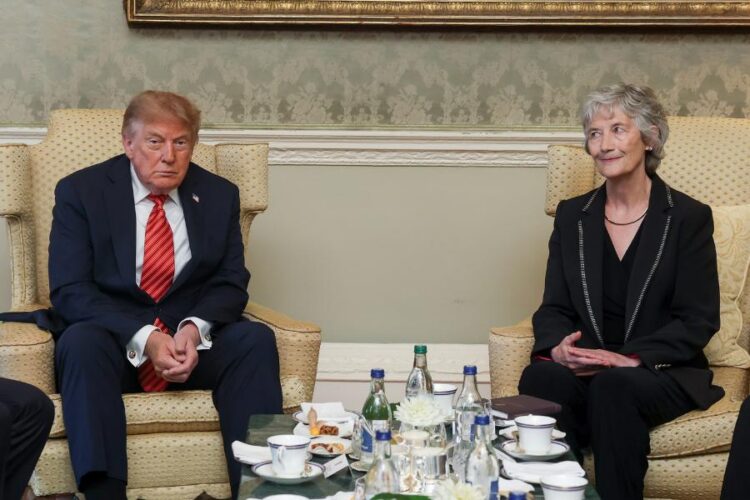
Speaking a she sat alongside Taoiseach Micheál Martin on his trip to Dublin today (September 12), Trump said: “Well, I don’t want to cause any problems, but I will tell you I’d love to see it unified.

AD: Capeesh Restaurant
‘I have friends on both sides, great people. They’re Irish people. How can they be bad, right?
“I’d love to see it unified. I think it would be a great feather in everybody’s cap if that happened. It’s going to happen eventually.
“You know what? The way I look at it, it’s going to happen eventually. It may as well happen now.

AD: Oysterian Sea Food Restaurant And Bar
He added: “Now the UK will have something to say about it, obviously. But I think it would be a great thing. I mean, how can it be bad?”
Trump was greeted at Dublin Airport by Ireland’s deputy premier Simon Harris before beginning a packed programme of engagements that will take him from the capital to his golf resort at Doonbeg in County Clare, where the Irish Open is being staged.
The visit places Trump at the centre of both diplomatic and domestic attention at a politically sensitive moment, with Ireland seeking to maintain its traditionally close relationship with the United States while public opinion towards the American president remains deeply divided.
Irish President Catherine Connolly, who has previously been a longstanding critic of Trump, formally welcomed the US president at Áras an Uachtaráin, her official residence in Dublin’s Phoenix Park. The reception included a guard of honour, with Trump invited to inspect the ceremonial formation before the two leaders entered the residence for private discussions.
Trump subsequently travelled to Farmleigh House, where he met Taoiseach Micheál Martin for talks expected to cover a broad range of political, economic and international issues.
Ahead of the visit, Martin said he was looking forward to welcoming the American president and discussing issues of mutual interest while reaffirming the longstanding economic, cultural and personal connections between Ireland and the United States.
He also highlighted the timing of Trump’s visit, pointing to what he described as a remarkable sporting summer for Ireland. The Irish Open at Trump International Doonbeg, he said, would provide a fitting conclusion to the country’s sporting season, while expressing hope that an Irish player would lift the trophy.
The president’s visit to Doonbeg is likely to be one of the most closely watched elements of the trip. Trump’s County Clare golf resort has become an important part of the local economy, but his political presence has also made the property a focus for both supporters and opponents.
Trump is expected to attend a series of events at Deerfield, the residence of the US ambassador to Ireland, before travelling to his resort.
His arrival has been accompanied by an extraordinary security operation involving Ireland’s Gardaí, the Irish Defence Forces and other agencies. Security sweeps have been carried out around Trump International Golf Links Ireland, while extensive arrangements have been put in place around Dublin Airport, Shannon Airport, Dublin city and County Clare.
Garda Commissioner Justin Kelly said authorities would facilitate peaceful demonstrations wherever possible but issued a firm warning against disorder or attempts to interfere with the president’s movements.
He said there would be “no tolerance” for public disorder or efforts to disrupt what he described as the president’s “critical movements”.
“We have robust policing plans in place and will arrest and prosecute those committing offences,” Kelly said.
The scale of the operation reflects the sensitivity surrounding the visit. Several demonstrations have been planned in Dublin, Doonbeg and Shannon, with protesters expected to use the president’s presence to raise concerns about his political record and policies.
The protests come after a poll published earlier in the week suggested that 70% of Irish people did not want Trump to visit the country.
Trump himself appeared unconcerned when questioned about the demonstrations during his meeting with Martin.
“I haven’t seen any protests,” he told reporters.
The apparent disconnect between the president’s comments and the strength of opposition recorded in the poll has added another layer to the political atmosphere surrounding the visit.
Trump’s son Eric Trump has also rejected the suggestion that his father’s presence is widely unpopular in Ireland. Speaking to Sky News, he said he found the polling difficult to believe and pointed instead to what he described as the “amazing” relationship between Ireland and the United States.
Eric Trump argued that the large Irish-American population in the United States strongly supports his father and praised the family’s investment in Doonbeg.
“If you look at the Irish population in the United States, they love Donald Trump,” he said. “They absolutely adore Donald Trump and the job that he’s done.”
He also pointed to the hundreds of millions of dollars the Trump organisation has invested in the Doonbeg property, arguing that the investment had helped protect an important local economic asset.
According to Eric Trump, residents of Doonbeg recognise the importance of the resort to the area and appreciate what the Trump family has invested in the community.But attitudes among local residents are more complicated than a simple division between supporters and opponents.
Some people living in County Clare say they have little time for Trump politically but nevertheless recognise the economic importance of his resort.
Vicky Nolan, who lives near Kilkee, said she strongly opposed Trump’s presence but understood why people in Doonbeg depended upon the resort for their livelihoods.
“I hate the fact that he’s here, but I do understand that the people from Doonbeg rely on him for their livelihoods,” she said.
Another County Clare resident, Michael Moore, said he had “no time” for Trump politically but acknowledged that people in Doonbeg held him in high regard because of his investment in the village. Moore said Trump was “entitled to come and visit” his own property and argued that the Irish government had little choice but to maintain a constructive relationship with Washington.
He said the government had to “play ball” with Trump even if the American president did not always reciprocate, arguing that Ireland should avoid allowing political disagreements to damage broader relations. That balancing act is central to the visit.
Ireland has deep economic and cultural links with the United States, while American companies play an important role in the Irish economy. At the same time, Trump’s policies and political style have generated considerable opposition in Ireland, as they have elsewhere in Europe.
The Irish government must therefore navigate the diplomatic importance of hosting the US president while acknowledging that his presence is likely to provoke demonstrations and criticism.
The symbolism of Trump’s meeting with President Connolly is particularly notable given her previous criticism of the American leader. Their formal encounter at Áras an Uachtaráin demonstrates the distinction between political disagreement and the responsibilities of state diplomacy.
The visit is also taking place against a backdrop of growing international uncertainty, making the discussions between Trump and Ireland’s political leadership potentially significant beyond the ceremonial aspects of the trip.
For Dublin, maintaining a close relationship with Washington remains strategically and economically important. For Trump, the visit provides an opportunity to underline his personal and business connection to Ireland while appearing alongside the country’s political leadership and at a major international sporting event.
For County Clare, meanwhile, the president’s arrival represents something more immediate: a mixture of economic opportunity, disruption, political controversy and international attention.
Road closures and traffic restrictions are expected around Dublin Airport and throughout parts of the capital, as well as in County Clare and around Shannon Airport. Residents and businesses face disruption as security agencies attempt to protect the president while allowing ordinary life to continue.
The contrast is striking. A president whose visit is being protected by one of the largest security operations Ireland has undertaken is also arriving at a place where some residents see his presence as an economic benefit, others regard it as deeply unwelcome, and the national government must carefully balance both realities.
As Trump continues his two-day visit, the images from Ireland are likely to carry very different meanings depending on who is watching.
For the Irish government, they represent the importance of a relationship with one of its most significant international partners. For Trump’s supporters, they demonstrate the continuing strength of his connection with Ireland and the Irish-American community. For protesters, the visit provides a platform to challenge a president they strongly oppose.
And for the people of Doonbeg, the debate is perhaps more complicated still: whatever they think of Donald Trump the politician, his investment has become intertwined with the economic life of their community.
The challenge for Ireland now is to ensure that a visit carrying such political and diplomatic weight passes peacefully, while demonstrating that the country’s long-standing relationship with the United States can withstand profound disagreements over the man currently occupying the White House.

AD: Heritage And Restaurant Lounge Bar