
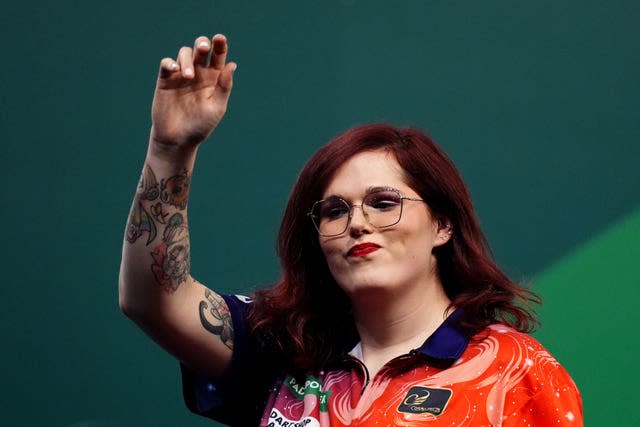
By Isabelle Wilson-
A leading transgender darts player says she has been pushed out of the women’s game overnight, after a governing body rule change barred her from competing in the category where she built her career.
Noa-Lynn van Leuven, a 29-year-old from the Netherlands, described the moment she learned of the decision as abrupt and deeply personal. In a video posted to social media, she said she felt she had been “retired not by choice,” after years spent climbing the professional ranks.

AD: Capeesh Restaurant
Her reaction has placed darts at the centre of a widening debate across sport, where questions of inclusion, fairness and eligibility are being revisited by governing bodies under growing legal and political pressure.
The change came into force this week, when the Darts Regulation Authority introduced updated eligibility rules stating that only biological females can compete in women’s tournaments. The decision applies across events sanctioned under its framework, including those linked to the Professional Darts Corporation.
With Van Leuven, the implications were immediate. She had been competing in the Women’s Series, where she secured multiple titles and established herself as one of the most recognisable figures in the women’s game.

AD: Oysterian Sea Food Restaurant And Bar
Her rise had been marked by historic milestones. In 2024, she became the first openly transgender player to compete at the PDC World Darts Championship, a breakthrough moment that drew both praise and scrutiny.
Now, that trajectory has been interrupted. “Apparently, I just got retired,” she said, describing how she received confirmation via email that she would no longer be eligible to play in women’s events. The governing body has defended its decision as the result of a formal review process that began in 2025, incorporating scientific analysis and legal advice. Officials concluded that restricting women’s competitions to biological females was necessary to ensure what they describe as fair competition.
The policy reflects a broader shift seen across multiple sports, particularly following legal developments in the UK and evolving positions from international organisations. In its statement, the authority indicated that darts should be treated as a “gender-affected” sport, citing potential physical advantages linked to male biology, including reach and stability.
Despite the restriction, Van Leuven remains eligible to compete in open tournaments, where players of any sex or gender identity can participate. But for an athlete whose success has been rooted in the women’s circuit, that distinction carries weight. “This isn’t just about me,” she said. “It’s about being told you don’t belong anymore.”
The response to the ruling has been immediate and divided. Supporters of the policy argue that women’s sport requires protected categories to remain competitive and equitable.
Some players and advocacy groups have previously raised concerns about fairness, with a small number choosing to withdraw from events where transgender competitors were present.
Others, however, see the move as exclusionary, warning that it risks marginalising athletes who have already navigated significant barriers to compete at elite level.
Van Leuven’s case has become a focal point because of her visibility and achievements. With six Women’s Series titles and appearances on some of the sport’s biggest stages, she is not a fringe figure but a central one.
Her reaction has echoed beyond darts, resonating with ongoing discussions in athletics, swimming and cycling, where governing bodies have introduced or tightened similar rules in recent years.
In her statement, she framed the decision not only as a personal setback but as part of a broader trend affecting transgender athletes globally. She pointed to a growing sense of uncertainty about where, or whether, they will be able to compete at elite level in the future.
Officials insist the door is not entirely closed. The governing body has said it will continue to review its policy as new evidence emerges and has emphasised that inclusive participation remains possible in open categories. That position, however, does little to resolve the immediate reality for players like Van Leuven.
Within the darts community, reaction has been mixed. Some professionals have previously voiced support for her right to compete, while others have called for clearer boundaries in women’s sport. The issue has at times divided fans as much as players, with debates playing out both in arenas and online.
With the practical outcome being clear. One of the sport’s most prominent figures in the women’s game is no longer eligible to take part in it. Van Leuven has made it equally clear she does not intend to step away quietly. “This isn’t the end,” she said. “I’m not done fighting.”
Her next steps remain uncertain, whether through competition in open events, potential legal challenges, or continued advocacy. But her situation has already ensured that darts, a sport more often associated with pub culture and televised tournaments, is now firmly part of a global conversation about identity, fairness and the future of sport.
While governing bodies continue to redraw the lines, cases like this suggest the debate is far from settled, and that for athletes caught in the middle, the consequences are immediate and deeply personal.
Decisions made in boardrooms and committee meetings are often framed in terms of policy, eligibility, and fairness, but for those directly affected, they land in a far more human space where careers, identities, and long-built routines are suddenly disrupted.
With professional athletes, especially in niche sports like darts, opportunities are limited and highly competitive. A single ruling can alter the entire structure of a livelihood that depends on consistent entry into tournaments, ranking points, and sponsorship visibility.
When eligibility changes overnight, it does not simply close off future competitions; it can erase momentum built over years of training, travel, and financial investment.
There is also the psychological weight that accompanies such shifts. Athletes often describe sport not just as a profession but as a defining part of identity. Being told they can no longer compete in a category where they have found belonging can create a sense of dislocation that is difficult to quantify in policy language.
Even when alternative categories exist, they do not always carry the same recognition, stability, or sense of place within the sport’s structure. Governing bodies say that they are responding to evolving scientific research, legal rulings, and pressure from stakeholders who demand clearer boundaries in competition. That tension between inclusion and perceived fairness has become one of the most difficult balancing acts in modern sport.

AD: Heritage And Restaurant Lounge Bar