
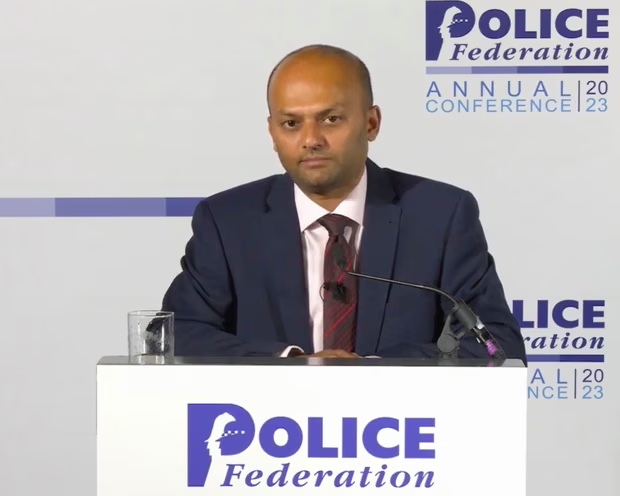
By Gabriel Princewill-
The chief executive of the Police Federation of England and Wales (PFEW), Mukund Krishna, (pictured)was arrested early on Wednesday, March 4, 2026, on suspicion of fraud by abuse of position and corruption, in a stunning development that has sent shockwaves through British policing and union circles. Two other senior members of the federation’s national board — a 51-year-old from Wales and a 55-year-old from Bristol — were also taken into custody in a coordinated operation conducted by the City of London Police Domestic Corruption Unit.
The City Of London Police said that over the last year the City of London Police (CoLP)’s Domestic Corruption Unit (DCU) have undertaken a significant investigation into allegations of fraud by abuse of position contrary to Section 4 of the Fraud Act (2006) in relation to the national Police Federation of England and Wales (PFEW).

AD: Capeesh Restaurant
They said that on Wednesday morning, 4 March 2026, DCU officers executed Schedule 1 Pace 1984 search warrants in Wales, Somerset, London and Surrey to arrest suspects and gather evidence.
To support a targeted, open and transparent witness appeal, a Major Incident Public Portal (MIPP) has been opened under Operation Kuat.
The arrests mark a dramatic escalation in an ongoing investigation targeting financial misconduct within the organisation that represents tens of thousands of police officers across England and Wales. PFEW, which serves as the statutory representative body for rank-and-file officers below superintendent rank, has been thrust into the centre of one of the most high-profile corruption inquiries in recent UK law enforcement history.

AD: Oysterian Sea Food Restaurant And Bar
Early on Wednesday morning, officers executed Schedule 1 search warrants at multiple locations, including PFEW’s national headquarters in Surrey and residential addresses in Wales, Somerset, London and Leatherhead. According to official police statements, the raid and arrests were the culmination of a year-long investigation into alleged financial wrongdoing and possible abuse of public trust.
Detectives from the Domestic Corruption Unit, which specialises in tackling serious financial crimes and public sector corruption, described the probe as “significant, complex and active,” urging anyone with relevant information to come forward via an open Major Incident Public Portal established for the case. They confirmed that the arrests were made on suspicion of fraud by abuse of position under the Fraud Act 2006.
At the centre of the investigation is Mukund Krishna, a 46-year-old former management consultant who was appointed as the first chief executive of the Police Federation of England and Wales in 2024. His appointment was widely noted at the time because the role — newly created — signalled a shift toward a more corporate leadership structure within PFEW. Despite representing more than 145,000 officers across England and Wales, the federation is legally constrained from functioning as a union with full collective bargaining powers and is instead governed by statute and its own internal rules.
Since taking up the top executive role, Krishna’s leadership and remuneration package have drawn scrutiny both within policing circles and in wider public debate. Reports indicate he earned in excess of £700,000 in salary and bonuses in 2025 — the highest pay package of any trade body or representative association chief in Britain, ranking higher than the pay of senior civil servants and many public officials.
That level of remuneration sparked political debate last year, including calls from some Members of Parliament for clearer financial transparency from PFEW and formal publication of accounts that had not been made public. However, Krishna and the federation consistently resisted detailed disclosure, citing governance and regulatory complexities.
Now, with the City of London Police’s Domestic Corruption Unit focusing on alleged fraud, corruption and abuse of position, the leadership question has become central to understanding how an organisation built to support frontline officers has itself become subject to one of the most serious criminal investigations in recent policing history.
Officials confirmed that the three men arrested — Krishna and two national board members — were detained on suspicion of fraud by abuse of position, a criminal offence that carries significant penalties if proven. The City of London Police emphasised that the investigation remains active, with detectives pursuing multiple lines of inquiry and evaluating financial records, correspondence, and internal documents seized during the raids.
In an official statement, Detective Superintendent James Halkett, head of the Domestic Corruption Unit, described the arrests as part of an ongoing effort to uncover and disrupt serious misconduct where alleged evidence suggests public trust may have been undermined. He underscored the operation’s breadth, spanning several jurisdictions, and invited witnesses to assist the investigation.
Despite the gravity of the situation, PFEW has issued limited comment, stating that it is fully cooperating with authorities but declining to elaborate due to the “live nature” of the enquiry. The federation reaffirmed its commitment to supporting its members and emphasised that day-to-day operations would continue.
The news has triggered reactions at every level of law enforcement and government. Senior police leaders, including chiefs from regional forces, have stressed the importance of due process, with many affirming confidence in the investigative work of the City of London Police. Politicians from across the political spectrum have called for transparency and accountability, stressing that policing institutions must maintain the highest standards of integrity.
Shadow home affairs spokespeople have voiced particular concern, pointing out that an organisation meant to advocate for the welfare of police officers must itself be beyond reproach. Calls for statutory reform and independent oversight have already emerged, with some lawmakers highlighting the need for greater transparency in how representative bodies handle funds and executive appointments.
Analysts and commentators note that this scandal has broader implications beyond the immediate criminal allegations. “This is not just about one individual or two others,” said an expert in governance and public sector accountability. “It’s about an entire system of representation that is underwritten by statute and funded to support officers who rely on that representation.” Such analysts argue that the unfolding scandal could prompt structural reforms in policing governance if evidence of misconduct within PFEW’s leadership is proven.
The Police Federation’s role in British policing is unique. As the statutory body representing rank-and-file officers, it functions differently from traditional trade unions, which have full collective bargaining powers. Police officers in England and Wales are legally prohibited from striking, and the federation’s remit includes advocacy, welfare support, negotiating working conditions, and liaising with government ministers on policing policy. However, over the years, the organisation has occasionally faced criticism for a lack of transparency, particularly regarding finances and executive accountability.
While this week’s arrests are unparalleled in magnitude, this is not the first time that the federation has been the subject of legal scrutiny. Similar investigations in the past, both in the UK and internationally, have highlighted the vulnerability of representative bodies when oversight mechanisms are weak or inconsistent. The current investigation seeks to determine whether alleged misconduct by leadership figures — including Krishna and his co-accused — constitutes criminal offences that could lead to prosecution.
Political and Institutional Fallout: What Happens Next
In the coming days and weeks, the legal and political fallout will likely intensify. Prosecutors and detectives will determine whether there is sufficient evidence to charge Krishna and the other two men with specific offences under the Fraud Act 2006 or related statutory provisions. Should charges be brought, the case could proceed through pre-trial hearings and, ultimately, to Crown Court proceedings.
Political leaders have already signalled that they will monitor the investigation closely, with some advocating for expanded parliamentary oversight of police representative bodies. Others foresee calls for an independent audit of federation finances stretching back multiple years, particularly if further allegations emerge.
Frontline officers — the very members the federation was created to support — are now facing uncertainty about leadership direction and representative credibility. Some rank-and-file officers, speaking on condition of anonymity, expressed dismay that their organisation’s leadership could be embroiled in such serious allegations, while underscoring support for due legal process and constructive reform.
The arrests also come at a sensitive moment for policing policy in the UK, with political debates ongoing about funding, officer recruitment, accountability frameworks, and the role of representative bodies in negotiating working conditions. Any erosion of trust in institutions meant to uphold the rule of law and officer welfare could have ripple effects across these policy arenas.
This publication contacted the Police Federation, asking for full details of the circumstances of the corruption allegation. We pointed out that such information is often made public in relation to arrests of celebrities and police officers accused of particular offences. Disclosing details about the nature of the alleged corruption and fraud would unarguably not compromise the integrity of a live investigation.
However, a PFEW spokesperson told The Eye Of Media.Com: ”We are aware that three individuals connected to the Police Federation have been arrested as part of an ongoing police investigation.
This is a live matter and it would be inappropriate to comment further at this stage.
The organisation is cooperating fully with the relevant authorities.
Our focus remains on continuing the work of the Federation and representing our members across England and Wales”.
Equally, The Coty Of London Police told this publication that the official statement regarding this matter had gone through rounds of vetting, and the information given out is all they are willing to give at this point of the investigation where the suspects have not been charged.
Their spokesperson further explained on phone that this is a matter being handled by the City Of London Police, and as such they would only be disclosing what the particular force has put out
Detective Superintendent James Halkett, of the City of London Police Domestic Corruption Unit, said:
“The City of London Police Domestic Corruption Unit are leading a criminal investigation into allegations of fraud made against three individuals connected to the national Police Federation of England and Wales (PFEW).
“A 46-year-old man from Surrey, a 51-year-old man from Wales and a 55-year-old man from Bristol were all arrested on suspicion of fraud by abuse of position.”
from Bristol were all arrested on suspicion of fraud by abuse of position.”
D/Supt Halkett added “This is a complex and active investigation in which we are pursuing all lines of enquiry, and I would ask that anyone with further information related to our enquiries contact us via our major incident Public Portal”.

AD: Heritage And Restaurant Lounge Bar