
By James Simons-
A 72-year-old sexual abuse survivor, turned Christian, evangelist has been acquitted after being prosecuted for distributing a controversial Gospel tract in London’s Soho, in a case that has raised fundamental questions about the limits of freedom of expression and whether parts of the capital can effectively become “safe spaces” from religious speech that some people find deeply offensive.
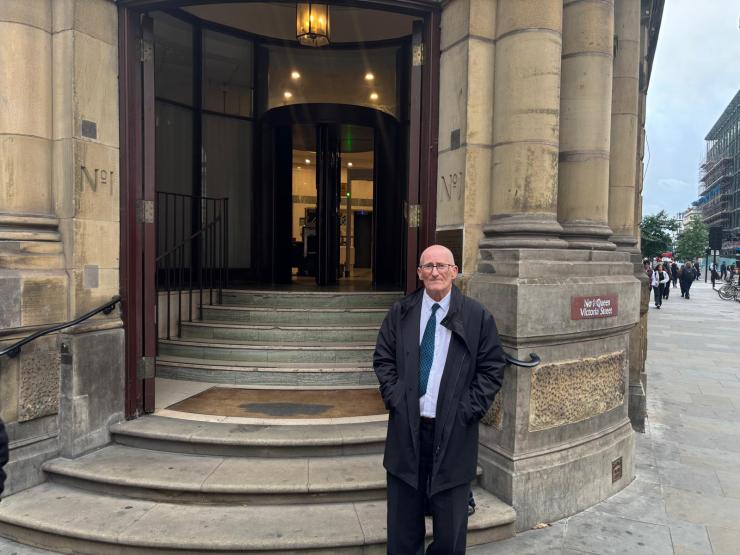
Richard JohnsonIpictured) was found not guilty at City of London Magistrates’ Court following a full-day trial on 4 September 2026. He had faced prosecution under section 4A of the Public Order Act 1986 after distributing copies of an illustrated evangelical tract, Doom Town, in Soho in April 2025.

AD: Capeesh Restaurant
The tract retells the biblical account of Sodom and Gomorrah and presents an evangelical Christian message about sin, judgement, repentance and salvation. Two people complained about the material, objecting particularly to its treatment of homosexuality and LGBT issues. One complainant described Soho as an LGBT “safe space” and argued that the presence of the tract in the area was particularly objectionable because of its message towards the LGBT community.
The prosecution’s reliance on the character of Soho as a particular geographical environment became one of the most striking features of the case. Johnson’s legal team argued that accepting such an approach could create what amounted to a “gay buffer zone”, in which expression that might be lawful elsewhere could effectively be subjected to a different standard because it was delivered in an area strongly associated with one particular community.
The defence argued that there is no separate legal regime for Soho. Freedom of religion and freedom of expression apply in Old Compton Street just as they apply in the rest of London, and the criminal law cannot create geographical zones in which controversial beliefs are given less protection merely because they are unwelcome.

AD: Oysterian Sea Food Restaurant And Bar
The magistrates ultimately acquitted Johnson, finding that although the tract was offensive and had caused genuine upset, the prosecution had failed to establish all the elements necessary to prove a section 4A offence. The court found no threatening conduct and concluded that the high threshold required before controversial expression can be criminalised had not been crossed. The defence was also awarded its costs.
The decision is significant because it underlines a distinction that is increasingly important in disputes over public speech. Something can be offensive, provocative or deeply upsetting without necessarily becoming a criminal offence.
Johnson’s prosecution arose from events on 14 April 2025. He had spent around two hours at the British Library researching Bibles before travelling through London’s West End carrying a large quantity of Christian literature. He said that he had already distributed numerous tracts in Soho, most of which had nothing to do with homosexuality and included material addressing subjects such as alcoholism.
As he passed the Comptons pub in Old Compton Street, Johnson handed several tracts to men outside and told them that he had previously lived what he described as a homosexual lifestyle before becoming a Christian. He then continued towards Chinatown.
According to his evidence, two younger men followed him into Rupert Street, shouting at him and telling him to “get out of Soho”. Johnson said the confrontation attracted the attention of bystanders and that he feared he might be assaulted. He subsequently left the area and later received several voicemail messages.
One complainant told the court that he found the tract inflammatory and offensive and was particularly angry about its references to homosexuality, AIDS and the biblical destruction of Sodom and Gomorrah. The defence, however, challenged the prosecution over the distinction between being offended or angry and the statutory requirement to establish harassment, alarm or distress of the kind contemplated by section 4A.
The court also heard that Johnson had not personally handed the tract to that complainant. Instead, the complainant received it from another person after Johnson had left the immediate vicinity of Comptons. He later telephoned the number printed on the tract, left a message describing the leaflet as disgusting and said he would report Johnson to police.
A second charge effectively collapsed before the trial could proceed. The second complainant had discovered a copy of the tract on a window sill at the French House but had never seen or spoken to Johnson. He did not attend court.
The Crown Prosecution Service sought to introduce his statement as hearsay under section 114 of the Criminal Justice Act 2003, but Johnson’s barrister, Michael Phillips, successfully opposed the application. The court refused to admit the evidence and the prosecution offered no evidence on that charge.
The defence also successfully resisted an attempt to exclude expert evidence from Dr Martin Parsons, who explained the biblical and evangelical context of Doom Town. His evidence addressed the tract’s relationship to Genesis 19, the use of dramatic language in evangelistic literature and the distinction between describing biblical judgement and advocating violence against LGBT people.
Johnson told the court that he had distributed Christian literature throughout England and Europe since 2007, estimating that he had handed out more than 100,000 Gospel tracts. He said he had enjoyed many positive conversations and believed that around ten people had become Christians through his evangelism. Until the Soho incident, he said, he had never been arrested or warned by police for distributing Christian literature.
His own history added another dimension to the case. Johnson described being sexually abused as a child at boarding school and subsequently engaging in same-sex sexual activity for many years. He later married and has a stepson and step-grandchildren. In his mid-50s, he said, he became a born-again Christian, abandoned his former lifestyle and began evangelising because he wanted others to experience what he regarded as the transformation and peace he had found through Christianity.
The case comes amid continuing controversy in Britain over the boundary between offensive expression and criminal conduct. The magistrates’ reference to the recent High Court decision in DPP v Coskun [2026] EWHC 427 (Admin) is particularly significant. That case concerned the burning of a Qur’an outside the Turkish Consulate and raised questions about when highly provocative religious expression crosses the threshold into criminal public-order behaviour.
The comparison is instructive because British courts are increasingly being required to confront a difficult question: how far should the law protect expression that many people regard as hateful, insulting or profoundly offensive, provided that it does not amount to threatening or otherwise criminal conduct?
The answer cannot simply depend upon which community happens to be the intended audience, the location in which the speech occurs or how strongly people react to it. If public-order law is applied differently according to whether a speaker enters an area associated with a particular religious, ethnic or sexual community, critics warn that Britain could gradually develop informal censorship zones around particular identities.
That does not mean that religious evangelists, political campaigners or other speakers have an unrestricted right to harass people. Nor does it mean that LGBT people are obliged to welcome messages condemning homosexuality. The significance of Johnson’s acquittal lies elsewhere: the court was asked to distinguish between speech that causes genuine offence and speech that satisfies the statutory ingredients of a criminal offence.
Following his acquittal, Johnson said: “After nearly 2 years of having this hanging over me, I am glad to be free. I do this because I really love LGBT people and I want them to go to heaven and not hell. Love is telling people the truth, even if people are offended by the message.”
Andrea Williams, chief executive of the Christian Legal Centre, which supported Johnson, said the prosecution should never have been brought and argued that no part of London should become a censorship zone where Christian beliefs are subjected to a different standard.
Williams told The Eye Of Media.Com: ”the case leaves an uncomfortable question for prosecutors and police. In an increasingly diverse society, virtually every controversial religious or political message will inevitably offend somebody somewhere. The challenge for the criminal law is to identify the point at which offence becomes unlawful conduct, without allowing public spaces to become places where unpopular opinions can be prohibited simply because they provoke anger.
‘Johnson’s acquittal may not settle that wider contention, but it sends a clear judicial signal: Soho may be a place where LGBT people feel at home, but it is not a place where the ordinary rules governing freedom of expression cease to apply.
‘In a democracy committed to freedom of religion and expression, the right to speak publicly cannot depend upon whether the message is popular, comfortable or welcomed by the people who happen to hear it’.
The harder question—and one the courts will continue to face—is how to preserve that freedom while protecting people from genuine intimidation and criminal harassment.

AD: Heritage And Restaurant Lounge Bar