
By Ben Kerrigan-
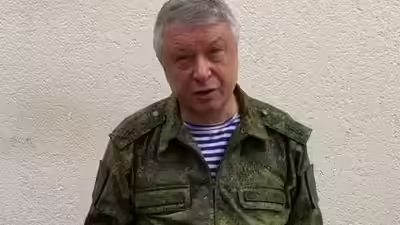
In a dramatic and rare incident in the heart of Russia’s capital, Lieutenant General Vladimir Alekseyev, one of the country’s most senior military intelligence officials, was shot multiple times on Friday morning and rushed to hospital in critical condition. The brazen attack widely described as an assassination attempt has sent shockwaves through the Kremlin and reignited global attention on targeted violence against Russian military leaders amid the ongoing war in Ukraine. With the suspected gunman still at large, investigators in Moscow have launched a nationwide manhunt and opened a criminal case for attempted murder.
Alekseyev, 64, serves as first deputy head of the Main Directorate of the General Staff (GRU) Russia’s military intelligence arm and has been a prominent figure in Moscow’s security establishment for more than a decade.

AD: Capeesh Restaurant
He has been involved in key operations ranging from oversight of private military companies to negotiations with mercenary leaders. His role has made him a high-profile figure within the Russian defense apparatus, drawing scrutiny both domestically and internationally.
The shooting occurred early on Friday outside Alekseyev’s apartment building in northwest Moscow, according to statements from the Investigative Committee of Russia. The unidentified assailant reportedly opened fire on the general as he exited his residence on Volokolamskoye Highway, striking him multiple times before fleeing the scene.
Law enforcement agencies quickly cordoned off the area and began examining CCTV footage and eyewitness accounts to track down the perpetrator. A criminal investigation into attempted intentional homicide and illegal firearm use has been launched.

AD: Oysterian Sea Food Restaurant And Bar
Russian state media have confirmed that Alekseyev was hospitalized in serious condition, though official updates on his health status remain limited. Authorities have not yet named any suspects or offered a clear motive for the attack. The investigation is ongoing, and federal-level security services are assisting in the search for the gunman.
The abrupt nature of the shooting in a residential area of the capital underscores the boldness of the attack and raises questions about security for senior officials in Moscow.
The Kremlin has not publicly speculated on who may be responsible, but there is intense speculation both inside Russia and internationally. In past incidents involving targeted violence against Russian generals and officials, Moscow has blamed Ukrainian intelligence agencies; Kyiv, for their part, rarely confirms involvement in such operations.
Analysts caution that without conclusive evidence, attribution remains uncertain, and internal domestic tensions or rogue actors cannot be ruled out.
Lieutenant General Alekseyev is a veteran spymaster whose influence has grown significantly over the years. Born in Ukraine’s Vinnytsia region and a graduate of the Ryazan Airborne Command School, he has been at the heart of Russia’s military intelligence strategy since 2011.
In recent years, he has been widely described as a key figure in overseeing operations against Ukraine and in supporting the activities of private military companies tied to Russia’s broader strategic interests abroad.
Notably, Alekseyev played a significant role during the Wagner Group rebellion in June 2023, acting as a key negotiator with mercenary leader Yevgeny Prigozhin during his short-lived mutiny against the Russian military hierarchy.
The crisis exposed deep rifts within Russia’s security establishment, and Alekseyev’s involvement reinforced his status as a trusted lieutenant within the GRU and the broader defense sector.
He has also been the subject of international sanctions, including by the United States and other Western governments, for his alleged involvement in cyber operations and hybrid warfare activities. These sanctions reflect the broader geopolitical tensions that surround Russia’s military leadership and underscore how figures like Alekseyev are viewed outside Russia’s borders.
The attack on Alekseyev comes amid a troubling trend of violence targeting high-ranking Russian officials. In December 2025, Lieutenant General Fanil Sarvarov another senior Russian commander was killed in a car bombing in Moscow, a blast that sent shockwaves through the Russian defense establishment and was attributed by Moscow to Ukrainian operatives. Such high-profile incidents have heightened tensions and raised concerns about both internal security and battlefield reprisals.
Russia’s long-running war in Ukraine, now entering its fourth year, has significantly destabilized the security landscape within and around Russian territory. Kyiv has increasingly targeted logistical and command infrastructure, and Russia has responded with accusations of sabotage and covert operations inside its borders.
The pattern of targeted attacks has contributed to an atmosphere of heightened paranoia and defensive posturing among Russia’s elite circles.
Experts caution that while the attack on Alekseyev could be politically motivated, linking it directly to foreign intelligence without definitive proof is premature.
A combination of counterintelligence operations, internal dissent, and underground networks exploiting wartime conditions might all play a role in such a brazen assault. Russian investigators are likely examining a wide range of possible motives as they pursue leads in the case.
The assassination attempt has already drawn attention from both domestic and international political analysts. Within Russia, the attack is likely to be leveraged by the Kremlin as evidence of the dangers it claims to face from Ukrainian provocations and Western influence.
Russian media have largely framed the incident as a security breach with potential links to foreign enemies, echoing narratives used in previous incidents to justify tighter internal controls and crackdowns on perceived subversion.
Ukrainian officials, by contrast, have denied involvement in specific targeted hits. Kyiv generally refrains from claiming responsibility for covert actions, though Ukrainian military spokesman and intelligence channels have in the past hinted at operations that disrupt Russian command structures and logistics.
Analysts say that such ambiguity is part of modern hybrid warfare, where plausible deniability and strategic messaging play into broader battlefield dynamics.
Western governments including the United States and members of the European Union are monitoring the situation closely. Analysts point out that targeted attacks on senior military leaders risk escalation if misattribution or retaliatory responses occur. Such incidents can inflame tensions further and complicate diplomatic efforts to negotiate ceasefires or peace agreements.
The shooting also underscores the critical need for robust intelligence cooperation to prevent misunderstandings that could inadvertently lead to wider conflict.
In Moscow, the attack has sparked debate among Kremlin watchers over the security vulnerabilities of even top‐tier officials. The fact that a senior general could be shot outside his home raises questions about the reach of hostile networks and the effectiveness of domestic security measures.
This could prompt changes in how Russia protects its military leadership and perhaps lead to increased security protocols in major cities.
More broadly, the Alekseyev shooting highlights how the continuing war in Ukraine permeates not just frontlines but also the political and security fabric of Russian society. While Russia grapples with external pressures and internal fissures, such high-profile attacks could influence policymaking, military strategy, and public perceptions of the war effort.

AD: Heritage And Restaurant Lounge Bar