
By Chris Williamson-
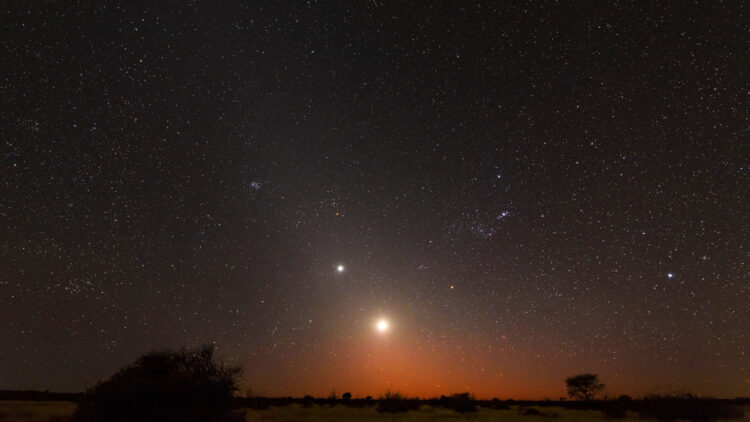
Astronomy fans around the world are preparing for a rare and spectacular celestial event this February, as six planets in our solar system will trace a broad arc across the evening sky, creating what skywatchers call a “planetary parade.”
Between late February and early March, the planets will appear clustered along the ecliptic the plane of Earth’s orbit around the Sun in a configuration that, while not a perfect straight line, brings these distant worlds into a single visible stretch after sunset.

AD: Capeesh Restaurant
This month-long procession culminates on Saturday, 28 February 2026, when Mercury, Venus, Jupiter, Saturn, Uranus, and Neptune will all appear simultaneously along the night sky shortly after sunset, a phenomenon drawing excitement from amateur stargazers to professional astronomers.
Celestial events like this serve as vivid reminders of the orderly motions of the solar system and offer a rare opportunity for people to connect with cosmic rhythms that unfold on timescales far beyond everyday life.
From mid-February onward, observers in many parts of the world will see multiple planets climbing into the evening sky at dusk. The brightest of these Venus and Jupiter will be visible with the naked eye soon after sunset, glowing against the darkening sky toward the west and southeast, respectively.

AD: Oysterian Sea Food Restaurant And Bar
Saturn will also be visible to the unaided eye, appearing as a gentle yellowish point of light, while the much fainter Uranus and Neptune will typically require binoculars or a small telescope to bring them into view.
The peak of the planetary parade occurs around 28 February 2026, when all six planets lie along the ecliptic plane, visually stretching from the western horizon toward the eastern sky.
With enthusiasts in Europe, the western sky shortly after sunset will offer the best view, with Venus and Mercury sitting low near the horizon and Jupiter rising higher later in the evening.
Viewing prospects extend across the globe: from São Paulo and London to Tokyo and New York, observers are encouraged to find a clear horizon and watch soon after sunset, as the rare configuration gradually shifts night by night. With Mercury and Venus setting soon after sunset and the outer planets lingering longer into the night, timing and clear weather will be crucial for catching the full parade.
While four of the six planets Venus, Jupiter, Saturn, and sometimes Mercury are bright enough to be spotted with the naked eye, Uranus and Neptune’s faint light will generally require optical aids like binoculars or a small telescope to see them clearly against the starry backdrop.
Astronomers emphasise that this celestial parade is a visual effect from Earth’s perspective: although the planets appear close together along the sky’s dome, they remain separated by vast distances in space. Their apparent alignment occurs because they all orbit the Sun in roughly the same plane, creating occasions where multiple worlds can be seen along a shared celestial path.
Whether you are a seasoned stargazer or simply curious, this planetary parade offers an accessible and awe-inspiring chance to witness the motion of worlds beyond our own.
The six-planet parade is just one of several notable astronomical features gracing the February sky. According to The Planetary Society, Jupiter dominates the eastern evening sky throughout February as one of the brightest celestial objects, making it an anchor point for skywatchers tracing the parade’s arc.
Saturn will be visible toward the western horizon in the early evening, while Mercury and Venus dance low to the southwest shortly after sunset before dropping below the horizon.
Astronomy apps and interactive sky charts can help spectators plan their viewing, pinpointing the precise locations of individual planets relative to familiar stars and constellations. A clear view of the western horizon soon after sunset is generally key to seeing the parade at its fullest, particularly for Mercury, which sets quickly after twilight.
This planetary parade has inspired excitement not only among amateur skywatchers but also within scientific and photography communities, which welcomed similar events in recent years and have documented rare alignments, such as last year’s seven-planet sighting where even distant worlds made an arc across the evening sky.
Despite the poetic idea of planets “lining up,” astronomers clarify that these parades are not true alignments in the strictest sense the planets are not physically in a straight line through space. Instead, they appear grouped from our vantage point because they orbit in similar planes around the Sun.
Even so, visual groupings of six planets at once are exceptionally rare. A similar event involving six or more planets does not occur often, and, according to astronomers, the last multi-planet parade visible to the unaided eye happened at different configurations in previous years.
Events featuring seven planets with Mars also visible are estimated to be decades apart. What makes February’s parade particularly compelling is its month-long window of observability, which extends the opportunity for a broader audience worldwide to witness the event, provided weather conditions cooperate. This extended visibility sets it apart from brief conjunctions or alignments that may only be viewable for a single night.
To make the most of this rare event, experts suggest finding a location with a wide, unobstructed view of the horizon, away from bright city lights. Even in light-polluted urban areas, Venus and Jupiter should stand out clearly, but binoculars or a telescope will significantly enhance the experience for Uranus and Neptune.
The best viewing times are shortly after sunset, when the sky darkens but the planets have not yet dipped below the horizon. Mercury and Venus will be easiest to catch early in the evening due to their proximity to the Sun, whereas Jupiter and Saturn remain visible longer into the night.
Skywatchers are also encouraged to watch the planetary parade over several days, as the planets will gradually shift positions relative to Earth’s viewpoint. Even if you miss the 28 February peak, there will be opportunities in the days surrounding it.

AD: Heritage And Restaurant Lounge Bar