
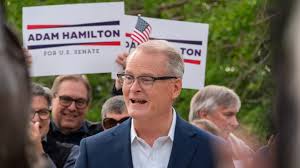
By Aaron Miller-
The Rev. Adam Hamilton, leader of the nation’s largest Methodist congregation, has launched a bid for the U.S. Senate in Kansas, injecting an unexpected dynamic into a race that could test the political influence of faith leaders in an increasingly polarised America.
Hamilton, senior pastor of the United Methodist Church of the Resurrection, formally announced his candidacy on Thursday, entering the Democratic primary in a state long dominated by Republicans. His decision to run after initially weighing an independent bid positions him as a potentially formidable challenger to incumbent Republican Sen. Roger Marshall in the 2026 election.

AD: Capeesh Restaurant
At 61, Hamilton brings a national profile uncommon among first-time candidates. Over more than three decades, he has built his Kansas City-area church into a sprawling, multi-campus institution with roughly 22,000 members, giving him access to a wide donor network and volunteer base.
His entry into the race comes at a moment of shifting political currents. While Kansas remains a Republican stronghold having not elected a Democrat to the Senate in nearly a century the state has shown signs of softening at the margins, particularly in suburban areas.
Hamilton’s candidacy reflects a broader trend of religious figures stepping more directly into electoral politics, challenging long-held assumptions about the separation between the pulpit and public office. He has described himself as an “independent-minded Democrat,” emphasising unity and civility in a political climate he says is increasingly defined by division.

AD: Oysterian Sea Food Restaurant And Bar
That message may resonate with some voters, particularly moderates and independents. But it also raises questions about how religious leadership translates into political leadership, especially in a state where evangelical and conservative Christian voters have traditionally aligned with Republicans.
Hamilton is not entering a vacuum. He joins an already crowded Democratic primary field, competing against candidates with more conventional political backgrounds. His late entry could disrupt the race, drawing attention and potentially resources away from lesser-known contenders.
His candidacy has already attracted scrutiny. Kansas Republicans have filed a complaint alleging improper use of church resources during the early stages of his campaign, an accusation Hamilton denies.
The tension underscores the legal and ethical complexities that arise when clergy seek elected office. U.S. tax law prohibits churches from directly participating in political campaigns, and candidates with active religious roles must carefully navigate those boundaries to avoid violations.
Hamilton has argued that his pastoral experience uniquely equips him for public service. Over months of travel across Kansas, he said he heard concerns from farmers, teachers and small-business owners about healthcare costs, economic pressures and political gridlock issues he now hopes to address on a national stage.
The broader implications of Hamilton’s candidacy extend beyond Kansas. His campaign arrives amid renewed Democratic efforts to engage religious voters, a constituency that has often leaned Republican in recent decades.
If successful, Hamilton could represent a new model for Democratic candidates one that blends faith-based messaging with centrist political positioning. Even if he falls short, his presence in the race may influence how both parties approach religious outreach in future elections.
The challenge is less about immediate electoral risk and more about narrative. Marshall, who won his seat in 2020 by a comfortable margin, remains the favourite. But Hamilton’s candidacy introduces an element of unpredictability, particularly if he can mobilise suburban voters and tap into dissatisfaction with partisan politics.
The race also highlights the enduring role of personality and biography in American politics. Hamilton’s decades in ministry, his authorship of dozens of books, and his reputation as a bridge-builder could appeal to voters weary of conventional politicians. At the same time, critics argue that his lack of direct political experience could prove a liability in a high-stakes federal role.
Hamilton’s candidacy has already achieved one outcome: it has transformed what might have been a predictable Senate race into one of the more closely watched contests of the 2026 election cycle.
In a state like Kansas, where Republican dominance in federal races has long been the norm, the entrance of a figure such as Adam Hamilton introduces a level of intrigue that extends far beyond typical partisan calculations.
Part of that heightened attention stems from Hamilton’s unusual profile. Unlike traditional candidates who rise through party ranks or public office, Hamilton’s influence has been cultivated through decades in the pulpit at the United Methodist Church of the Resurrection.
That platform has allowed him to build not only a large following, but also a reputation for addressing politically sensitive issues ranging from immigration to healthcare through a moral and theological lens. Translating that influence into electoral support, however, remains an open question.
Early reactions suggest that both parties are recalibrating their strategies in response. For Democrats, Hamilton offers a potential bridge to voters who may feel alienated by the party’s national image but remain open to candidates who foreground faith and community values.
His messaging focused on civility, compromise and practical problem-solving could help reshape how Democrats compete in traditionally conservative regions, particularly in the Midwest.
Republicans, meanwhile, are likely to frame Hamilton’s candidacy as emblematic of what they see as the politicisation of religious institutions.
Incumbent Sen. Roger Marshall and his allies have already signalled that they intend to scrutinise Hamilton’s record closely, highlighting areas where his views may diverge from the state’s conservative electorate. Issues such as abortion, taxation and federal spending are expected to feature prominently in that contrast.
The financial dimension of the race is also poised to shift. Competitive Senate campaigns require significant resources, and Hamilton’s national profile combined with his connections through speaking engagements and book publications could unlock fundraising channels not typically available to first-time candidates.
Increased attention from outside groups, including political action committees and advocacy organisations, is likely to pour additional money into the contest, further elevating its profile.
Media coverage is already reflecting this change. What might have once been a regional political story is now attracting national scrutiny, with analysts viewing the race as a potential bellwether for broader trends. In particular, Hamilton’s campaign may serve as a test case for whether candidates who emphasise faith-based unity can gain traction in an era often defined by ideological rigidity.
Yet the heightened visibility also brings intensified scrutiny. Hamilton’s sermons, writings and public statements many of which were delivered in a pastoral rather than political context are likely to be dissected for clues about how he would govern.
The transition from religious leader to political candidate inevitably invites questions about how he would navigate the separation of church and state, and whether his pastoral instincts would translate effectively into legislative decision-making.
The race’s newfound prominence reflects a convergence of factors: an unconventional candidate, a shifting political landscape and a national appetite for narratives that challenge entrenched expectations. Whether that attention ultimately translates into electoral success for Hamilton remains uncertain.
But what is clear is that his candidacy has already altered the trajectory of the contest, ensuring that Kansas rarely a focal point in Senate politics will be watched closely as the 2026 election approaches.

AD: Heritage And Restaurant Lounge Bar