
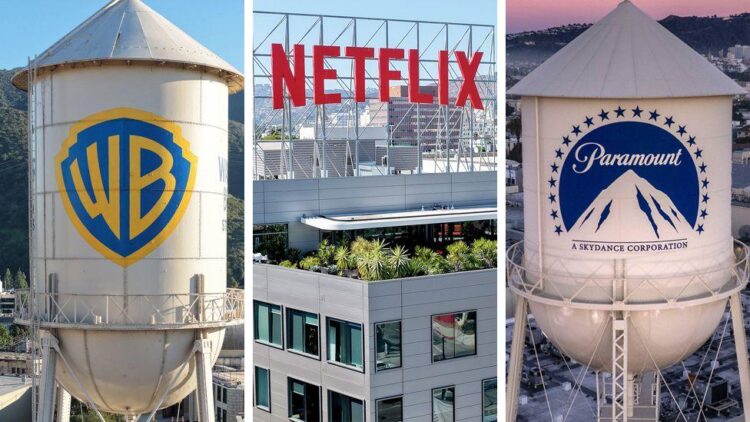
By Aaron Miller-
In a stunning corporate twist that has sent ripples through Hollywood and Wall Street alike, Netflix has officially walked away from its long‑heralded bid to acquire Warner Bros.
Discovery a decision that effectively clears the way for Paramount Skydance to emerge victorious in what had become one of the most high‑stakes bidding wars in modern entertainment history.

AD: Capeesh Restaurant
While negotiations had stretched on for months, culminating in competing offers that captured global attention, Netflix’s leadership co‑CEOs Ted Sarandos and Greg Peters concluded that the escalating terms proposed by Paramount represented a valuation their company was no longer willing to match.
In a strongly worded statement earlier this week, the streaming giant said the deal “is no longer financially attractive,” even as its stock price climbed in the hours after the announcement.

AD: Oysterian Sea Food Restaurant And Bar
The saga began in late 2025 when Netflix agreed to purchase Warner Bros.’ studio, streaming service HBO Max and other entertainment assets in a deal that initially captured the industry’s imagination as a transformative combination of classic Hollywood storytelling and streaming dominance.
However, that agreement was soon disrupted by a rival bid from Paramount Skydance an aggressive “hostile” offer that sought to acquire not just the studio and streaming arms but all of Warner Bros. Discovery, including cable networks like CNN and legacy franchises such as Harry Potter and DC Comics.
Paramount’s final offer reportedly $31 per share with substantial termination and regulatory guarantees was deemed a “superior proposal” by Warner Bros.
Discovery’s board, triggering contractual clauses that gave Netflix a short window to respond but ultimately compelling it to bow out. The move shifts momentum decisively to Paramount, which now looks poised to secure a deal valued over $110 billion.
Industry analysts noted that Netflix’s strategic retreat may reflect broader concerns about regulatory scrutiny especially from bodies like the U.S. Department of Justice and the financial strain of absorbing such an expansive media empire at the price Paramount was willing to pay.
The ramifications of Netflix’s withdrawal and Paramount’s likely takeover extend far beyond boardrooms. Should Paramount’s bid be approved, it would reshape the media landscape by consolidating some of the world’s most influential content creators and distribution platforms under one roof a scenario that has already raised antitrust concerns among regulators and politicians alike.
Critics warn that such consolidation could diminish competition, reduce creative diversity, and lead to significant restructuring within the industry.
Netflix is positioning this moment as an opportunity to refocus on its core strengths: original content, global reach, and subscriber growth without overextending financially.
Observers say investors responded positively to the decision, seeing it as disciplined stewardship rather than defeat. Meanwhile, Paramount enters the final phase of approval and regulatory review with momentum but not without scrutiny from watchdogs wary of media consolidation and market power.
While shareholders and regulators weigh the future of Warner Bros. Discovery, the industry watches closely. What was once a battle for control of a storied Hollywood institution now stands as a defining moment in the evolution of global entertainment one where strategic restraint may have won Netflix more than it lost, and where Paramount’s calculated aggression could redefine an era.
The drama of the past few months is more than a corporate skirmish; it is a reflection of the seismic shifts transforming the media landscape. Streaming, once a disruptive upstart challenging traditional studios, has become intertwined with legacy content in ways that make these high-stakes negotiations both complex and unprecedented.
Netflix’s decision to withdraw from the Warner Bros. Discovery deal, though seemingly a retreat, can be seen as an exercise in disciplined strategic judgment.
The streaming giant had long sought to expand its portfolio through acquisition, aiming to merge its unparalleled global reach with Warner Bros.’ treasure trove of franchises, from Harry Potter and DC Comics to the vast catalog of HBO originals.
However, the rising costs of such a merger, coupled with mounting regulatory scrutiny, made the proposition increasingly fraught. While stepping back, Netflix preserves its financial flexibility, allowing it to invest in content development, technology, and international expansion areas that have consistently driven its growth.
In a market increasingly wary of debt-laden acquisitions, this measured approach signals to investors that the company is prioritizing sustainable growth over the allure of headline-grabbing deals.
Paramount, in contrast, has embraced a strategy defined by calculated audacity. Its final bid, surpassing Netflix’s offer, demonstrates a willingness to stake its claim on one of the world’s largest entertainment ecosystems.
Through acquiring Warner Bros. Discovery, Paramount positions itself to control not just a streaming service or a single studio, but a sprawling empire encompassing film, television, and cable networks.
The potential to integrate these assets under one roof represents a paradigm shift: content creation, distribution, and audience engagement could become more vertically aligned than ever before. With Paramount, the risks are high, but so too are the potential rewards, offering the chance to redefine competitive dynamics in Hollywood for the next decade.
The implications extend far beyond corporate boardrooms. Creators, executives, and talent across the industry are acutely aware that mergers of this magnitude often reshape the ecosystem of opportunities.
Writers, directors, and actors may find new avenues for collaboration on mega-franchises or global streaming projects, yet they also face uncertainty as restructuring, cost-cutting, and strategic realignment unfold.
Similarly, audiences could see both the benefits of a more consolidated content platform with access to richer libraries and cross-service experiences and the drawbacks of reduced diversity in creative voices as fewer companies dominate the market.
Regulators, meanwhile, are tasked with balancing innovation against competition. Antitrust authorities in the U.S. and abroad will scrutinise Paramount’s prospective acquisition to ensure it does not stifle competition or create barriers for emerging platforms.
The scrutiny itself underscores the stakes: a successful merger could inspire other conglomerates to pursue similarly ambitious deals, while any intervention could reshape future M&A strategies across the sector.
In this sense, the Warner Bros. Discovery saga serves as a case study in modern media governance, highlighting the tension between growth ambitions and market safeguards.
In the end, this chapter of Hollywood history is less about the triumph of one company over another than about the evolution of an entire industry. Netflix’s strategic restraint preserves its agility, ensuring it remains a formidable force in the streaming wars without overextending itself.
Paramount’s bold manoeuvring demonstrates how legacy studios can adapt and assert dominance in an era defined by digital consumption and globalised audiences.
The convergence of these strategies reflects a broader lesson for media companies: success no longer depends solely on ownership of content, but on the ability to navigate financial, regulatory, and creative complexities in a rapidly shifting landscape.
With shareholders, creators, regulators, and audiences await the final outcome, one fact is clear: the entertainment world has entered a new era, one in which bold decisions and measured caution exist side by side, reshaping how stories are produced, distributed, and consumed across the globe.
What seemed at first to be a simple battle for control has, in fact, become a defining moment for an entire generation of media, a turning point that will reverberate long after the ink dries on the contracts.

AD: Heritage And Restaurant Lounge Bar
-
Share On
- Categories
- Date