
By Aaron Miller-
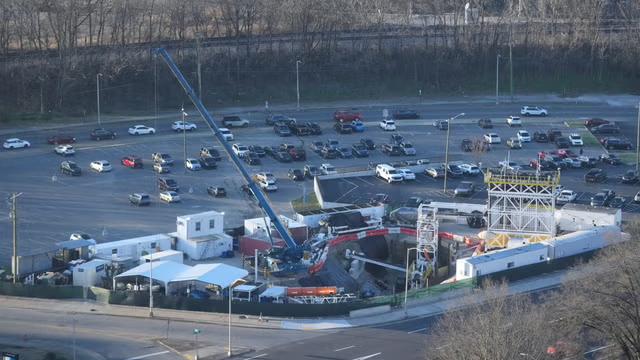
In Nashville, Tennessee, a tech‑charged battle has emerged between local government officials and one of the world’s most prominent inventors over a privately funded transportation project that could reshape travel in the city. Metro Nashville Council members voted Tuesday night to formally oppose the proposed Music City Loop, an underground Tesla‑vehicle transit system championed by Elon Musk’s The Boring Company even as construction on the tunnel begins and state leaders enthusiastically back the project. The decision marks a rare moment of public friction between the city’s leaders and a high‑profile private tech venture, reflecting deeper tensions over local input, safety, transparency, and the future of urban infrastructure in Music City.
The 20‑15 council vote was symbolic it has no legal power to halt or delay construction but it signals intense local unease with how the project has progressed.

AD: Capeesh Restaurant
Council members backing the resolution cited concerns about the lack of meaningful consultation with Nashville residents and city officials, as well as potential safety, environmental, and accessibility issues surrounding tunnelling through the region’s porous limestone and flood‑prone geological layers.
Supporters of the resolution argued that public infrastructure decisions affecting city land and long‑term transit planning should involve local voices rather than be driven primarily by state alliances with external companies.
While The Boring Company and state leaders, including Republican Gov. Bill Lee, have promoted the Music City Loop as an innovative transit solution that will connect downtown Nashville with the airport at no taxpayer cost, opponents in Nashville worry that the rush to begin tunnelling bypassed standard channels of community engagement and regulatory oversight.

AD: Oysterian Sea Food Restaurant And Bar
Some residents and activists have voiced broader doubts about whether Tesla‑driven pods operating in an underground loop represent a sound approach to public transportation when compared with more conventional mass transit systems.
The tension has not been confined to the Metro Council chambers. The Tennessee Chamber of Commerce recently urged council members to reconsider or defer their opposition, warning that public uncertainty could deter future business investment in the state.
At the same time, state lawmakers have introduced legislation aimed at keeping oversight of subterranean transit projects at the state level, effectively limiting Nashville’s authority to regulate the burgeoning tunnel network.
One such bill would designate that all “subsurface passenger transit” companies report to the state comptroller rather than local tax assessors, a move that critics say further sidelines municipal control over infrastructure shaping the city’s future.
Advocates for the tunnel emphasise that it is privately funded and designed to offer faster, lower‑cost travel options for commuters and visitors, potentially reducing surface traffic congestion. The Boring Company has pointed to its ongoing tunnel operations in Las Vegas as proof of its engineering capabilities and has suggested exploring future autonomous vehicle applications in the system.
Broader Impact and Future Debates
Nashville’s pushback against the Music City Loop highlights a growing debate across American cities about the role of private companies in public infrastructure and the balance between innovation, community engagement, and regulatory oversight.
With urban regions experiment with new transportation technologies, questions about accountability, safety, and long‑term planning continue to surface. The council’s opposition, while not legally binding, marks a clear demand from local leaders for transparency and involvement as the project moves forward.
This clash comes at a moment when other major infrastructure and transit initiatives are unfolding across the United States. From expanding light rail networks in cities like Dallas to debates over high‑speed rail corridors linking the Northeast, urban transportation remains central to discussions of economic growth, environmental stewardship, and equitable access to mobility. Nashville’s resistance to the Tesla tunnel project may become a reference point in future conversations about how cities navigate these competing priorities.
While tunnelling continues beneath Nashville’s streets, with the first leg of the Music City Loop expected to reach operational status in the coming year, even as local leaders continue to push for greater engagement, disclosure, and accountability from its backers.
The ambitious underground project, spearheaded by Elon Musk’s The Boring Company, promises a revolutionary transit system designed to shuttle Tesla vehicles between key points in downtown Nashville and the airport in mere minutes.
While proponents hail it as a high-tech solution to the city’s growing traffic congestion, the ongoing construction has sparked intense debate about transparency, oversight, and the role of private enterprise in public infrastructure.
City officials and community advocates have repeatedly emphasised that Nashville residents deserve a voice in shaping such transformative projects.
The Metro Council’s opposition, while largely symbolic, reflects broader concerns that the planning and approval process has favoured state-level interests and corporate enthusiasm over the input of local communities directly impacted by the tunnelling.
Questions about environmental safety, the potential for soil subsidence in the region’s limestone-rich underground, and flood management have also been raised, highlighting the engineering risks of digging subterranean corridors in an area prone to heavy rainfall and karst topography.
Meanwhile, The Boring Company has pressed forward, relying on privately funded operations and the promise of an innovative transportation model. Engineers involved with the project emphasise that advanced tunnelling technologies, including automated tunnel-boring machines and state-of-the-art monitoring systems, are being deployed to mitigate risks.
Yet skeptics argue that the project’s pace, secrecy around contracts, and limited public hearings have fuelled unease among both residents and local politicians. The tension underscores a broader national debate about the balance between private innovation and public oversight, especially when projects have the potential to alter urban landscapes permanently.
The stakes extend beyond technical and regulatory concerns. Nashville, already a rapidly growing city with rising traffic volumes, is at a crossroads in planning its future mobility infrastructure. Decisions made now regarding the Music City Loop could set precedents for private-public partnerships in other high-profile transportation projects across the country.
Advocates envision a connected city where commuters bypass congestion and emissions are reduced through rapid electric transit. Critics, however, fear that prioritizing a privately operated, Tesla-centric system may undermine investment in broader public transit networks that serve all residents equitably.
Even as tunneling advances, both sides agree on one point: the project represents a bold experiment in urban mobility. For city leaders, ensuring accountability, environmental stewardship, and public involvement remains paramount.
With Elon Musk and The Boring Company, completing the Music City Loop successfully could reinforce their model for high-speed, underground transit as a scalable solution for congested urban centers worldwide.
The coming year will reveal not just whether the tunnels can operate safely and efficiently, but whether Nashville can reconcile innovation with civic responsibility, setting a benchmark for how modern cities negotiate the tension between progress and participation.
In short, the subterranean work beneath Nashville is more than a construction project; it is a test of governance, engineering, and public trust, a tangible reflection of how 21st-century cities navigate the collision of technology, politics, and community.

AD: Heritage And Restaurant Lounge Bar