
By Gavin Mackintosh-
Almost seven in 10 GCSE entries achieved the standard grade 4 pass this year, with 67.3% of GCSE results across England, Wales and Northern Ireland awarded grade 4 or above. The figure is only marginally lower than the 67.4% recorded last year Despite the relatively small drop, the results are good.Most of those who enter for GCSE exams at least come out with a standard pass in many of their subjects. A standard pass cannot progress a pupil to the tougher A levels programme, but there are many other college courses they can comfortably do. Even for those who go straight into the world of work, it is something to be proud of that you passed your GCSE exams.
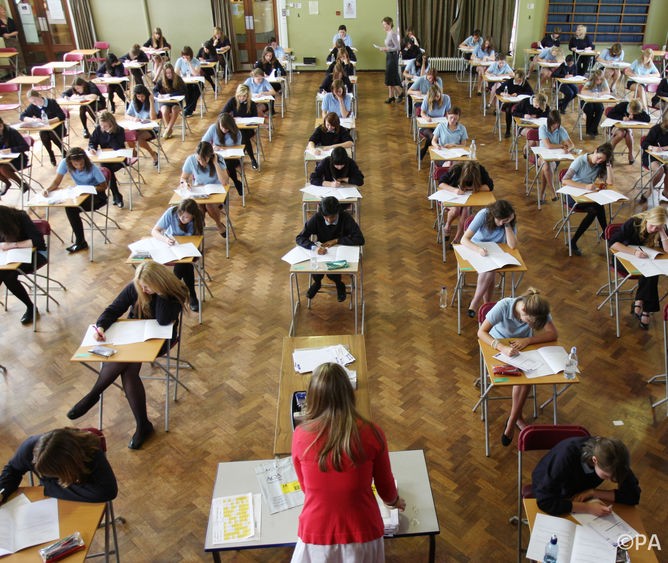
The statistics for those who obtain five subjects at grade 5 or above, which is a strong pass, is less annually. Just around 50% achieve this strong pass, an indication that the standard of GCSE exams are quite high. Passing easy exams is nothing to be proud of. The answer may have less to do with what happens inside the examination hall than with what happens during the two years before pupils ever sit their final papers. GCSE preparation is a prolonged process rather than a last-minute rush. Pupils spend Years 10 and 11 being taught the specifications on which they will eventually be examined, completing classroom assessments, sitting mock examinations, answering past-paper questions and receiving repeated feedback from teachers. By the time they reach the summer examinations, many have encountered the same concepts, terminology and question formats repeatedly. However, this long practise does not make the exams easy. all it means is that serious students have become famiiliar with the pattern over time, and work hard at it. A number of parents also hire private tutors in the final two years to ensure their children are up to standard.

AD: Capeesh Restaurant
That routine could help explain why the national pass rate remains remarkably stable. The 67.3% figure should not be interpreted as meaning that 67.3% of individual pupils passed their GCSEs, because the statistic refers to GCSE entries. A pupil taking eight or nine GCSEs contributes eight or nine entries to the national total. Nevertheless, the figure demonstrates the extent to which pupils are successfully reaching the standard required across a very large examination cohort. The stakes are considerable. GCSE grades can determine whether a student progresses to A-levels, T-levels, vocational education, an apprenticeship or another post-16 route. That knowledge can create a powerful incentive to concentrate during lessons and take assessments seriously. For schools, meanwhile, GCSE results remain one of the most visible measures of academic performance, creating an equally strong incentive to monitor pupils’ progress and intervene when students begin falling behind.
This means that a GCSE candidate is rarely left to discover their strengths and weaknesses on results day. Schools have two years in which to identify struggling pupils, provide additional teaching, organise revision programmes and encourage students to address gaps in their knowledge. The humble classroom test can play an important role in that process. Before a pupil sits a final GCSE paper, they have completed dozens of smaller assessments. Some schools also use open-book or resource-assisted tests, particularly after the teaching of new material. This helps students master or at least familiarise themselves with materials without feeling under intense pressure. Such tests are not equivalent to GCSE examinations, which are generally conducted under formal examination conditions, but they can familiarise pupils with the curriculum and teach them how to locate, interpret and apply information. Repeated testing can also make the final examination environment less unfamiliar. A student who has regularly been asked to answer timed questions, explain their reasoning or apply knowledge to unfamiliar problems is not encountering those demands for the first time when they walk into an examination hall.

AD: Oysterian Sea Food Restaurant And Bar
This may be particularly important in subjects where knowing the content is only part of the challenge. GCSE examinations increasingly require pupils to demonstrate how they use knowledge rather than simply reproduce it. Regular classroom questioning and assessment can therefore become a form of examination preparation without necessarily being labelled as such. The results also show that success is not distributed equally. Girls continued to outperform boys at the highest grades in 2026, with 24.4% of girls’ GCSE entries receiving grades 7 to 9 compared with 19.6% of boys’ entries. But the gender gap varies considerably between subjects. In mathematics, boys performed more strongly at the top end, while girls continued to have a substantial advantage in English.
. Ofqual’s system is designed to maintain comparable standards between examination years, with grade boundaries adjusted according to the difficulty of papers and the performance of candidates. A change in a grade boundary is not necessarily evidence that pupils have been given easier grades. It is part of the process intended to ensure that grades retain their meaning from one year to the next. Nor should the stability of the pass rate be confused with evidence that GCSEs have become easy. Reaching grade 4 is only one part of the story. The same cohort contains pupils achieving grades 7, 8 and 9, while others struggle to reach the pass threshold. This is important because a national average can conceal enormous variation between individual students and subjects. Perhaps the most revealing way to look at the GCSE results is therefore to stop thinking of results day as the moment at which pupils “achieve” their grades.
The examination is simply the final measurement of learning that has taken place over a much longer period. The journey may have involved hundreds of lessons, countless questions, homework assignments, mock examinations and classroom tests. Each individual exercise may appear insignificant, but collectively they create a substantial preparation programme for students. Also, the option to drop out of GCSE exams, which countless numbers of pupils do every year, provides confirmation that only students who are serious about passing their exams participate in those exams. Not even the persuasion or influence of parents changes this fact, because no student can literally be forced to take their GCSE exams.
That could be one reason why the national grade 4 figure has remained so remarkably consistent. The 67.3% result is not simply a snapshot of how pupils performed in a few hours of examinations; it is, in part, a reflection of an education system that spends two years preparing young people for those examinations. The bigger question is whether that success represents genuine learning or increasingly effective examination preparation. The answer is probably both. Schools have become adept at identifying what pupils need to know, while students have become accustomed to the demands of formal assessment. But the persistence of significant differences between pupils shows that preparation alone cannot eliminate inequality. What this year’s GCSE results ultimately reveal is therefore more subtle than a simple rise or fall in pass rates. The headline 67.3% figure is the visible outcome of thousands of classrooms in which pupils have spent two years learning, testing themselves, making mistakes and trying again. And perhaps that is the real GCSE story. success on results day is rarely created on results day. It is built lesson by lesson, test by test and year by year.

AD: Heritage And Restaurant Lounge Bar
-
Share On
- Categories
- Date