
By Sammy Jomes-
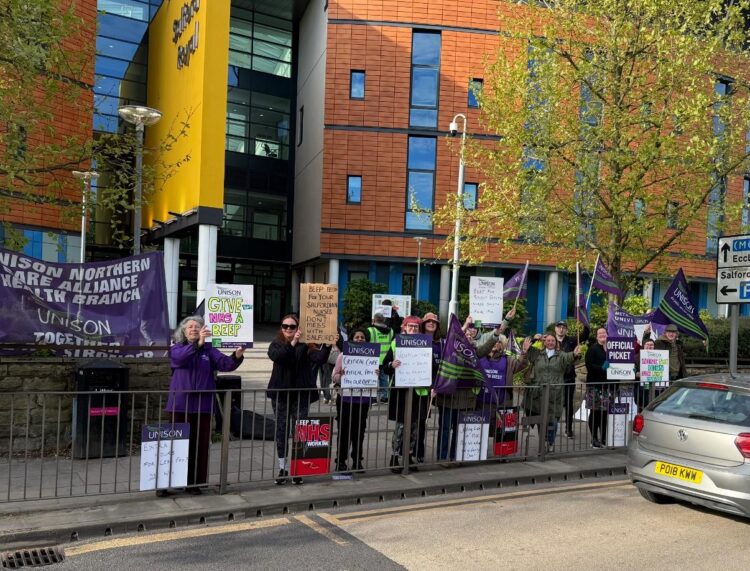
The latest strike action across four greater Manchester hospitals is easy to frame as another chapter in the NHS’s long-running disputes. That would miss the story. More than 350 operating theatres are not walking out because they want higher pay or improved benefits. they are taking industrial action because they are not being paid what their existing contracts already guarantee. Salford Royal Hospital, Royal Oldham Hospital, Rochdale Infirmary and Fairfield Hospital in Bury will strike on Monday 24 August, Wednesday 26 August and Friday 28 August. That distinction changes the nature of the dispute entirely. Most industrial action begins with negotiations over future pay settlements, staffing levels or improved working conditions. here the central claim is that employees are fighting for the enforcement of existing contractual rights, rather than seeking new ones.
According to unison, operating theatre staff covering workforce shortages are entitled to receive time and a half for overtime shifts. instead, the union says many workers have received less than their normal hourly rate, with some losing more than £80 on a single shift. if those claims are accurate, the issue extends beyond a disagreement over payroll. It raises broader conceerns about accountability, governance and whether contractual obligations are being consistently upheld within one of Greater Mancheste’s largest NHS trusts.

AD: Capeesh Restaurant
The dispute centres on the Northern Care Alliance Foundation Trust’s use of NHS Professionals (NHSP) to administer overtime payments. While outsourcing administrative functions is not unusual within the NHS, unions argue that the current arrangements have left staff financially disadvantaged when stepping in to cover workforce shortages. Ironically, these are the very shifts that hospitals depend on to keep operating theatres functioning safely and efficiently. When staff volunteer to work beyond their contracted hours, they are helping maintain services that might otherwise face delays or cancellations. If those extra hours are not rewarded as agreed, it risks undermining the willingness of employees to continue providing that flexibility.
The Northern Care Alliance now finds itself caught in a dispute that has steadily escalated over several months. Four rounds of strike action in June failed to produce a breakthrough, and workers have scheduled additional walkouts for 24, 26 and 28 August. Clinical support staff, nurses and housekeepers from Fairfield Hospital, Rochdale Infirmary, Royal Oldham Hospital and Salford Royal Hospital will all participate in the action. The breakdown in negotiations appears to have become as important as the financial dispute itself. Unison says the trust initially presented an offer aimed at resolving the disagreement before withdrawing it before meaningful discussions could take place. From the union’s perspective, that decision damaged confidence that management was committed to reaching a settlement. Kevin Dolan, Unison’s North West regional organiser, has argued that staff are not demanding more than they are already entitled to. Instead, he says, they simply want the trust to honour the terms already set out in their contracts. That message has become the defining theme of the dispute: this is not a campaign for higher wages but for the payment of agreed contractual entitlements.
The timing could hardly be worse for the Northern Care Alliance. The trust is already operating under intense pressure, with public reports highlighting serious concerns about patient safety, delayed treatment and workforce shortages. Trust records have linked treatment delays with dozens of patient deaths and incidents of severe harm, while thousands of patients experienced delayed care during the past year. High sickness absence and persistent staffing pressures have been identified as contributing factors, illustrating the strain under which services are already operating.

AD: Oysterian Sea Food Restaurant And Bar
Against that backdrop, every additional strike day carries consequences that extend beyond the immediate dispute. Hospitals can prepare contingency plans, reschedule elective procedures and prioritise urgent and emergency care, but such measures cannot eliminate disruption entirely. Patients awaiting routine operations may experience further delays, while staff who remain on duty often face increased workloads to maintain essential services. Even when emergency care continues uninterrupted, repeated industrial action inevitably places additional pressure on an already stretched healthcare system.
The trust has sought to reassure the public that patient safety remains its highest priority. Strategy officer Gertie Nic Philib has said preparations are in place to minimise disruption, maintain safe services and ensure urgent and time-critical care continues throughout the strike period. She also stressed that the trust respects employees’ legal right to take industrial action while remaining committed to constructive dialogue. Those assurances are important, but they also underline the broader challenge facing NHS employers: maintaining public confidence while simultaneously repairing relationships with their workforce.
The wider implications of this dispute extend well beyond Greater Manchester. Across the NHS, hospitals increasingly rely on staff volunteering for overtime to fill gaps created by vacancies, sickness absence and growing demand for healthcare services. That system depends on mutual trust. Employees must believe that when they agree to work additional hours, the terms under which they accepted those shifts will be honoured fairly and consistently. Once confidence in that arrangement begins to erode, trusts may find it increasingly difficult to persuade experienced staff to take on extra work, potentially worsening staffing shortages in the long term.
There is also an important governance question that deserves greater attention. If disagreements over overtime payments are becoming sufficiently widespread to trigger repeated industrial action, it may be appropriate for NHS employers to undertake independent reviews of how overtime is calculated and administered. Such reviews would not only establish whether contractual terms are being applied correctly but could also identify weaknesses in payroll systems before they develop into wider disputes. Greater transparency around overtime calculations would benefit both employers and employees by reducing uncertainty and strengthening confidence in the system.
The most practical solution therefore remains the simplest. If the dispute centres on contractual overtime payments, an independently verified audit of overtime calculations, coupled with a commitment to reimburse any staff found to have been underpaid, could provide a clear path towards rebuilding trust. Such an approach would establish the facts, reduce speculation and create a stronger foundation for meaningful negotiations than continued confrontation. This dispute is about more than payroll. It highlights the fragile relationship between NHS employers and the workforce that keeps hospitals operating every day. Contracts are not simply administrative documents; they represent commitments made between employers and employees. When either side believes those commitments are no longer being honoured, trust quickly becomes the casualty.

AD: Heritage And Restaurant Lounge Bar