
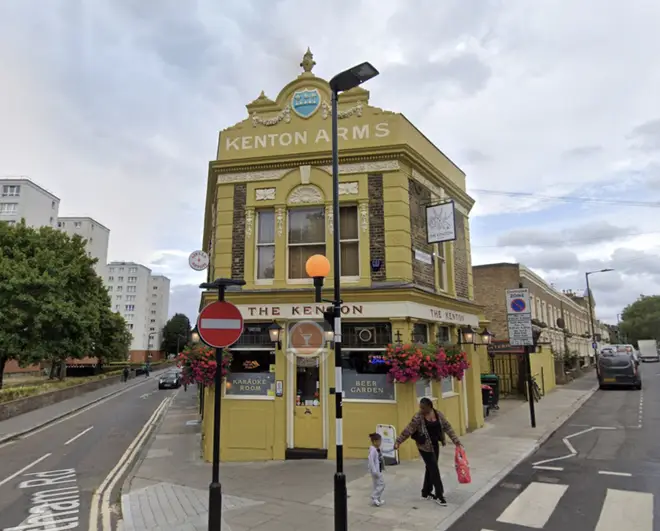
By James Simons-
A pub in east London has sparked a fierce debate over family life and adult social spaces after its landlord announced a no‑children policy, attributing the move to what he described as “entitled parents” and poor supervision. The decision by The Kenton in Hackney to prohibit those under 18 from entering has divided opinion across social media and the local community, leading some to praise the move and others to condemn it as exclusionary.
The change comes after years of mounting frustrations by pub owner Egil Johansen, who said that children’s behaviour had become increasingly difficult to manage and that many parents were failing to supervise their kids properly in what is primarily an adult social venue.

AD: Capeesh Restaurant
Speaking to reporters, Johansen said the pub had increasingly been treated like a “creche,” with children running into customers carrying drinks and approaching stressed animals, leading to confrontations between adults. He stressed that, despite having signage urging parents to supervise their children, the issues have persisted, leaving him with little choice but to endchildren’s entry completely.
The Kenton’s decision follows broader shifts in attitudes toward family presence in pubs across London. While many establishments maintain family‑friendly hours, some venues have tightened rules on children’s attendance in recent years.

AD: Oysterian Sea Food Restaurant And Bar
Critics of The Kenton’s new policy called the move unfair and argued that it penalises well‑behaved families for the actions of a few, while supporters point out that pubs are legally entitled to set their own age restrictions under their licensing conditions.
The landlord says that although the reaction has been “overwhelmingly positive” from many regulars, some parents are disappointed by the ban, saying they had enjoyed bringing their children to the pub in earlier years. One social media commenter lamented losing a place they used to visit frequently with their four‑year‑old, underscoring how the decision may affect long‑standing community relationships.
Johansen a parent himself insisted that he sympathises with families but believes that the environment simply isn’t suitable for children any longer. He encouraged locals who prefer child‑free spaces to respect the decision, while noting that there are other pubs in the area that continue to welcome families at set times or in designated areas.
The policy has tapped into wider cultural conversations about parenting responsibilities, public space etiquette and the role of children in adult‑oriented venues.
Social media threads about The Kenton’s decision have seen sharp‑toned exchanges between those who believe parents should bear full responsibility for supervising their children and those who feel pubs should be safe and inclusive spaces for all ages.
Online User Supporters of child‑free pubs argue that adults deserve spaces to relax without fear of accidents or disruptions, and that parents who refuse to manage their children’s behaviour harm the social experience of others. Opponents counter that such policies alienate families and erode the community function pubs once played as inclusive social hubs.
Even nationally, similar debates have cropped up in cultural commentary about whether pubs and other hospitality spaces should ever be “kid‑free,” with some opinion pieces arguing that the balance between adult enjoyment and family inclusion has shifted too far in one direction.
With The Kenton and its neighbours, the effect of the ban will unfold over the coming months as the local pub scene adapts to evolving customer expectations. Whatever the outcome, this episode highlights how a single licensing decision can ignite passion on both sides of the generational divide, challenging communities to consider how public spaces can best serve diverse needs.
Beyond the immediate question of whether children are welcome, the debate touches on deeper societal issues: how adults and families share public spaces, how businesses balance commercial interests with community inclusion, and how social etiquette is enforced in informal settings.
The conversation sparked by The Kenton illustrates that even small changes to longstanding local traditions can generate significant discourse, reflecting broader tensions between personal responsibility and collective enjoyment.
Local hospitality experts suggest that this is part of a wider trend in the UK, where pubs, cafés, and restaurants increasingly make explicit choices about which demographics they wish to attract.
Some establishments have embraced family-friendly policies with play areas and child-focused menus, while others have leaned into adult-oriented atmospheres, offering craft beers, live music, and quiet spaces where children’s presence might disrupt the intended experience.
In this context, The Kenton’s decision is not an isolated incident but a reflection of evolving consumer segmentation and the pressures faced by business owners trying to maintain both safety and atmosphere.
Community responses have been equally telling. Parents frustrated by the ban argue that pubs have historically served as inclusive spaces where adults and children could socialize together, fostering intergenerational connections. Others, particularly younger patrons or those without children, welcome the change, citing an expectation that certain venues remain calm and focused on adult enjoyment.
The clash of perspectives underscores the difficulties in crafting public spaces that accommodate both relaxation for adults and safe, enjoyable experiences for children.
The situation also raises questions about parental responsibility. Many supporters of the ban have highlighted that entitled or inattentive parenting can inadvertently spoil experiences for other patrons, while critics worry that removing children entirely is a heavy-handed response that punishes the majority for the missteps of a few.
It is a delicate balance, one that requires consideration of legal licensing, public safety, social norms, and the economic viability of pubs in a highly competitive market.
Ultimately, The Kenton’s move is likely to influence neighboring pubs and local businesses as they navigate similar pressures. Whether the policy becomes a model for other venues or sparks further controversy, it demonstrates how decisions in public hospitality spaces can illuminate cultural fault lines, spark debate about civility and community, and challenge society to think creatively about inclusive yet functional shared spaces.

AD: Heritage And Restaurant Lounge Bar