
By Ben Kerrigan-
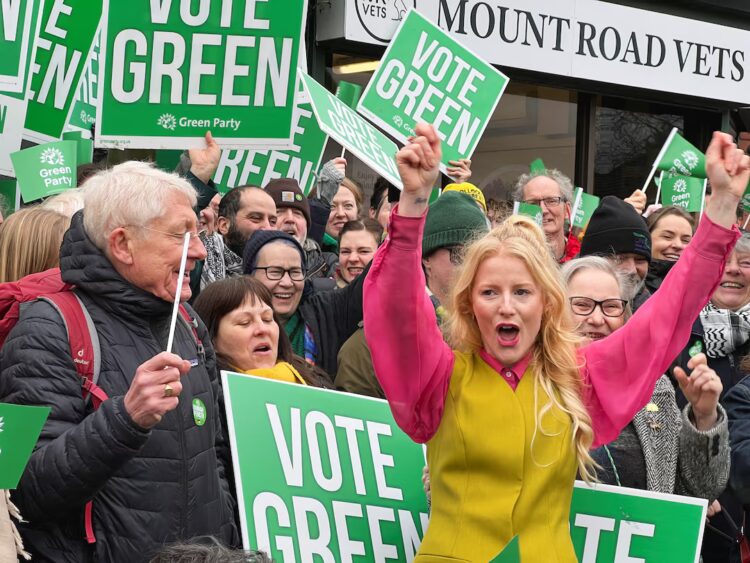
In one of the most dramatic political upsets of the year, the UK Green Party has achieved a historic breakthrough in the Gorton and Denton by election, overturning decades of Labour dominance and presenting itself in the words of party leader Zack Polanski as the most effective force to take on Reform UK in future contests.
The victory by Hannah Spencer, a local councillor and plumber, sending shockwaves through the UK’s political establishment comes after years of steady gains for smaller parties amid voter dissatisfaction with the traditional duopoly of Labour and Conservatives.

AD: Capeesh Restaurant
Spencer’s win has not only reshaped the narrative about what is possible for the Greens, but also reignited fierce debate about strategy on both the left and right of the political spectrum.
In a seat once considered one of Labour’s safest, the Green Party’s Hannah Spencer secured a commanding victory with nearly 41 per cent of the vote, tallying 14,980 ballots a majority of 4,402 over her nearest rival.
Reform UK’s candidate Matt Goodwin trailed in second place with 10,578, while Labour’s candidate finished third on 9,364, marking a stunning collapse in support for Sir Keir Starmer’s party.

AD: Oysterian Sea Food Restaurant And Bar
According to political analysts, the scale of the swing more than 26 percentage points from Labour to the Greens marks the largest reduction in Labour’s vote share in this constituency since the 1930s. This moment not only signals a seismic shift for a party long on the fringes of national politics but also raises pressing questions about the future of progressive alliances in the UK.
Speaking after her victory, Spencer emphasised community solidarity and a vision of economic justice, telling supporters she was driven by the “ordinary people” who felt left behind by mainstream parties. The result was described by observers as a clear signal that voters are seeking fresh alternatives to the centrist politics that have dominated Westminster for years.
The significance of this win extends beyond local boundaries. Polanski himself argued that the byelection shows “voting Green is now the way to defeat Reform,” insisting that many former Labour voters may never return to their old party.
“This used to be one of Labour’s safest seats,” Polanski said, pointing to the dramatic swing and insisting that a new political alignment is taking shape one in which the Greens can plausibly act as the principal bulwark against the rise of right-wing populism.
Strategic Ripples and Political Fallout
The byelection result has already triggered a wave of reaction across the political spectrum. With Labour, the defeat represents a shocking rebuke and has intensified internal debate over the party’s direction, leadership, and ability to capture progressive voters.
While some commentators argue that Labour needs to return to a more left-wing agenda to reclaim its base, others caution against alienating centrist voters ahead of future elections.
Meanwhile, Reform UK figures, including Goodwin and party founder Nigel Farage, have responded angrily, casting the result as evidence of broader cultural and electoral battles. Farage went further by claiming without evidence accepted by local officials that the election was tainted by instances of illegal “family voting,” an allegation strongly denied by election authorities.
Beyond the immediate fallout, the Greens’ success could have strategic implications for the May local elections and beyond. Capturing a seat in northern England especially a constituency that had been a Labour stronghold for nearly a century highlights the growing fragmentation of British politics and the appeal of smaller parties.
Supporters of the Greens argue that their victory proves the party can replicate successes in other traditionally safe seats, breaking through the barriers that have long kept it on the periphery of national power. Critics warn, however, that such gains might split the progressive vote and inadvertently assist right-wing parties like Reform in constituencies where the anti-Reform vote is divided.
In parliament, Spencer’s arrival will also affect the balance of influence among smaller parties and could embolden other minor parties to push for more ambitious policies or electoral reforms.
While the political landscape continues to shift, one thing is clear: the era of predictable electoral outcomes in British politics may be drawing to an end.
Through election dramas like Gorton and Denton offer more than a snapshot of local protest; they provide a window into a new electoral age defined by volatility, fragmentation and the erosion of long-standing loyalties. Voters who once identified instinctively with one of the two dominant parties now appear more willing to shop around and to do so repeatedly.
This phenomenon is not uniquely British. Across Europe, insurgent and non-establishment movements have reshaped parliaments and forced traditional parties into uncomfortable recalculations.
In Germany, the rise of Alternative for Germany has upended assumptions about postwar political stability. In France, La France Insoumise has consolidated a combative left-wing bloc outside the traditional Socialist framework.
Meanwhile, Brothers of Italy has transformed from a fringe nationalist force into the anchor of government. Each case differs in ideology and context, yet the pattern is similar: established parties lose their once-automatic claim on voters, and politics becomes a more competitive, less predictable arena.
In the UK, the fragmentation is multidirectional. On the right, Reform UK has drawn support from voters disillusioned with Conservative leadership and frustrated by cultural and economic grievances.
On the left and among younger voters, the Greens and other progressive forces are capitalising on concerns about climate change, housing affordability and public services. The traditional binary Labour versus Conservative no longer captures the full spectrum of political energy in the country.
Byelections historically function as laboratories for dissent. Freed from the immediate consequence of choosing a government, voters often use them to register frustration or test alternatives. What distinguishes the present moment is that these experiments are no longer isolated.
They are accumulating. Each upset chips away at the aura of inevitability surrounding major parties and builds credibility for challengers. A vote that once felt symbolic now carries strategic weight.
Technology has accelerated this shift. Digital campaigning allows smaller parties to mobilise with precision and speed, bypassing the financial and organisational advantages once monopolised by larger rivals. Local grievances can be amplified nationally within hours.
Candidates cultivate personal followings that sometimes eclipse party brands. The result is a political culture that prizes perceived authenticity and responsiveness over institutional tradition.
Demographic change also plays a role. Younger voters exhibit weaker partisan attachment and greater openness to issue-based politics. Older patterns of class alignment once the backbone of British electoral sociology have loosened considerably.
Economic precarity, cultural realignment and regional inequality intersect in unpredictable ways, producing constituencies that can swing dramatically from one contest to the next.
If this trajectory continues, future general elections may resemble intricate mosaics rather than straightforward two-horse races. Tactical voting could become more complex, as alliances shift constituency by constituency. Coalition-style thinking may seep into campaign strategy long before ballots are cast.
With established parties, the warning is unmistakable: loyalty is now earned, not inherited. For insurgents, the opportunity is historic but so too is the scrutiny that accompanies success.

AD: Heritage And Restaurant Lounge Bar