
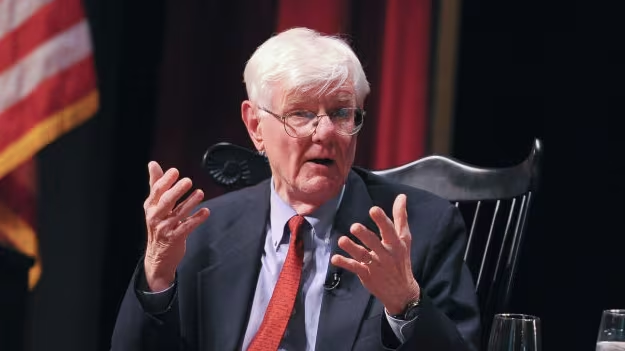
By Theodore Brown-
Gordon S. Wood, the Pulitzer Prize–winning historian whose sweeping reinterpretations of the American Revolution reshaped academic and public understanding of the nation’s founding, has died at the age of 92 after being struck by a car in Rhode Island, according to officials and family reports.
His death marks the loss of one of the most influential scholars of early American history, a writer whose work became foundational in universities and debates over how the United States should understand its own origins.

AD: Capeesh Restaurant
Wood died on Sunday after being hit in a supermarket parking lot in East Providence while walking, police said. He was transported to a nearby hospital with serious injuries but did not survive. The driver remained at the scene and cooperated with authorities, according to initial reports.
A professor emeritus at Brown University, Wood was widely regarded as the leading interpreter of the political and social transformations unleashed by the American Revolution.
His 1993 Pulitzer Prize–winning book The Radicalism of the American Revolution argued that the revolution was not merely a political break from Britain, but a profound social upheaval that reshaped class structures, manners, and ideas of equality across the new United States.

AD: Oysterian Sea Food Restaurant And Bar
He also authored The Creation of the American Republic, 1776–1787, a landmark study that won the Bancroft Prize and remains a staple in graduate and undergraduate curricula. Across decades of scholarship, Wood consistently challenged simplified narratives of the founding era, insisting that the revolution’s consequences were deeper and more transformative than often assumed.His work, while celebrated, also provoked sustained debate, particularly among historians who emphasised the centrality of slavery, gender, and Indigenous histories in the American story.
A scholar who reshaped the founding narrative
Born in Concord, Massachusetts, in 1933, Wood grew up in a town steeped in American literary and revolutionary memory. Yet his own path to history was not immediate. He later recalled that his high school history classes felt uninspiring, taught in a rote manner that failed to capture his imagination.
It was not until college at Tufts University that he discovered his passion for historical inquiry, graduating summa cum laude before completing graduate studies at Harvard University under influential historian Bernard Bailyn.
That intellectual lineage proved decisive. Bailyn’s emphasis on ideological origins deeply influenced Wood’s early work, including his dissertation-based The Creation of the American Republic, published in 1969. The book earned immediate acclaim and established Wood as a major voice in Revolutionary studies.
Over the following decades, Wood’s scholarship expanded into broader interpretations of early American society. In The Radicalism of the American Revolution, he argued that ordinary social relationships were transformed by the revolution, with hierarchical colonial norms giving way to more fluid and democratic forms of interaction.
The book became one of the most discussed works in American historiography in the late 20th century, praised for its clarity and scope even by critics who disputed its conclusions.
Wood later extended his synthesis in works such as Empire of Liberty, part of the Oxford History of the United States series, further cementing his reputation as a historian of exceptional range and narrative power.
In 2010, he received the National Humanities Medal from President Barack Obama, recognising scholarship that deepened public understanding of the nation’s founding.
Gordon S. Wood was a prominent critic of the 1619 Project, joining other leading historians in disputing its claim that the American Revolution was primarily driven by the preservation of slavery. He argued in interviews that while slavery was a profound contradiction within the new republic, many colonists believed it would gradually decline and that the Revolution’s primary motivations lay in ideological commitments to republicanism and equality rather than slavery.
Critics of Wood’s position, however, contended that such interpretations downplayed the central role of slavery in shaping American political and economic development and marginalised the lived experiences of enslaved people.
Ken Burns described Gordon S. Wood as a “teacher of generations of students and other historians,” reflecting the wide influence of his scholarship beyond the academy. Obituaries and academic assessments likewise emphasise that Wood’s work shaped generations of students and historians, with his books becoming foundational texts in the study of the American Revolution and early republic.
His influence extended not only through interpretation but also through a methodological emphasis on careful reading of primary sources and clear reconstruction of revolutionary political thought.
Wood’s writing also reached beyond academia. A famous reference to him in the 1997 film Good Will Hunting introduced his name to a broader audience, where it became shorthand for dense but essential historical scholarship. The moment amused Wood himself, who later remarked that more students seemed to know him from the film than from his books.
Despite the occasional cultural cameo, Wood remained most committed to the discipline of history as a craft one rooted, he often argued, in resisting the temptation to impose present-day moral frameworks too rigidly on the past. He cautioned against “presentism,” urging historians to understand historical actors within the constraints and beliefs of their own time.
His scholarly output continued well into his later years, including essays and retrospectives that revisited long-running debates about ideology, class, and the meaning of the American founding. Even critics acknowledged the seriousness of his engagement with opposing viewpoints and the intellectual rigor he brought to historical controversy.

AD: Heritage And Restaurant Lounge Bar