
By Samantha Jones-
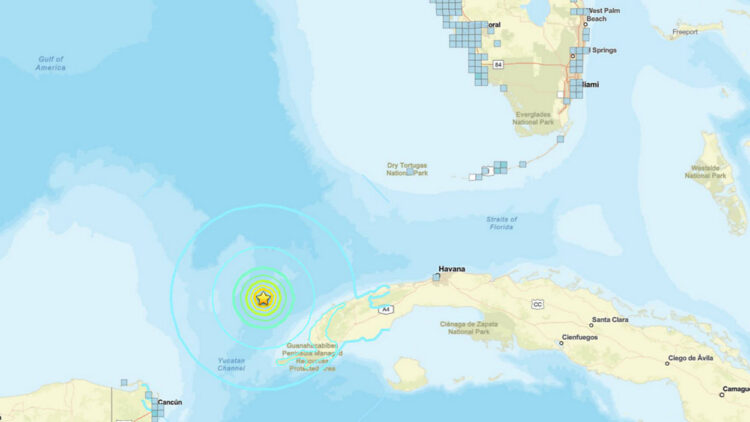
A magnitude 6.1 earthquake struck offshore near western Cuba on Monday, sending tremors through parts of the Caribbean and triggering shaking reports as far away as Florida.
The United States Geological Survey (USGS) confirmed the quake occurred in waters west of the Cuban capital Havana at a shallow depth of around 10 kilometres, a level that often allows seismic energy to travel widely across surrounding regions.

AD: Capeesh Restaurant
Residents across western Cuba reported swaying buildings and brief panic as the ground moved beneath them, while authorities in both Cuba and the United States began assessing the extent of the event.
In Florida, the National Weather Service office in Miami confirmed it had received multiple reports of light shaking in the state’s southern and central regions, though no immediate damage or injuries were recorded. The quake adds to a long history of seismic activity in the region, which sits along a complex boundary between the North American and Caribbean tectonic plates.
While Cuba is not typically associated with frequent high-magnitude earthquakes compared with regions along the Pacific “Ring of Fire,” it is still vulnerable to offshore fault movement, particularly along the Oriente fault system south of the island.

AD: Oysterian Sea Food Restaurant And Bar
That same fault zone has produced several significant earthquakes in modern history, including a powerful 7.7 magnitude event in 2020 that was felt across the Caribbean.
Shaking felt across the Caribbean and into Florida
The United States Geological Survey (USGS) reported that the magnitude 6.1 earthquake struck offshore in waters off western Cuba, with seismic agencies placing the epicentre approximately 104 kilometres west-northwest of Mantua in the island’s Pinar del Río province.
The shallow quake, recorded at around 10 kilometres deep, occurred in a tectonically active region near the boundary between the North American and Caribbean plates, a factor that often amplifies the area of perceptible shaking even when major surface damage is limited.
Despite its offshore location helping to reduce the likelihood of severe destruction on land, the tremor was still widely felt across western Cuba, with reports from Havana and surrounding provinces describing brief but strong shaking that prompted residents to step outside buildings as a precautionary response.
In Florida, particularly in coastal communities closest to the Caribbean, residents reported mild but unusual shaking following the offshore earthquake near Cuba, according to reports, While such seismic effects are uncommon in the state, they are not unprecedented, with AP noting that strong Caribbean earthquakes have previously sent tremors across the region.
The January 2020 magnitude 7.7 earthquake between Jamaica and Cuba, for example, was felt widely across South Florida and prompted brief evacuations in some Miami high-rise buildings as people reacted to swaying structures.
The same reporting highlights that seismic energy from powerful offshore earthquakes can travel efficiently through the Caribbean basin, making distant but perceptible shaking in Florida a known, if infrequent, occurrence linked to the region’s active tectonic boundary.
The US National Weather Service in Miami reiterated that no tsunami threat was issued following Monday’s quake. Experts noted that while underwater earthquakes can sometimes displace enough water to generate tsunami waves, the conditions of this event did not meet those thresholds.
Authorities in Cuba also reported no immediate confirmation of major structural damage or casualties in the hours following the quake. However, emergency services continued to monitor vulnerable coastal areas and older buildings, particularly in Havana and surrounding provinces where infrastructure can be more susceptible to seismic stress.
Seismologists say the Caribbean region’s geology makes it inherently prone to earthquakes, even if many are not widely destructive. The boundary between the Caribbean Plate and the North American Plate runs just south of Cuba, creating a long system of strike-slip faults that release energy in irregular intervals. One of the most active is the Oriente fault zone, which has been responsible for several of the region’s most powerful historical earthquakes.
In recent years, Cuba has experienced a steady pattern of moderate earthquakes, including multiple events above magnitude 5.0 that have been felt by residents but caused limited damage. Scientists note that while these smaller events can be unsettling, they also serve as reminders of the ongoing tectonic pressure building beneath the region.
The broader Caribbean has also seen heightened seismic awareness in recent years due to a cluster of moderate-to-strong quakes affecting Jamaica, Haiti, and the Cayman Islands. These events have reinforced the importance of regional preparedness, particularly in coastal communities where both earthquake shaking and potential tsunami risks must be considered together.
In Florida, emergency management officials regularly review contingency plans for distant but impactful seismic events originating in the Caribbean. While the state is not located near major fault lines, its proximity to active plate boundaries means it can occasionally experience perceptible shaking from strong offshore earthquakes.
Monday’s magnitude 6.1 quake appears to have passed without serious consequences, but it has once again underscored the interconnected nature of seismic activity across the Caribbean basin. Monitoring agencies continue to analyse aftershock risk, both Cuba and Florida remain alert to the possibility of further tremors in the days ahead.
Seismologists note that offshore earthquakes in this region are often followed by smaller aftershocks as stress redistributes along nearby fault lines, a process described by the United States Geological Survey as the crust continuing to adjust after the main rupture as energy is transferred to surrounding rock formations.
These aftershocks occur because earthquakes happen in clusters, with stress changes along faults triggering additional seismic activity in the same general area over time.
This is particularly relevant within the complex boundary between the North American and Caribbean tectonic plates, where multiple interacting fault systems generate frequent seismic activity and stress transfer across regions.
Even when initial damage is limited, aftershocks can still pose concern in coastal communities because they may continue for days, weeks, or longer and in some cases are strong enough to cause additional structural stress on already shaken buildings.
Authorities in Cuba are expected to continue inspections of older structures, especially in western provinces closest to the epicentre, where brief but strong shaking was reported. In Florida, emergency management officials typically monitor Caribbean seismic events closely, even when no direct threat is issued, due to the state’s long history of feeling distant tremors from larger offshore quakes.
While no tsunami warning was issued in this case, agencies routinely reassess coastal conditions following underwater seismic activity as a precaution.
The event also adds to a broader pattern of moderate earthquakes across the Caribbean in recent years, reinforcing the region’s status as one of the most seismically active zones in the Atlantic. For residents across both islands and coastal mainland areas, the latest tremor serves as a reminder that even brief seismic events can ripple widely across borders and oceans.

AD: Heritage And Restaurant Lounge Bar