

By Sammy Jones-
A remarkable Equinix UK data centre investment of £4 billion has been officially confirmed today, representing a significant boost to the United Kingdom’s digital infrastructure. Sky News exclusively revealed the funding package, which comes from Equinix, one of the most prominent providers of data centre space on the global stage.
This massive financial commitment is the largest single investment the company has ever earmarked for the European continent, reflecting strong corporate confidence in the UK economy despite prevailing concerns over energy costs and environmental impact.

AD: Capeesh Restaurant
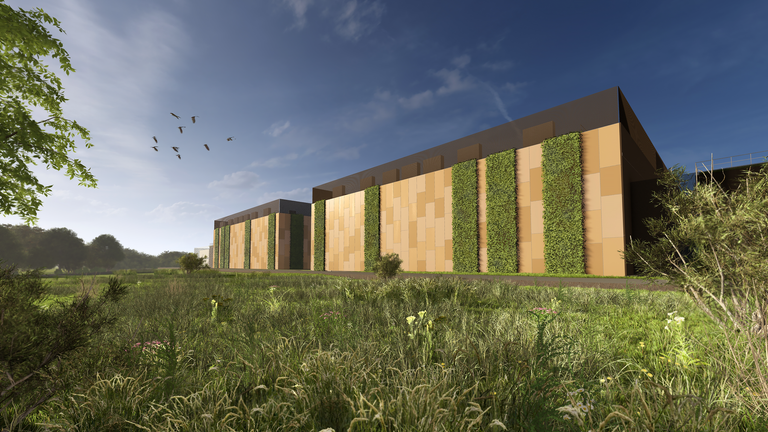
A render of what Equinix hopes the data centre at South Mimms will look like. Pic: Equinix
The planned new facility will occupy an expansive 85-acre site near the South Mimms services in Hertfordshire. Construction aims to start before the end of 2026 or the beginning of 2027, with the crucial goal of becoming fully operational by 2030. Once running, the centre will boast 250 megawatts (MW) of cutting-edge processing capacity. This enormous new capacity effectively Equinix UK data centre investment doubles the company’s existing processing power across Britain, significantly expanding its footprint.

Equinix already has a data centre site in Slough. Pic: Sky News
In order to provide accurate context, a government estimate reported late last year placed the UK’s total data centre capacity at approximately 1,566MW. An addition of 250MW represents a substantial uplift in the country’s computational firepower, a necessity driven by the explosive growth of artificial intelligence (AI) technologies. Technology Secretary Liz Kendall immediately welcomed the news, describing the landmark announcement as a “huge vote of confidence in Britain.” .
This substantial Equinix UK data centre investment carries profound strategic and political significance, moving beyond simply increasing computational capacity. Data centres are fundamentally important to modern economies; they support high-value jobs, actively redevelop post-industrial areas, and critically boost overall economic growth. Since they must be located as close as possible to the primary office workers who utilize their servers, the chosen South Mimms location is supremely important.

AD: Oysterian Sea Food Restaurant And Bar
In the fast-paced financial world, a few miles equals milliseconds, and milliseconds can easily mean millions of pounds in lost or gained revenue for the City of London’s institutions. The proximity to existing commercial hubs is therefore a non-negotiable requirement for hyperscale facilities like this.
The government has prioritized making it easier for these large, sometimes divisive projects to gain planning approval. They have enthusiastically embraced a policy allowing “grey belt” designation for certain areas of green belt land earmarked for development.
According to government definitions, the grey belt includes land situated near existing settlements, roads, or other necessary infrastructure, along with disused car parks and petrol stations. Although the location sits on oilseed rape fields currently wedged between the M25, the A1(M), the South Mimms service station, and Potters Bar, the Labour-controlled Hertsmere council approved the project.
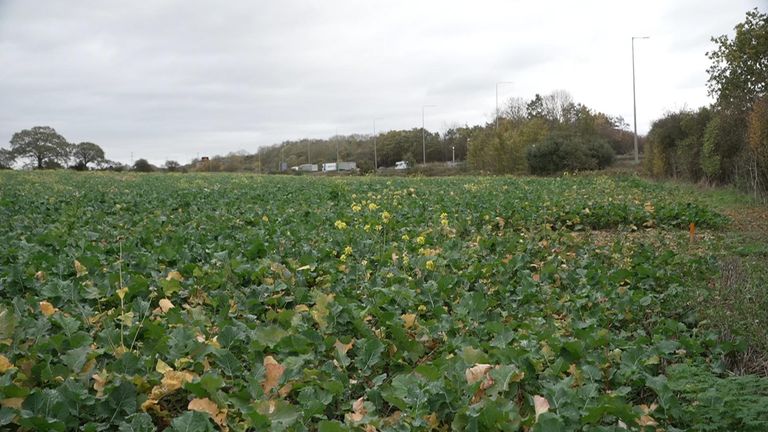
The oilseed rape farm at Equinix’s site in South Mimms. Pic: Sky News
Planning officers justified the controversial decision by arguing the land officially qualified as “grey belt” under the new guidelines. James Tyler, the firm’s UK managing director, expressed genuine excitement about the underlying demand in the UK. He also noted Equinix’s choice in investment location, confirming their excitement about the entire underlying environment and the strong government support for this project.
The facility is expected to directly support hundreds of construction roles while helping sustain thousands of technology jobs throughout London and the City.
The environmental impact and vast energy consumption of these massive digital processing facilities often form the main point of contention for planners and environmental groups. One of the key obstacles for developers aiming to build these hugely power-demanding sites is reliably securing the neces
sary connection to the National Grid, where the waiting list often stretches for a decade or more.
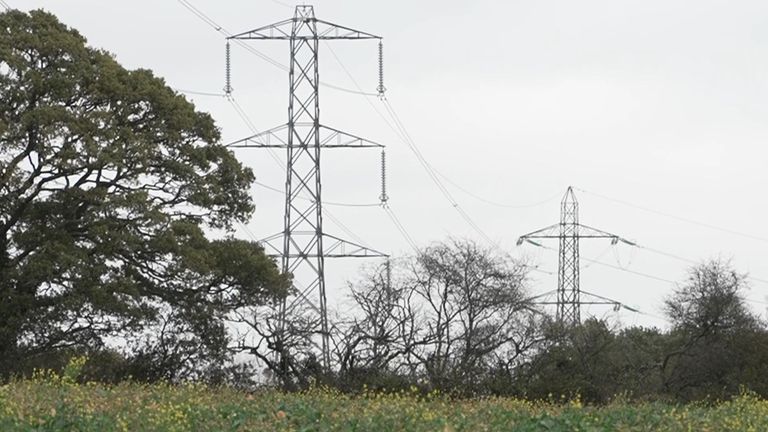
Power lines at the site. Pic: Sky News
Fortunately, this specific South Mimms site already possesses a connection lined up due to previous strategic work, allowing Equinix to accelerate their plans for a 2030 launch. The company has made concrete green commitments, pledging to use 100% renewable energy by the time the facility goes live. Furthermore, the massive site will use air cooling technology and not place any extraneous demand on local water supplies beyond standard usage, like on-site toilets.
Equinix executives confirmed the plan includes substantial ecological commitments designed to achieve a measurable biodiversity net gain. Andrew Higgins, the global head of master planning and sustainability, emphasized the comprehensive ecological approach to Sky News. He explained they will fully retain all existing high-value woodlands and essential streams, actively planting thousands more trees across the property.
Additionally, the developers intend to convert much of the existing monoculture arable land into diverse wildflower meadows, strategically installing several new ponds. This careful planning ensures that more than 50% of the plot will remain designated as green space, ultimately resulting in a minimum biodiversity net gain exceeding 10%.
Technology Secretary Liz Kendall stated the government wants to “make sure they draw on renewable energy sources” while simultaneously aiming to harness the vast advantages of AI.

Technology Secretary Liz Kendall welcomed the investment. Pic: Sky News
The government announced a £55 billion boost for research and development, funding sectors like climate science and AI safety, demonstrating their belief that AI itself can actively help tackle major challenges like climate change. The government’s strong backing for this substantial Equinix UK data centre investment reflects the crucial role digital infrastructure plays in achieving the nation’s stated “AI superpower” ambition.

AD: Heritage And Restaurant Lounge Bar


