
By Theodore Brown-
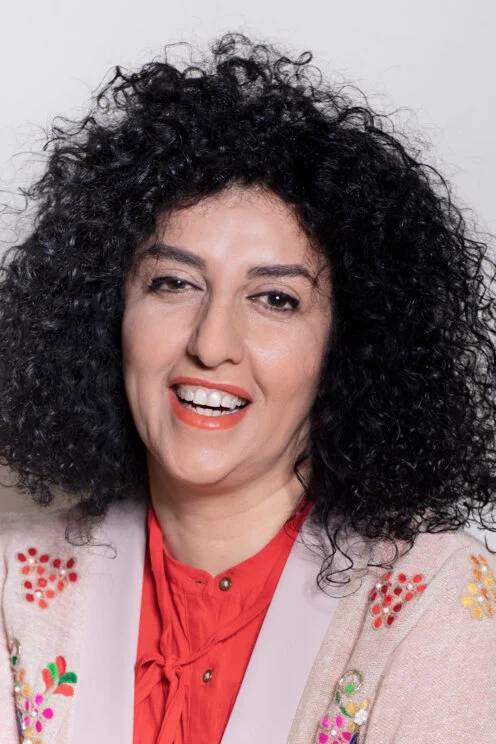
France has called for the release of Nobel Peace Prize winner Narges Mohammadi(pictured)to an additional seven and a half years in prison.
The French government said that the Iranian regime has once again opted for repression and intimidation, in defiance of the Iranian people’s fundamental rights, which Narges Mohammadi tirelessly defends.

AD: Capeesh Restaurant
In a statement issued today, February 9, France said it had learned “with deep concern” of Mohammadi’s sentencing to seven and a half years in prison.
The French Foreign Ministry said the ruling showed that Iranian authorities had once again chosen “repression and intimidation,” disregarding the fundamental rights of the Iranian people.
“Through this conviction, the Iranian regime is once again choosing repression and intimidation, in contempt of the fundamental rights of the Iranian people, of which Narges Mohammadi is the tireless defender,” the statement said, calling for her immediate release.

AD: Oysterian Sea Food Restaurant And Bar
Germany also reacted strongly, praising Mohammadi’s courage and condemning the new prison term.
“Narges Mohammadi, Nobel Peace Prize laureate from Iran, fearlessly stood up for human rights,” Tobias Tunkel, the Director of the German Foreign Ministry’s Middle East and North Africa Department said.
“The regime in Tehran sentenced her to another long prison term. We strongly condemn this attempt to silence her and all the other human rights defenders. It will not succeed,” he said.
Mohammadi, 53, has been repeatedly tried and jailed for her vocal campaigning against Iran’s use of capital punishment and the mandatory dress code for women.
She has spent much of the past decade behind bars and has not seen her twin children, who live in Paris, since 2015.
Mohammadi’s sentence of more than seven extra years in prison is on top of an existing nearly 14-year sentence, on charges that include “gathering and collusion against national security” and “propaganda against the state.”
Her lawyer, Mostafa Nili, confirmed the sentence, handed down by a Revolutionary Court in the city of Mashhad, while Iranian authorities have so far offered no official confirmation.
Along with the prison term, the ruling includes a travel ban and two years of internal exile to the city of Khosf in Iran’s eastern province of South Khorasan.
This latest verdict comes amid an intensified domestic crackdown on dissent and escalating tensions in Tehran’s international relations, including sensitive nuclear negotiations with the United States and mounting regional security pressures.
Mohammadi’s story cannot be separated from the sweeping political and cultural shifts that have defined Iran since the 1979 Islamic Revolution.
A physicist by training, she emerged in the late 1990s and early 2000s as a journalist and activist, co-founding the Defenders of Human Rights Center (DHRC), an organization initially established by her mentor, Nobel laureate Shirin Ebadi.
She focused on human rights, abolition of the death penalty, and gender equality. Over the years she campaigned tirelessly against Iran’s mandatory hijab laws, harsh criminal penalties, and systemic suppression of political freedom. These efforts made her a target for repeated arrests and long stints behind bars.
Her perseverance culminated in winning the Nobel Peace Prize in 2023, awarded while she was imprisoned in Tehran’s notorious Evin Prison. Her twin children, who have lived in Paris since 2015, collected the award on her behalf.
The Nobel Committee recognized her “courageous fight against oppression,” particularly her work against capital punishment and for women’s rights in Iran.
Yet, instead of heralding a new era of reform, her Nobel accolade has often coincided with intensified pressure from the Iranian state — a pattern that crystallizes the paradox of winning the world’s highest honour for peace while being treated as a pariah at home.
According to civil liberties groups and Mohammadi’s own legal counsel, the recent ruling consists of multiple components.
They include six years’ imprisonment for “gathering and collusion against state security.”
1.5 years’ imprisonment for “propaganda against the government.”
Two years of internal exile to Khosf, limiting her ability to return to Tehran.
Two-year travel ban, effectively severing her connection to international fora during that time.
Under Iranian legal statutes, sentences often run concurrently — reducing the total time behind bars — but internationally the news has been reported as an additional 7.5 years of incarceration.
Human rights defenders note that this sentence has been issued while Mohammadi was on a hunger strike, reportedly started on 2 February 2026 to protest her detention conditions and restricted contact with family and legal counsel.
Her health, already precarious due to multiple heart attacks and previous surgeries, is reported to be deteriorating further.
Her supporters call the trial proceedings a “sham,” noting that she refused to participate because she does not recognize the legitimacy of the judiciary that is prosecuting her for peaceful activism.
The Pattern of Repression Since 2022
The new sentence cannot be viewed in isolation. Since the nationwide protests that erupted in 2022, sparked by the brutal death of Mahsa Amini — a young woman who died in the custody of Iran’s morality police — the Iranian state has cracked down aggressively on civil society.
This has included thousands of arrests and deaths in street demonstrations, the widening repression of journalists, reformists, and activists
In early February 2026, authorities also arrested leading reformists close to Iran’s president, including figures like Azar Mansouri and Mohsen Aminzadeh — illustrating a domestic political purge that extends well beyond Mohammadi’s individual case.
The targeting of reformist and civil-society leaders has alarmed analysts who see the regime consolidating power amid both economic pressures and international negotiations, particularly over Iran’s contentious nuclear program.
The timing is notable: the sentencing of a global peace icon coincides with renewed talks with the United States aimed at averting military conflict and sanctions escalation.
The Iranian foreign minister, Abbas Araghchi, has cast Tehran’s position as steadfast defiance, declaring that the regime’s “power to say no to great powers” underscores its sovereignty, even as Western capitals push for stricter nuclear boundaries.
The international community has already reacted with condemnation. Amnesty International and other rights groups have decried the verdict as symptomatic of “skyrocketing lethal repression” against dissent in Iran.
Calls have emerged for Mohammadi’s immediate release and for greater international pressure on Tehran to uphold basic human rights.
In Europe, lawmakers and human rights advocates have demanded that the EU and NATO leverage diplomatic tools, including sanctions and multilateral forums, to press Iran. The Nobel Committee itself, though traditionally circumspect on direct political advocacy, has implicitly spotlighted Mohammadi’s plight as a symbol of wider injustices.
Tehran’s broader geopolitical posture complicates such pressures. Facing strong regional adversaries and a volatile Middle East, Iran has positioned itself as a bulwark against Western interference, using sovereignty rhetoric and strategic alliances to counter criticism over civil liberties
During the 1979 revolution and subsequent political upheavals, dissidents from varied ideological backgrounds were systematically marginalized, imprisoned, or eliminated. Today’s crackdown reflects a continuation rather than a departure from a political tradition that views dissent as existential threat.

AD: Heritage And Restaurant Lounge Bar