
By Isabelle Wilson-
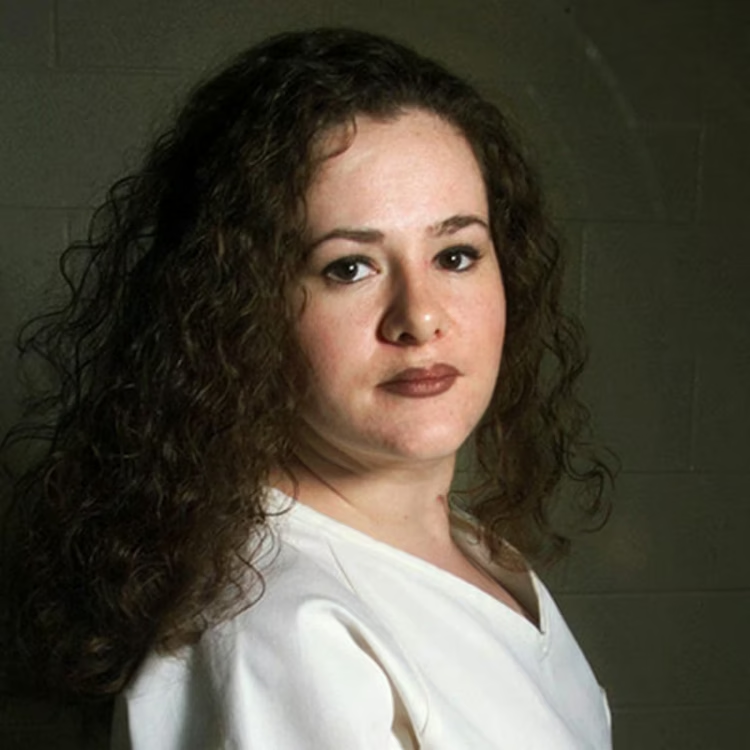
With just days remaining before Tennessee is due to carry out the execution of its first woman in 200 years- Christa Pike- her lawyers have made a final, deeply personal request.
They have asked for an only female corrections staff present in the execution chamber. Pike, 50, is scheduled to be put to death by lethal injection on September 30 at Riverbend Maximum Security Institution in Nashville. If the execution goes ahead, she will become the first woman executed by Tennessee in more than 200 years.

AD: Capeesh Restaurant
The request comes as Pike’s legal team continues to pursue every available avenue to stop the execution, including a clemency petition filed with Tennessee Governor Bill Lee and challenges to the state’s lethal-injection procedure.
At the heart of the women-only request is Pike’s reported history of severe childhood sexual abuse. Her lawyers have argued that being restrained on an execution gurney and physically handled by male officers could trigger traumatic memories of the abuse she experienced as a child.
The Guardian has reported that Tennessee has not guaranteed that only female corrections staff will be present in the death chamber.

AD: Oysterian Sea Food Restaurant And Bar
A childhood marked by repeated abuse
Pike’s lawyers have presented a picture of a childhood marked by instability, neglect and repeated sexual violence. According to her clemency petition, Pike was sexually assaulted repeatedly as a very young child.
The Death Penalty Information Center, summarising the 226-page petition, reported that the abuse allegedly began when Pike was between two and five years old, when she was repeatedly sexually assaulted by her grandmother’s boyfriend.
The petition further states that Pike was raped by a neighbour when she was 11. According to the filing, the man pleaded no contest to charges involving taking improper liberties with a child but did not receive a prison sentence. Pike’s lawyers say he subsequently returned to live near her.
The petition also describes another rape when Pike was 17, approximately a year before the killing for which she was sentenced to death. The attacker was never identified, according to the filing.
Her lawyers have argued that these experiences formed part of a childhood in which the adults and institutions around her repeatedly failed to protect her.
That history was not presented fully to the jury at her original capital trial, according to subsequent legal filings. Amnesty International has similarly reported that Pike’s court-appointed lawyers failed to present much of the mitigating evidence surrounding her childhood abuse and its psychological consequences
The evidence is significant to the current legal effort because Pike was only 18 when she committed the murder that resulted in her death sentence.
The murder that put Pike on death row
Pike was convicted of murdering 19-year-old Colleen Slemmer in Knoxville in January 1995.
Prosecutors said Pike, then 18, and her boyfriend, Tadaryl Shipp, lured Slemmer to an isolated area before attacking her. Pike was convicted of the killing and sentenced to death in 1996.
Shipp, who was 17 at the time of the crime, received a different sentence and is eligible for parole, while Pike has remained under a death sentence for almost three decade
Nothing in Pike’s legal team’s current arguments disputes her responsibility for Slemmer’s death. Instead, her lawyers have focused on the circumstances surrounding Pike’s childhood, her age at the time of the crime, her mental health and the extent to which mitigating evidence was presented to the original jury.
Pike’s own campaign acknowledges the seriousness of the crime. A statement attributed to her says: “There is no excuse for what I did. There are reasons for the way that I acted, but nothing excuses the crime and the damage it has caused to so many lives.”
The last legal attempts
Pike’s lawyers filed a 226-page clemency petition with Governor Lee’s office on September 2, asking him to commute her death sentence to life imprisonment without the possibility of parole.
The petition argues that Pike has changed substantially during her nearly three decades in prison, and that her childhood trauma, mental-health problems and young age at the time of the offence should be considered alongside the crime.
Her lawyers have also challenged Tennessee’s lethal-injection protocol. Pike has essential thrombocytosis, a condition involving elevated blood platelets. Her medical experts have argued that it could create complications with intravenous access and potentially make lethal injection more painful. The state has disputed the severity of those risks.
During an August hearing, experts for Pike also discussed the possibility that the physical restraints and procedures surrounding an execution could cause severe psychological re-traumatisation.
A Tennessee judge subsequently ruled that Pike’s condition would not prevent medical staff from establishing an IV, leaving the execution date in place.
Reprieve US deputy director Matt Wells has separately warned of what he described as a risk of a “prolonged and agonizing death”, according to reporting surrounding the case. The approaching execution has also taken a psychological toll on Pike. In a documentary examining her final days in prison, Pike described the effect of living with a scheduled execution date.
“I know I said I believed a date would never be set, but now that one has been set, it’s like a roulette wheel of thought and your actual brain is the ball bouncing around,” she said. My nerves are shredded. When I do sleep, my brain eats itself.”
She said the year-long wait had made the prospect of death an unavoidable part of everyday life.
“I’ve woken up and lived that thought all day, every day, every waking moment,” Pike said. Her lawyers now fear that the final hours could compound the trauma they say has followed her since childhood.
The women-only request is not simply about who will be standing inside the death chamber. Her legal team argues that the gender of the people restraining and handling her body could determine whether the execution becomes, in their view, a potentially severe psychological trigger for a woman whose childhood included repeated sexual violence by men.
In the absence of a sudden intervention from Governor Lee granting clemency, or that of a court , Pike’s execution remains scheduled for September 30. If Tennessee carries it out, the execution will have a historical distinction. Pike will be the first woman put to death by the state since 1819.
That makes her case unusual even within America’s death-penalty system, where executions of women are comparatively rare. The legal battle has consequently become about more than the final days of one death-row prisoner.
It has also focused attention on the treatment of women sentenced to death, the significance of childhood trauma in capital cases, and the question of whether evidence that was absent from an original trial should influence a later decision over whether a prisoner lives or dies.
The issue for Pike has become brutally immediate. Her lawyers are still seeking to prevent the execution entirely. But if those efforts fail, they want her final encounter with the state to be carried out by women.
And behind that request lies the traumatic history they say was missing when a jury first decided that an 18-year-old woman should die.

AD: Heritage And Restaurant Lounge Bar