
By Kenneth Williama-
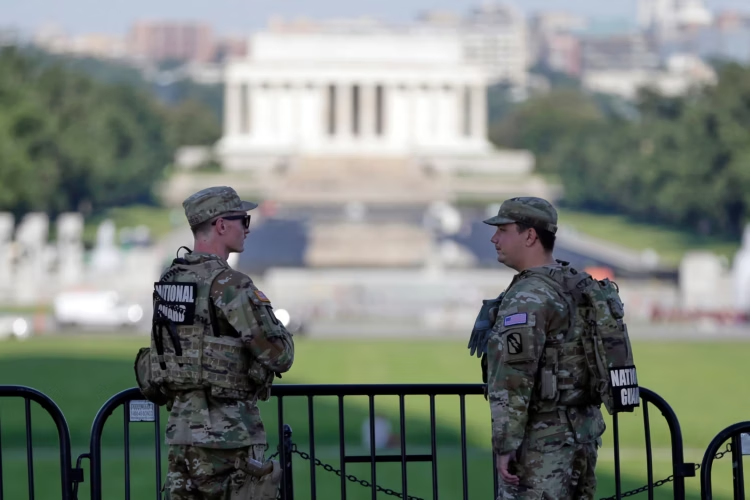
The District of Columbia has agreed to pay $50,000 to Sam O’Hara, a local resident who was detained by police after following an Ohio National Guard patrol while playing Darth Vader’s “Imperial March” from Star Wars on his phone.
The settlement, confirmed in court records and reported Monday, resolves claims that O’Hara’s constitutional rights were violated during what he described as a peaceful act of political expression. The case stems from a September 2025 incident that quickly escalated from street theatre into a legal battle over free speech, policing, and the presence of military forces in the nation’s capital.

AD: Capeesh Restaurant
O’Hara, represented by the American Civil Liberties Union of D.C., argued that he was exercising his First Amendment rights by using satire to criticise what he viewed as an “unusual and militarised” federal security presence in Washington. According to his complaint, he followed the patrol while playing the theme music associated with Darth Vader, a cultural shorthand for authoritarian power.
Police officers later detained him for approximately 15 to 20 minutes. No charges were filed, but O’Hara alleged violations of both free speech and protection against unreasonable seizure under the Fourth Amendment. The city’s settlement does not include an admission of wrongdoing, and it resolves claims against the District and four Metropolitan Police Department officers. Separate claims involving a National Guard member remain ongoing.
What might have been dismissed as a quirky street protest instead became a flashpoint in a broader debate about dissent, symbolism, and the visibility of federal force in Washington.The protest took place during a period of heightened federal law enforcement presence in the city, part of a controversial surge ordered under then-President Donald Trump’s crime emergency framework.

AD: Oysterian Sea Food Restaurant And Bar
The deployment of National Guard troops in urban patrols had already sparked tension between local officials and federal authorities, as well as criticism from civil liberties advocates who argued that the militarised optics of domestic policing risked chilling protest activity.
O’Hara’s method of protest was deliberately theatrical, according to court filings and reporting by the Associated Press. He repeatedly followed National Guard troops while playing Darth Vader’s “Imperial March” from Star Wars, turning routine patrols into a form of satirical political expression aimed at the federal law enforcement presence in Washington, D.C.
Through pairing his physical presence with the instantly recognisable orchestral cues of the franchise, he transformed ordinary street encounters into symbolic commentary on the militarised atmosphere of the city during the federal security surge. O’Hara described the music as “almost Pavlovian,” explaining that it immediately evoked ideas of tyranny and control in a way he felt communicated his message more powerfully than words alone.
Supporters of the lawsuit framed the detention as an overreaction to protected expression. The ACLU of D.C. argued that O’Hara’s actions were nonviolent, did not interfere with police duties, and fell squarely within constitutional protections for expressive conduct.
The District’s decision to settle has been interpreted by civil liberties advocates as a tacit acknowledgement of legal risk, even without an admission of fault. Critics, however, have pointed to the payout as another example of taxpayer funds being used to resolve misconduct claims without individual accountability.
O’Hara himself struck a measured tone after the agreement, expressing relief that the case had concluded but emphasizsng that the larger issues remain unresolved. He has continued to argue that the presence of armed patrols in civilian spaces raises fundamental questions about proportionality in law enforcement.
The settlement for the Metropolitan department closes one chapter of a case that began with a brief street encounter and ended in federal court filings, public scrutiny, and viral attention online. The case is less about the soundtrack than the constitutional questions it raises: when does protest become interference, and when does policing cross the line into suppression of expression?
Washington continues to grapple with the delicate balance between security and civil liberties, one protest scored by a villain’s march from a science fiction saga has taken on an outsized symbolic life beyond the moment it occurred.
What began as a brief, almost theatrical encounter between a lone demonstrator and uniformed National Guard troops has since been folded into a broader national conversation about how far the state should go in projecting force in public spaces, and how citizens respond when that presence becomes part of everyday life in the capital.
In recent years, Washington has increasingly found itself at the centre of debates over federal authority, especially during periods of heightened security deployment and expanded policing powers. The sight of armed patrols moving through civilian streets raises uncomfortable questions about normalisation: whether extraordinary measures taken in the name of safety gradually become ordinary features of urban life.
Supporters of such deployments, by contrast, argue that visible security presence is a necessary response to rising threats and a deterrent against disorder. The result is a city where the same street corner can be read in two entirely different ways either as a symbol of stability or as a reminder of overreach. Within that contested space, O’Hara’s protest stood out not because of its scale, but because of its symbolism. Using the unmistakable musical motif associated with cinematic authoritarian power, he reframed a routine patrol into something closer to performance art.
The effect was not merely to draw attention, but to impose interpretation: the scene invited observers to consider whether the imagery of armed patrols in a democratic capital carries meanings beyond its stated purpose. In doing so, the protest blurred the boundary between political expression and public disruption, forcing questions about where satire ends and interference begins.
Legal observers note that such acts sit in a long tradition of expressive conduct in American protest culture, where symbolism often carries more force than speech alone. From silent vigils to choreographed demonstrations, the use of visual or auditory metaphor has frequently been a way to compress complex political critique into a single, immediate moment. In environments where security operations are active and highly visible, those same gestures can be interpreted differently by law enforcement tasked with maintaining order.
And so the episode lingers not simply as a legal dispute resolved by a financial settlement, but as a cultural snapshot of a city negotiating its own identity. Washington, after all, is a place where governance and performance often overlap, where the machinery of power is constantly on display and constantly being interpreted.
In that sense, it is perhaps fitting that this particular protest arrived not with a chant or slogan, but with a score one instantly recognisable, emotionally charged, and impossible to separate from its associations. In a capital where politics is frequently described as theatre, this moment blurred the line between stage and street. And like any memorable production, it left behind a theme that continues to echo long after the scene has ended.

AD: Heritage And Restaurant Lounge Bar