
By Ben Kerrigan-
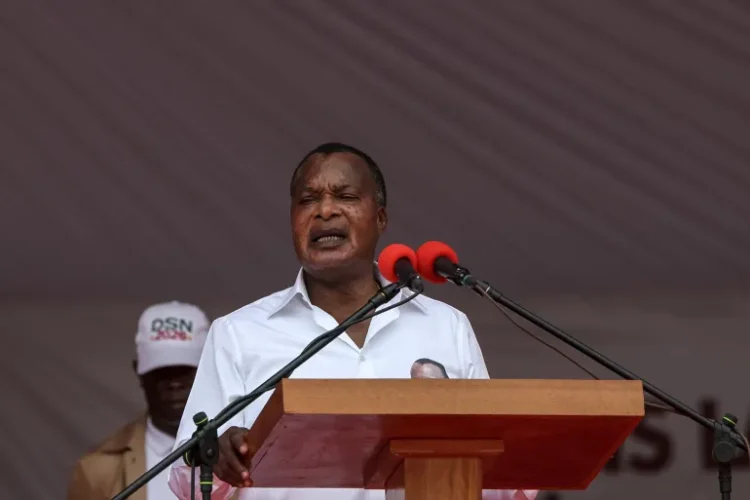
Voters across the Republic of Congo headed to polling stations Sunday in a presidential election widely expected to extend the rule of longtime leader Denis Sassou Nguesso, potentially pushing his grip on power beyond four decades and reinforcing one of the longest political tenures in modern Africa.
The vote comes at a pivotal moment for the Central African nation, where political continuity has long defined the state’s governance. If Sassou Nguesso secures another term, it would further cement a political legacy that began in 1979 and has shaped nearly every institution in the country, from the military to the ruling party’s dominance in parliament.

AD: Capeesh Restaurant
More than three million registered voters were eligible to cast ballots across hundreds of polling stations nationwide. Yet the election has attracted global attention not because of uncertainty over the result, but because many observers believe the outcome is largely predetermined.
The three million people from a population of 5.7 million are registered to vote in an election, which pits Sassou N’Guesso against six other candidates, none of whom is seen as having a realistic chance of winning the top job.
Two other major parties are boycotting the elections over allegations of unfair electoral practices.

AD: Oysterian Sea Food Restaurant And Bar
Voting stations opened at 7:00 a.m. local time and are to close at 6:00 p.m. (1700 GMT). Observers say voter turnout could reach a record low.
Opposition candidates have struggled to mount a strong national challenge against a leader whose influence has remained entrenched for decades.
The small field of rivals have attempted to rally voters around calls for economic reform and political renewal. However, analysts say the ruling party’s strong political machinery and decades of control over the country’s institutions place the incumbent in a commanding position.
The vote is widely expected to extend Sassou Nguesso’s rule and reinforce the continuity that has characterised Congolese politics for years.
Observers also note that the political climate leading up to the vote has been relatively subdued. Campaign rallies occurred in major cities like Brazzaville and Pointe-Noire, but the level of enthusiasm among the electorate has been mixed, particularly among younger voters who express skepticism about whether the election will produce meaningful change.
Few political figures in Africa have wielded influence as long as Sassou Nguesso. His leadership began during the Cold War when he first rose to power in 1979 after the death of President Marien Ngouabi. During that era, the country operated under a Marxist-leaning political system closely aligned with the Soviet bloc.
His rule continued until 1992, when the Republic of Congo briefly transitioned to multi-party democracy and Sassou Nguesso lost a competitive election, and his time out of office lasted only five years. In 1997, a violent civil war erupted between forces loyal to Sassou Nguesso and those supporting the sitting government. The conflict ultimately ended with his return to power, restoring his position at the helm of the state.
Since then, he has maintained authority through successive elections and constitutional reforms. Critics argue that key changes to the constitution removed term limits and age restrictions that might otherwise have prevented him from seeking additional terms.
Supporters, however, say the president’s long tenure has brought stability to a region often marked by political turbulence. They point to infrastructure projects, road development and investment in oil production as signs of progress achieved under his leadership.
Yet the country’s economic reality remains complex. Despite its oil wealth, large portions of the population live below the poverty line, and economic inequality remains widespread.
A report noted that while the Republic of Congo is one of Central Africa’s oil producers, many citizens continue to struggle with unemployment and limited access to economic opportunity. These economic concerns have become a central issue for voters, especially younger citizens who face uncertain job prospects.
Young Voters Weigh Stability Against Change
The generational divide is particularly visible in conversations across the country’s cities and university campuses. For many younger Congolese citizens, Sassou Nguesso’s presidency has defined their entire lives. Some voters say they have never experienced a different national leader.
This reality has shaped the tone of the election campaign. While the president’s supporters emphasize continuity and stability, critics argue that the country must open space for new leadership and stronger democratic institutions.
Opposition candidates have attempted to frame the election as a chance to reset the nation’s political trajectory. They have raised concerns about corruption, economic diversification and the need to expand political participation beyond the ruling elite.
Still, the structural challenges facing opposition movements remain significant. Limited funding, restricted media access and the dominant position of the ruling Congolese Labour Party have made it difficult for rivals to reach voters on the same scale as the incumbent administration.
It’s noted that despite these obstacles, some opposition supporters view participation in the election as an important symbolic step toward keeping democratic debate alive in the country’s political landscape.
International observers say the election also reflects broader debates unfolding across Africa. In recent years, several nations on the continent have confronted disputes over presidential term limits, constitutional amendments and the balance between stability and democratic renewal.
In the Republic of Congo, those questions carry particular weight because of the nation’s strategic and economic significance. Located in the Congo Basin one of the world’s largest rainforest regions the country plays an important role in environmental conservation, regional trade and energy production.
However, the immediate focus remains on the ballot boxes scattered across the country. As votes are counted and official results begin to emerge, many citizens are watching closely to see whether the election will simply reaffirm the political status quo or spark renewed debate about the future of leadership in the Republic of Congo.
Regardless of the outcome, the vote underscores a broader question facing the nation: how a country shaped by decades of one leader’s rule will navigate the expectations of a new generation seeking opportunity, representation, and a greater voice in its political destiny.
To many young Congolese, the political landscape is a reflection not of abstract ideology, but of lived experience an environment where power has been concentrated in the hands of a single individual and a small political elite for as long as they can remember.
This generational reality shapes not only perceptions of governance but also daily life, from access to education and employment to the ability to influence local and national decision-making.
Analysts suggest that bridging the gap between entrenched political structures and the aspirations of younger voters will be one of the most significant challenges facing the Republic of Congo in the years ahead.
Youth unemployment and limited access to higher education remain persistent issues, prompting many to question whether the continuity of leadership can genuinely address systemic economic inequalities.
At the same time, there is an increasing desire among younger citizens to see more participatory governance where community voices, civic organisations, and political opposition have meaningful influence on policy decisions.
Social media platforms, informal networks, and local initiatives have begun to serve as alternative spaces for political engagement, even when formal institutions remain largely controlled by the ruling party.
The current election, therefore, functions as more than a mere tally of ballots; it is a barometer of the broader societal currents at play in the country. While the outcome may reinforce existing power structures, it also casts a spotlight on the evolving expectations of a population that is increasingly educated, connected, and impatient for change.
The extent to which political leadership can adapt to these new demands or continue to resist them will likely shape not only the Republic of Congo’s domestic trajectory but also its position within the broader Central African region in the decades to come. The tension between continuity and change, between established authority and emergent voices, remains the defining question of this election and the period that follows it.

AD: Heritage And Restaurant Lounge Bar