
By Aaron Miller-
Violence has engulfed large swaths of Mexico after security forces killed Nemesio Rubén Oseguera Cervantes, the fugitive drug lord known as “El Mencho”, sparking one of the most dramatic escalations of the nation’s long war with organised crime.
The death of the leader of the powerful Jalisco New Generation Cartel (CJNG) has unleashed a wave of arson attacks, roadblocks and firefights that authorities in Mexico and abroad say could foreshadow a new and perhaps even deadlier phase of cartel violence.

AD: Capeesh Restaurant
Mexico’s Defence Ministry confirmed on Sunday that troops killed Oseguera long one of the country’s most wanted men during a military operation in Tapalpa, Jalisco.
The raid involved Special Forces units and was backed by U.S. intelligence, officials said, marking a significant blow to a cartel that federal authorities have described as among the most powerful criminal organisations in the country.
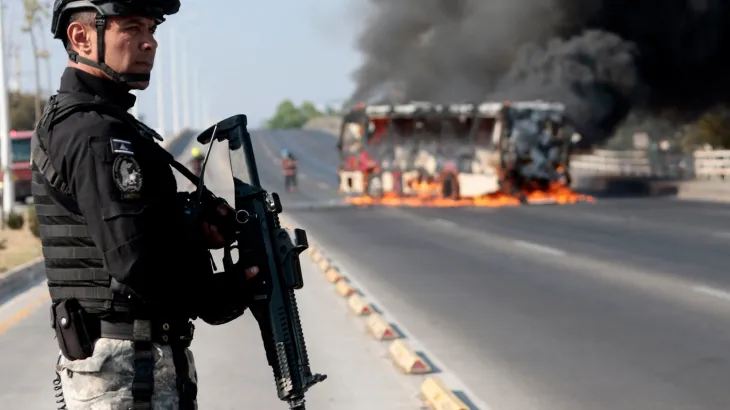
But within hours of the announcement, chaos broke out. Across multiple states, cartel gunmen set vehicles ablaze, blocked highways and battled with security forces.

AD: Oysterian Sea Food Restaurant And Bar
Tourist hubs such as Puerto Vallarta saw smoke rising over major thoroughfares, airlines cancelled flights, and foreign governments including those of the United States and Canada issued emergency travel advisories urging travellers to shelter in place.
The operation that led to El Mencho’s death was the culmination of months of high-stakes intelligence and coordination between Mexican forces and U.S. agencies.
According to a military statement, Oseguera and at least six of his associates were killed in an exchange of gunfire as forces attempted to arrest him. Two suspects were also detained, and authorities seized armoured vehicles, rocket launchers and a cache of weapons.
Oseguera, 59, had eluded capture for decades, cultivating a reputation for secrecy despite wielding enormous influence over drug trafficking routes that supply fentanyl, methamphetamine, heroin and cocaine into the United States.
The U.S. government had offered up to $15 million for information leading to his capture, and he was widely regarded as one of the most lucrative targets in the broader campaign against transnational organised crime.
But the celebration of his death was short-lived. Within hours, video and eyewitness reports showed torched buses and cars strewn across highways, checkpoints erected by armed men, and heavy gunfire echoing through urban centres.
In Jalisco state alone, officials reported more than a dozen fatalities in clashes between cartel gunmen and security forces. Other states including Guanajuato, Michoacán, Colima and Nayarit also reported violent unrest.
School closures, suspended public transport and widespread warnings for civilians to remain indoors added to the sense of crisis gripping multiple regions. In Guadalajara a sprawling metropolitan area and host city for the 2026 FIFA World Cup residents described scenes of “complete chaos” as smoke filled streets and emergency services struggled to respond to widespread attacks on infrastructure.
Foreign diplomatic missions cautioned their citizens to take precautions. The U.S. Embassy in Mexico City advised American travellers to avoid non-essential travel to states affected by violence and to monitor local news closely, following reports of coordinated retaliation by cartel factions.
Analysts said such a violent reaction was not unexpected. “The CJNG has built its power on fear and retaliation,” said a security expert based in Mexico City. “When you remove its central figure, you often see a violent backlash partly as a show of strength, and partly as various factions jockey for control.”
The Man Behind the Myth and Uncertain Future
Oseguera rose from modest beginnings in the western state of Michoacán to become head of the CJNG, a cartel that outgrew its rivals through ruthless violence and a sprawling criminal enterprise.
Despite being a former police officer, he amassed influence by expanding the cartel’s territorial reach and diversifying its operations from drug trafficking to extortion, kidnapping and oil theft. The group’s military-style tactics, including use of drones and improvised explosive devices, set it apart from other criminal organisations.
The CJNG’s footprint both in Mexico and abroad has grown in recent years. U.S. agencies have said that the cartel rivals the infamous Sinaloa cartel in terms of distribution networks and firepower, with ties stretching into every U.S. state.
Despite Oseguera’s prominence, cartel analysts caution that his death may not lead to a swift collapse of the organisation. “Cartel structures are deeply embedded,” said a Latin America security analyst. “Even the removal of a top leader doesn’t necessarily dismantle the network. In some cases, it opens the door to intensified conflict among emerging leaders or rival groups.”
That uncertainty was already visible on the ground. While news of his death spread, several CJNG cells appeared to operate independently, setting up roadblocks and attacking police and federal forces in a bid to assert influence and disrupt state authority.
In some communities, local residents expressed conflicting emotions relief at the removal of a feared figure, but fear that violence could worsen.
Mexican President Claudia Sheinbaum praised security forces for their role in the operation, describing Oseguera’s death as a “significant victory” in the ongoing battle against organised crime.
But she also acknowledged the immediate challenge of restoring order and protecting civilians caught in the crossfire. Federal authorities have mobilised additional troops and National Guard units to calm hotspots and assist with emergency response.
Some scholars argue that the cycle of decapitation operations where leaders are targeted for capture or killing can inadvertently fuel instability by fracturing cartels and triggering turf wars. This was seen in the past with other groups when leadership voids invited internecine conflict. Whether similar dynamics will unfold within the CJNG remains a central question for security analysts.
The immediate fallout from El Mencho’s death has reverberated beyond Mexico’s borders. In the United States, federal and state law enforcement agencies put their resources on heightened alert, with several states issuing advisories for communities near the southern border.
Mexican-American civic groups appealed for calm, urging authorities on both sides of the border to provide reassurances to residents.
Canada similarly warned its citizens to monitor developments, particularly travellers in resort regions affected by unrest. The coordinated international response underscored the broader geopolitical significance of Oseguera’s death, and the shared challenge posed by transnational organised crime.
Back in Mexico, economists and business leaders warned that prolonged instability could deepen economic disruptions, particularly in tourism-dependent regions already emerging from pandemic-era setbacks.
The media reported empty hotels in coastal cities, postponed cultural events and rising fear among local populations a reminder that cartel violence does not simply manifest in bullets but also in fear and economic paralysis.

AD: Heritage And Restaurant Lounge Bar