
By Kenneth Williams-
A deal has been reached between the company behind the Canvas educational platform and the hackers responsible for one of the largest cyberattacks ever to hit the education sector, according to statements released Tuesday by Instructure, the parent company of Canvas.
The agreement reportedly includes the deletion of vast amounts of stolen student and institutional data following a ransomware-style breach that disrupted schools and universities across several countries during final exam season.

AD: Capeesh Restaurant
The cyberattack, attributed to the notorious hacking group ShinyHunters, exposed sensitive information connected to nearly 9,000 educational institutions and potentially hundreds of millions of students, teachers, and school staff worldwide.
The breach forced temporary shutdowns of the widely used learning management platform and sparked alarm across schools already navigating a critical academic period marked by final assessments and graduation preparations.
Canvas is among the most heavily used digital learning systems in higher education, serving universities, colleges, and school districts in the United States, Canada, Australia, Europe, and other regions. The platform allows instructors to manage coursework, exams, grades, messaging, and online submissions, making it central to the daily operations of thousands of educational institutions.

AD: Oysterian Sea Food Restaurant And Bar
When the attack disrupted service last week, many students suddenly lost access to assignments, lecture materials, and testing systems during one of the busiest periods of the academic calendar.
Instructure said the agreement with the hackers resulted in the return of stolen data and digital evidence showing the files had been destroyed. The company stated it received what cybersecurity specialists refer to as “shred logs,” records intended to verify that copies of the stolen information were erased.
However, company officials acknowledged they cannot independently guarantee that every copy of the compromised data has been permanently deleted.
The company declined to disclose the terms of the agreement or confirm whether a ransom payment was made. Cybersecurity analysts familiar with ransomware negotiations said such arrangements often involve financial settlements, although organizations frequently avoid publicly acknowledging payments due to legal, ethical, and reputational concerns.
The hackers behind the breach, ShinyHunters, have been linked to several major cyberattacks in recent years involving technology companies, retailers, and large online platforms. In this case, the group claimed responsibility for stealing approximately 3.5 terabytes of information from Canvas systems and threatened to leak the data publicly unless negotiations occurred before a stated deadline in May.
Massive Education breach Raises Fears Over Student Data Strategy
The scale of the attack has triggered renewed concern over cybersecurity vulnerabilities within educational technology systems, especially as schools and universities increasingly rely on centralized online platforms to manage academic life.
Experts described the Canvas breach as unprecedented in both size and potential impact, with some researchers calling it one of the most significant education-related data compromises ever recorded.
According to Instructure and multiple cybersecurity reports, the compromised information included names, email addresses, student identification numbers, and private messages exchanged between students, teachers, and administrators. The company said there was no evidence that passwords, government identification numbers, birthdates, or financial data had been accessed.
The breach appears to have originated through vulnerabilities connected to Canvas’ “Free-for-Teacher” feature, a service designed to allow instructors and educators to test certain functions of the platform outside institutional accounts. Instructure has since disabled portions of that service while conducting forensic investigations and implementing additional security measures.
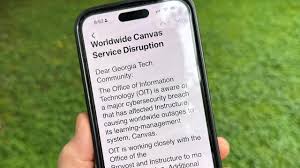
The cyberattack first became publicly visible when students logging into Canvas encountered ransom messages allegedly posted by ShinyHunters directly on the platform’s login pages.
In some cases, institutions temporarily disconnected Canvas from their internal systems to prevent further compromise, while others reverted to email, Microsoft Teams, or alternate online tools to continue classes and exams.
Universities across the United States, Australia, Canada, and parts of Europe reported disruptions. Some institutions delayed exams, extended assignment deadlines, or temporarily suspended online coursework altogether.
Students and faculty described confusion and frustration as systems became inaccessible during finals week, with some institutions warning users to remain alert for phishing scams or fraudulent emails connected to the breach.
Cybersecurity experts say educational institutions have increasingly become attractive targets for ransomware groups because they store large amounts of personal information while often operating with limited cybersecurity budgets compared to major corporations or government agencies.
Universities in particular manage extensive databases containing academic records, communications, financial information, and research materials, making them highly valuable targets for hackers seeking leverage.
The incident has also intensified debate over whether organizations should negotiate with cybercriminals at all. Some experts argue that paying or striking deals with hackers encourages future attacks and financially rewards criminal behaviour.
Others contend that organisations facing large-scale breaches involving sensitive personal information may feel compelled to negotiate if it reduces the likelihood of data being leaked publicly.
Federal authorities and cybersecurity agencies are continuing to investigate the breach, while lawmakers have already begun questioning how such a massive compromise could occur within one of the world’s largest educational technology systems.
It reported that members of Congress have requested testimony from Instructure executives regarding the company’s handling of the incident and its coordination with federal cybersecurity agencies, including the Cybersecurity and Infrastructure Security Agency.
Instructure CEO Steve Daly publicly apologized for the disruption caused by the attack, acknowledging frustration among students, educators, and institutions affected during the peak academic season. He said the company is working with external forensic experts and law enforcement while strengthening internal protections to prevent future incidents.
Despite the company’s assurances that the stolen files were destroyed, cybersecurity specialists caution that victims should remain vigilant. Experts note that once data has been exfiltrated by hackers, it is often impossible to independently verify whether all copies have truly been erased or whether portions may have already been distributed to other actors on dark web forums or private networks.
Privacy advocates have also raised concerns about the long-term implications of exposing student communications and institutional records. While the company insists that highly sensitive information such as passwords and financial records was not compromised, experts warn that even partial personal data can still be exploited for identity theft, phishing schemes, or targeted social engineering attacks.
The breach has highlighted the growing dependence of modern education systems on cloud-based platforms and the cascading effects that cyberattacks can have on daily academic operations. What began as a security incident quickly evolved into a broader disruption affecting coursework, examinations, grading systems, and communication between schools and students worldwide.
Educational institutions are now reviewing contingency plans and digital security policies in response to the incident. Some universities have announced independent assessments of their integrations with Canvas, while others are considering additional safeguards for student communications and institutional data storage.
Students and educators, the attack has served as a stark reminder of how deeply digital infrastructure now shapes modern education and how vulnerable those systems can become when targeted by sophisticated cybercriminal organisations. Although Canvas services have largely returned online, the broader fallout from the breach is likely to continue long after the immediate crisis subsides.
Investigations proceed and questions mount over the company’s decision to negotiate with hackers, the Canvas breach is expected to become a defining case in ongoing debates about ransomware, educational cybersecurity, and the responsibilities technology companies bear when entrusted with sensitive student data.

AD: Heritage And Restaurant Lounge Bar