
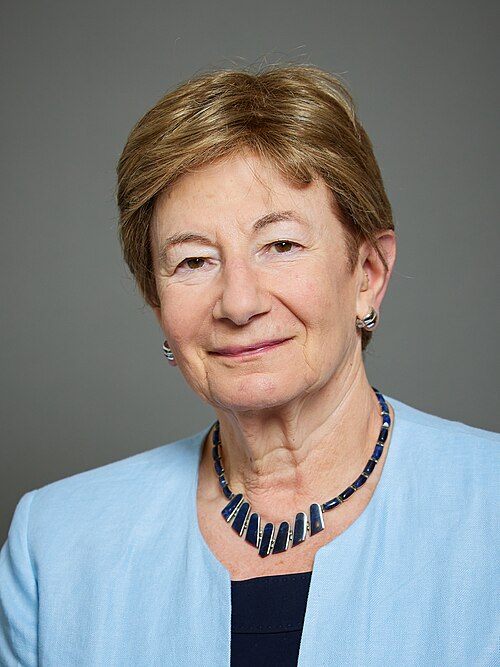
By Gabriel Princewill-
Lord peer, Baroness Deech, has been called upon by this publication to address the increasingly contentious debate surrounding academic freedom and free speech in light of the uproar caused by the invitation of race realist, Nathan Cofnas to give a talk at Oxford university. Few figures are better placed to contribute meaningfully to this debate than Baroness Deech, the distinguished barrister, academic lawyer and former senior Oxford University administrator. The controversy surrounding Dr Nathan Cofnas, whose views on race, intelligence and diversity, equity and inclusion have provoked considerable opposition, raises fundamental questions about the boundaries of lawful expression, institutional responsibility and the protection of intellectual freedom.
These are not questions that should be settled by public outrage, political pressure or the prevailing attitudes of university administrations. They require careful legal scrutiny, intellectual independence and a willingness to confront uncomfortable arguments. Baroness Deech possesses precisely the experience needed to help navigate this difficult terrain.

AD: Capeesh Restaurant
Her legal credentials are particularly relevant. Having been called to the Bar in 1967, Deech went on to establish a distinguished academic career in law at the University of Oxford, where she served as Principal of St Anne’s College from 1991 to 2004 and Pro-Vice-Chancellor between 2001 and 2004. She subsequently chaired the Bar Standards Board from 2009 to 2014 and served as a member of the Law Commission between 2018 and 2022. Crucially, she also became the first Independent Adjudicator for Higher Education, holding that position from 2004 to 2008. This combination of legal scholarship, regulatory experience and first-hand knowledge of university governance gives her an unusually comprehensive understanding of the competing obligations facing higher education institutions.
Her experience in equality matters is equally significant and should not be overlooked. Between 1990 and 1998, Deech was the initiator of Oxford University’s first Equal Opportunities Committee. This was an important contribution to the development of institutional equality policies at a time when such questions were becoming increasingly prominent in British higher education. She has therefore experienced the evolution of equality initiatives from within the university system itself. Her background makes her particularly well placed to understand both the legitimate objectives of equality policies and the dangers that arise when their implementation is allowed to compromise open intellectual discussion. Equality and freedom of expression should not be treated as inherently incompatible principles; the challenge is to establish a lawful and proportionate balance between them.
The Cofnas controversy illustrates why her highly esteemed position matters. His published arguments have attracted widespread condemnation, particularly his claims concerning racial differences and the implications of meritocracy. Many regard his positions as deeply offensive and fundamentally objectionable. Nevertheless, the offensiveness of an argument cannot, by itself, establish that its expression falls outside the protection of free speech. In October 2025, the University of Cambridge stated that a rigorous disciplinary inquiry had concluded that Cofnas’s published views, although considered offensive by many, had neither breached the law nor contravened university regulations designed to uphold freedom of speech. That finding deserves serious consideration, irrespective of whether one agrees with his arguments.

AD: Oysterian Sea Food Restaurant And Bar
This is precisely where the public discussion has frequently become confused. There is an important difference between defending someone’s right to express a controversial opinion and endorsing the substance of that opinion. Similarly, protecting academic freedom does not require universities to abandon their responsibilities towards students or tolerate unlawful harassment and discrimination. The challenge is to distinguish between speech that is objectionable, speech that is academically contentious and speech that actually crosses a legal threshold. Conflating these categories risks creating a climate in which institutional decisions are driven more by reputational anxiety and external pressure than by consistent legal principles.
Deech’s previous responsibilities make her especially qualified to examine this distinction. As Independent Adjudicator for Higher Education, she dealt with complaints from students across universities, while her experience at the Bar Standards Board required an understanding of professional independence, regulatory accountability and competing rights. Her legal background also equips her to recognise that difficult cases cannot be resolved through simplistic appeals to either unrestricted expression or absolute protection from offence. Both equality obligations and freedom of expression operate within a legal framework, and neither should be selectively invoked to silence legitimate disagreement.
The events surrounding Cofnas’s appearance at Oxford’s Oriel College in November 2026 have demonstrated how quickly these tensions can escalate. Protesters, institutional concerns and competing demands for inclusion and academic freedom have placed universities under considerable pressure. Yet a university’s responsibility is not to guarantee that every speaker is agreeable; it is to uphold lawful expression while maintaining an environment in which disagreement can be conducted safely and legitimately. Preventing disruption and protecting the rights of those wishing to attend an event are also essential components of that responsibility.
Baroness Deech should therefore be encouraged to address this issue publicly, not because she must defend Nathan Cofnas personally, but because the principles at stake extend far beyond one academic or one controversial lecture. Her experience gives her the authority to challenge misunderstandings, distinguish legal obligations from political preferences and explain why freedom of speech must remain meaningful even when the opinions expressed are unpopular. Indeed, her involvement would be particularly valuable precisely because the subject is so complex and frequently misunderstood.
The wider question is whether British universities can remain places of genuine intellectual inquiry if the expression of unpopular but lawful arguments becomes sufficient grounds for exclusion or professional sanction. Deech is exceptionally well placed to address that question. At a time when the difference between equality, academic freedom and censorship is becoming increasingly contested, the country needs voices capable of approaching the debate with legal precision, institutional experience and intellectual courage. Baroness Deech should be one of them.
The Conservative headquarters party was contacted for comment

AD: Heritage And Restaurant Lounge Bar