
By Tony O’Reilly And Lucy Caulkett-
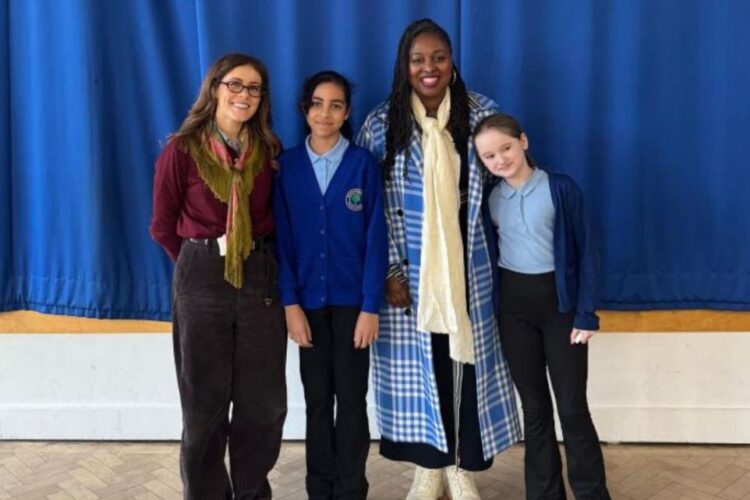
Budding journalists at an outstanding primary School in north-west London, Layan and Veronica conducted a thoughtful interview with Dawn Butler, the MP for Brent East, asking questions that ranged from the future of artificial intelligence to the realities of political leadership and whether she might one day run to become Mayor of London.
The meeting, held at the Dollis Hill school in North West London, marked a milestone for the school’s newly launched Gladstone Park News team, a pupil-led journalism initiative established earlier this year to give children first-hand experience in reporting, interviewing and digital storytelling.

AD: Capeesh Restaurant
The programme, formed in January, encourages pupils to research local issues, produce news updates about school life and create short video reports designed for social media platforms.
Layan and Veronica approached their task with a seriousness that would not have looked out of place in a professional newsroom. Their questions probed Ms Butler’s career highlights, her motivations in public life and her thoughts on emerging technologies shaping society.
The MP responded with candid reflections on her political journey, discussing the importance of perseverance, civic engagement and the responsibilities that come with representing a diverse London constituency.

AD: Oysterian Sea Food Restaurant And Bar
Pupils found the encounter both a learning exercise and an introduction to the democratic process. Their journalism training at the school includes lessons in writing clear news reports, conducting interviews, fact-checking information, and presenting stories through video and digital platforms. T
Their very committed teachers also guide pupils in understanding the ethics of journalism—encouraging them to ask fair questions, listen carefully and present information accurately.
The initiative reflects the school’s wider commitment to giving pupils opportunities beyond traditional classroom learning. As part of the programme, students collaborate to produce short news bulletins about school events, community projects and educational topics. Some pupils take on roles as presenters or camera operators, while others write scripts or edit footage for the school’s online channels.
Headteacher Laura Green said the visit provided an invaluable opportunity for pupils to practise those skills in a real-world setting.
“It was a real privilege to welcome Ms Butler to Gladstone Park and we would like to thank her for giving up her time to visit us,” she said.
“We were very proud of Layan and Veronica for conducting the interview with Ms Butler with such integrity, determination and respect, embodying our school’s core values.
“MP visits like this are so important because they help children to understand how their voices matter beyond the classroom. All our pupils were outstanding ambassadors for the school and we are immensely proud of them for making this visit such a success.”
”The Mps visit represented a chance to connect directly with young constituents and encourage their interest in civic life. During the conversation she spoke about the challenges and rewards of being an MP, highlighting the importance of listening to communities and advocating for fairness in public policy”.
Campaigning And Public Service
Butler’s political career has been shaped by a long record of campaigning and public service. Before entering Parliament, Butler worked in the trade union movement and the telecommunications sector. She was first elected to Parliament in 2005 as MP for Brent South, later serving as a minister under Prime Minister Gordon Brown. After losing her seat in 2010, she returned to Westminster in 2015 representing Brent Central and now serves as the MP for Brent East following constituency boundary changes.
Throughout her career, Butler has become known for her outspoken advocacy on issues such as racial equality, social justice and media representation. She has served as Shadow Women and Equalities Minister in the Labour Party and has frequently spoken out on the need to tackle discrimination and improve opportunities for marginalised communities.
Her willingness to challenge institutions has also drawn controversy at times. Butler has previously faced criticism from political opponents over comments made in parliamentary debates and public statements, particularly when she accused then-Prime Minister Boris Johnson of misleading Parliament during the Covid-19 pandemic.
The remark led to her being asked to withdraw the claim under parliamentary rules about language in the House of Commons. Supporters, however, praised her for raising concerns about political accountability and transparency.
Despite such controversies, Butler remains a prominent figure in Labour politics and a vocal advocate for community engagement. Her visit to the school reflected that emphasis on grassroots connections, offering pupils a glimpse into the realities of political life while encouraging them to think about their own ambitions.
During the interview, the pupils asked whether she would ever consider running for Mayor of London, a question that prompted laughter from those watching but also a thoughtful response. Butler explained that while she remains focused on her work in Parliament, leadership roles require dedication and vision—and that young people themselves should not be afraid to aspire to such positions in the future.
The conversation also turned to artificial intelligence, a topic increasingly shaping education, work and society. Butler told the students that while AI offers enormous possibilities, it must be used responsibly and ethically, with safeguards to ensure it benefits everyone rather than widening inequalities.
The visit also highlighted the wider educational environment at Gladstone Park Primary, which is part of Anthem Schools Trust. The school serves more than 660 pupils aged between three and eleven and is known for its diverse community, with a large proportion of students speaking English as an additional language. Many families come from a wide range of cultural and linguistic backgrounds, contributing to the vibrant atmosphere within the school.
Inspectors from Ofsted rated the school as “Good” in its most recent inspection, praising the quality of teaching and the supportive environment created by staff. The school has maintained that rating in successive inspections, reflecting consistent standards in teaching and leadership.
The education Inspectorate sad the school has an ambitious curriculum for most subjects is being implemented in all years. In history, pupils build up their knowledge through learning about the Romans, followed
by the Anglo-Saxons and then the Vikings in Britain.
The school is reputed for supporting pupils’ wider development is strong. They also benefit from after school clubs for pupils to join and a wide range of interesting visits planned throughout the year.
Academically, the school’s performance in national Key Stage 2 assessments also reflects strong outcomes compared with national averages. Recent statistics show that around 84 per cent of pupils achieved the expected standard in reading, 81 per cent in writing and 83 per cent in mathematics, with 76 per cent meeting the expected standard across all three subjects combined—significantly above the national average of around 62 per cent.
Such figures illustrate the school’s emphasis on academic achievement alongside creative learning opportunities like the journalism project. Staff say the combination of rigorous teaching and extracurricular initiatives helps cultivate both confidence and curiosity among pupils. The school also emphasises the importance of developing a love for reading amongst its pupils.
The school’s ethos also extends beyond pupils themselves to the wider community. Among those contributing to its activities is volunteer educator Ms Amanyar, who runs weekly English for Speakers of Other Languages classes for parents. The free sessions help families improve their language skills and engage more confidently with school life.
Currently around 20 parents attend the ESOL classes, with another 20 on a waiting list, highlighting the demand for such community support programmes.
David Hatchett, chief executive of the Anthem Schools Trust, said the MP’s visit showcased the positive work happening across the trust’s schools.
“We are delighted that Ms Butler visited Gladstone Park Primary School, giving the school the opportunity to showcase the fantastic work taking place every day in our classrooms,” he said.
“MP visits like this are a wonderful opportunity to celebrate the dedication of our staff and the enthusiasm and creativity of our pupils. We look forward to welcoming MPs and other dignitaries into all the schools in our trust, as we create ambitious and successful learning environments in which every child thrives.”
The event represented more than just a special school activity. for the pupils. It offered a rare opportunity to put their emerging reporting skills into practice with a national political figure.
Teachers say experiences like these help pupils develop confidence, communication skills and an understanding of how institutions work. By learning to research questions, listen carefully to answers and present information clearly, the children begin to appreciate the role journalism plays in society.
The highlight of the project may remain their first major interview for Layan and Veronica. Sitting across from a Member of Parliament and asking questions about leadership, ambition and the future was an experience few primary school pupils encounter.
As the cameras stopped recording and the notebooks closed, the two reporters had accomplished something remarkable; demonstrating that curiosity and confidence can flourish even at the earliest stages of education.
In a school committed to nurturing young voices, the message of the day was clear. Journalism is not just about telling stories—it is about asking questions, seeking truth and understanding the world beyond the classroom. And for the pupils of Gladstone Park Primary, that journey has already begun.

AD: Heritage And Restaurant Lounge Bar