
By Lucy Caulkett-
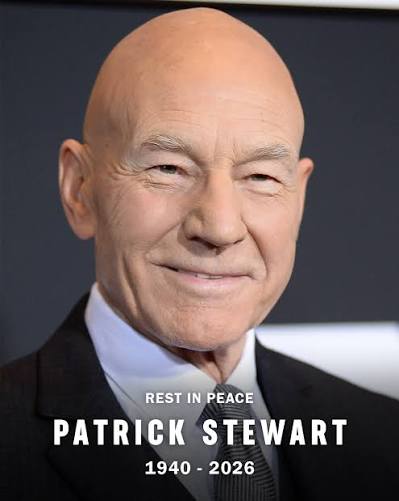
The entertainment world is united in mourning following the death of Sir Patrick Stewart, whose extraordinary six-decade acting career made him one of Britain’s most recognisable and internationally admired performers.
The celebrated actor, best known for portraying Captain Jean-Luc Picard in Star Trek and Professor Charles Xavier in the X-Men franchise, died aged 86 at his Los Angeles home on Wednesday, October 28. His death was announced by his family the following day, prompting an outpouring of tributes from fellow actors, filmmakers, entertainment institutions and admirers across the world.
Stewart’s death marks the passing of an actor whose influence extended far beyond the characters that brought him international fame. His distinctive, commanding voice, measured delivery and extraordinary ability to convey authority, vulnerability and compassion made him a performer of rare versatility.

AD: Capeesh Restaurant
Whether delivering Shakespearean dialogue on a theatre stage or commanding a futuristic starship, he possessed an unmistakable presence that could transform even the simplest exchange into a memorable moment. The tributes have been particularly heartfelt from colleagues who worked alongside him and witnessed the qualities that made him so admired.
Among the first to express his grief was Hugh Jackman, Stewart’s co-star in the X-Men films, who described him as one of the greats of stage and screen, as well as a tremendous friend. Jackman acknowledged the influence Stewart had on him personally, saying he had learned so much from the veteran performer and would miss him deeply.

AD: Oysterian Sea Food Restaurant And Bar
William Shatner, another towering figure in the Star Trek universe, also paid tribute, describing Stewart as a magnificent actor whose performances were characterised by intelligence, grace and humanity. Reflecting on the character of Captain Picard, Shatner suggested that the values audiences associated with the fictional commander were also evident in the man who portrayed him.
Jonathan Frakes, who played Commander William Riker alongside Stewart in Star Trek: The Next Generation, offered a deeply personal farewell, simply writing: “Rest in peace my friend.”
George Takei, another familiar face from the Star Trek universe, remembered Stewart as an irreplaceable figure whose portrayal of Picard inspired generations to imagine a more hopeful future for humanity. Marvel Studios also issued a tribute, recognising the extraordinary humanity he brought to Professor Charles Xavier and describing him as a singular talent and a true gentleman.
The tributes reveal something important about Stewart’s legacy: he was not simply an actor who became famous through two hugely successful franchises. He was a performer whose work gave emotional substance to characters that might otherwise have remained confined to the conventions of science fiction and superhero entertainment.
Born in Mirfield, West Yorkshire, in 1940, Stewart’s journey to international stardom was far from an overnight success. He developed his craft through years of dedication to theatre, eventually joining the prestigious Royal Shakespeare Company, where he established himself as a formidable classical performer.
His theatrical background was fundamental to what made him such a compelling screen actor. Stewart understood the importance of language, timing and emotional restraint. He could communicate authority without shouting, sadness without sentimentality and humour without sacrificing the dignity of a character. His performances carried the weight of an actor who had spent decades mastering his profession.
His Shakespearean credentials included celebrated interpretations of Macbeth, Othello, Prospero, Shylock and Mark Antony. He received two Laurence Olivier Awards, recognising his outstanding contributions to British theatre. His stage work was not merely a foundation for his television career; it remained an important part of his artistic identity throughout his life.
Yet it was television that would introduce him to millions.
In 1987, at the age of 47, Stewart was cast as Captain Jean-Luc Picard in Star Trek: The Next Generation. It was a decision that would change his life and help redefine the franchise.
Taking command of the USS Enterprise, Stewart created a character whose authority rested not on aggression or physical strength but on intelligence, diplomacy, integrity and an unwavering belief in the value of human life. Picard became one of television’s most recognisable fictional leaders. His thoughtful speeches, measured responses and memorable commands, including “Make it so”, became part of popular culture.
Over seven television seasons, Stewart established a remarkable relationship with audiences. He subsequently reprised the role in four feature films and returned to the character in Star Trek: Picard, which ran from 2020 to 2023.
What made Picard particularly enduring was the humanity Stewart brought to him. He portrayed a leader capable of making difficult decisions while remaining conscious of their consequences. In an era when television frequently celebrated action and spectacle, Stewart helped demonstrate that intelligence, compassion and moral courage could be equally compelling.
If Star Trek made Stewart a household name, the X-Men franchise introduced his talents to another generation. Cast as Professor Charles Xavier in the 2000 film X-Men, he brought dignity, warmth and philosophical depth to the wheelchair-using telepath who founded a school for mutants.
His interpretation of Xavier was central to the emotional foundation of the franchise. The character represented tolerance, peaceful coexistence and the possibility of overcoming prejudice, themes that gave the superhero films a significance beyond their action sequences.
His on-screen partnership with Hugh Jackman’s Wolverine became one of the franchise’s defining relationships. Their contrasting personalities created a compelling emotional dynamic, with Stewart’s Xavier offering guidance and compassion against Wolverine’s instinctive aggression.
His performance in Logan (2017) was particularly celebrated, presenting a vulnerable and ageing Professor X whose relationship with Wolverine took on a deeply affecting dimension. It demonstrated that Stewart could revisit an established character and discover new emotional territory. Marvel’s tribute also acknowledged his contribution to Avengers: Doomsday, in which he was due to reprise Professor X.
Why He Was A Legend
Stewart’s greatness lay in his ability to move effortlessly between apparently different acting worlds. He was equally comfortable with Shakespeare, science fiction, superhero cinema, comedy, television drama and voice acting.
His appearances in American Dad!, where he voiced CIA Deputy Director Avery Bullock, revealed a mischievous comic sensibility that contrasted delightfully with his usually authoritative screen persona. He also received Emmy nominations and a Tony nomination, alongside numerous other professional honours.
In 2010, he was knighted for services to drama, formal recognition of a career that had already secured an enduring place in British acting history. Away from entertainment, Stewart was also recognised for his humanitarian work, particularly his advocacy concerning domestic violence, human rights, refugees and animal welfare.
His 2023 memoir, Making It So, offered audiences further insight into his Yorkshire upbringing, professional struggles and remarkable journey to international recognition.
A Legacy That Will Endure
The loss for his family is deeply personal. His family announced that he had died following what they described as a brief and poignant journey with Alzheimer’s disease and Lewy body dementia. They remembered his final days as being surrounded by loved ones, music, prayers, tears and laughter.
The entertainment industry has lost an actor whose work helped shape modern popular culture.There will be other starship captains, superhero mentors and Shakespearean performers. But few will possess Stewart’s particular combination of theatrical authority, emotional intelligence, unmistakable voice and humanity.
His characters taught audiences about leadership, tolerance, courage and the importance of looking beyond differences. His career demonstrated that an actor need not abandon classical theatre to embrace popular entertainment, nor sacrifice artistic integrity to achieve international fame.
From the Yorkshire stages of his youth to the farthest reaches of the fictional universe, Sir Patrick Stewart travelled an extraordinary professional journey. The tributes pouring in are therefore about more than the death of a famous actor. They celebrate a man who made audiences think, laugh, reflect and believe in the better possibilities of humanity.
The final curtain has fallen, but the performances remain. And for millions who grew up listening to Captain Picard command the Enterprise or watching Professor X defend a world that feared him, Sir Patrick Stewart will always be remembered as one of the greats.