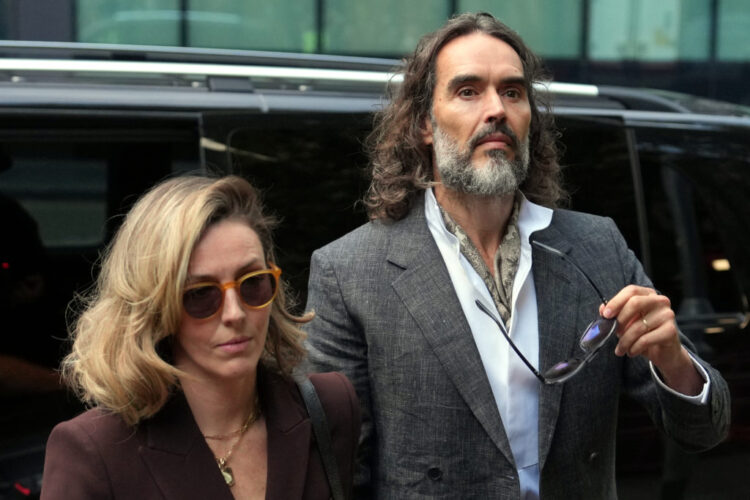
At Southwark Crown Court, Russell Brand’s defence of his sexual encounters has come under intense scrutiny, as prosecutors challenge his recollection of events and examine his own admissions about fame, persuasion and past behaviour.
Russell Brand’s appearance in the witness box at Southwark Crown Court on Wednesday marked a tense chapter in a trial that has placed his past relationships, public image and understanding of consent under the judicial spotlight. Standing stiffly with his hands clasped behind his back, the comedian began his evidence by firmly denying the allegations against him.

AD: Capeesh Restaurant
Yet as cross-examination progressed, the proceedings became increasingly focused on inconsistencies in his recollections and his acknowledgement that he had used his celebrity status to facilitate sexual encounters. The 51-year-old former entertainer denies three counts of rape, three counts of sexual assault and one count of attempted indecent assault relating to six women and alleged incidents between 1999 and 2009.
The allegations concern encounters said to have taken place in settings including a hotel room, a private residence, a bar toilet, a recording studio and a radio station corridor. Brand maintains that the sexual encounters in question were consensual.

AD: Oysterian Sea Food Restaurant And Bar
Fame and Influence
One of the most revealing aspects of Brand’s testimony was his admission that he had allowed his growing fame to play a role in his sexual relationships. Under questioning from prosecutor Riel Karmy-Jones KC, he acknowledged that his public standing had given him an advantage he had used selfishly.
“I was in a position of fame, a successful person who was admired and I misused the commodity very selfishly,” he told the jury, referring to his celebrity status.
Brand also described himself as having been persuasive, seductive and determined in his pursuit of women, characterising aspects of his earlier conduct as “beyond reckless philandering and idiocy”. He accepted that his increasing success had made him comfortable with fame facilitating sexual activity.
These admissions provided a significant point of examination for the prosecution. While Brand’s acknowledgement of behaviour he now considers wrong does not establish the criminal allegations against him, it places questions of influence, boundaries and consent at the centre of the case. The jury must consider whether the evidence relating to individual encounters supports the specific charges he denies.
The cross-examination became particularly pointed when Karmy-Jones challenged Brand over changes in his recollection of an alleged encounter in 2009. The prosecutor questioned why certain details, including the fact that he had stored a complainant’s telephone number with the code “T” for tart, had reportedly emerged eight months after earlier accounts.
Brand attributed the developing detail in his testimony to an increasingly intensive process of recollection. He described the trial as a deeply traumatic episode that had affected his marriage, children and health, while acknowledging that some details were inconsistent.
The prosecution’s challenge was not simply about whether Brand remembered an encounter. It was about why particular details appeared later and whether those changes could be reconciled with his previous statements. Karmy-Jones repeatedly questioned whether he was being selective in what he recalled.
Brand denied leaving a woman bleeding, in pain and distressed after the alleged incident at his home. He also rejected the suggestion that he had feigned an inability to remember another encounter from 1999 until police discovered topless photographs in the accuser’s storage unit.
Brand repeatedly insisted that consent was central to his understanding of sexual relationships, telling the court that “consent is more important than sex itself”. However, prosecutors challenged his descriptions of encounters that complainants allege involved rape or sexual assault.
In relation to an alleged encounter at a Bournemouth event, Brand said he believed there was at least a possibility of sex when a woman invited him to her hotel room. He described her as attractive, lively and engaging, but denied pushing her onto a bed and raping her.
He also denied allegations concerning an encounter in a Soho bar toilet in 2004. Brand said he had invited the woman into the toilet to fool around, maintaining that the encounter was consensual and rejecting claims of sexual assault. The contrasting accounts leave the court to examine not merely whether encounters occurred, but what happened during them and whether the complainants’ accounts are supported by the evidence.
The prosecution also drew attention to passages from Brand’s 2007 autobiography, My Booky Wook. One caption accompanying a childhood photograph described him pretending to be gay to attract girls. Brand denied the suggestion that such behaviour was intended to make women trust him.
Earlier in his evidence, he had also described the damaging consequences of a 2023 television documentary alleging sexual misconduct, claiming the resulting publicity had made it impossible to find witnesses willing to support his defence.
The trial continues at Southwark Crown Court.

AD: Heritage And Restaurant Lounge Bar