
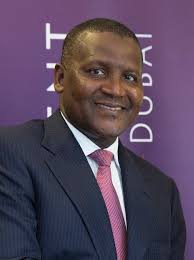
By Segun Ade
LAGOS, Nigeria — Africa’s richest man, Aliko Dangote, has opened the ownership of his giant Lagos refinery to the public in a landmark initial public offering that aims to raise $1.6 billion from investors across the continent.
Dangote announced the offering Monday, describing it as an IPO “for the people” and arguing that ordinary Nigerians and other African investors should have an opportunity to own part of an industrial project that has become one of the continent’s most important energy assets.

AD: Capeesh Restaurant
Retail investors can purchase shares in the Dangote refinery for 5,250 naira, or approximately $4, per share, with a minimum purchase of 10 shares. Dangote, however, will retain 87% ownership of the refinery, ensuring that the billionaire businessman remains firmly in control of the company even after the public offering. That combination makes the IPO both commercially ambitious and symbolically significant.
The offering represents an attempt to broaden participation in one of Nigeria’s most important private-sector industrial projects. For Dangote, it provides an opportunity to raise substantial capital while maintaining control of an asset that has already changed the country’s energy landscape.
The refinery, located near Lagos, cost approximately $19 billion to build and began production in 2024. With a capacity of 650,000 barrels per day, it is Africa’s largest refinery and has become a central part of Nigeria’s attempt to reduce its longstanding dependence on imported refined petroleum products.

AD: Oysterian Sea Food Restaurant And Bar
The significance of that transformation is difficult to overstate. Nigeria is one of Africa’s leading oil-producing countries, yet for decades it remained heavily dependent on foreign refineries because its own state-owned refining infrastructure suffered from years of inadequate maintenance, operational problems and underinvestment.
The paradox was striking because Nigeria could pump enormous quantities of crude oil from its reserves, but it frequently had to send that crude abroad for processing before importing refined fuel back into the country. Dangote’s refinery was built to challenge that model.
Its emergence as a major refining centre has given Nigeria the potential to become not merely an exporter of crude oil but a significant exporter of refined petroleum products. The refinery reached its full 650,000-barrel-per-day capacity earlier this year, reinforcing its position as the largest refining operation in Africa.
Dangote has even set his sights higher. The company announced plans last year to increase capacity to 1.4 million barrels per day. If that expansion is achieved, the refinery would surpass India’s Jamnagar refinery and potentially become the largest refinery in the world.
That ambition helps explain why investors are paying such close attention to the IPO.The refinery is not simply another company entering the stock market. It is an enormous industrial project at the centre of Nigeria’s energy ambitions, with the potential to influence fuel supplies, exports, foreign exchange flows and the country’s wider economic development.
The public offering has already generated excitement among retail investors.. Dangote’s name carries enormous weight in Nigeria and across Africa, where he has built one of the continent’s largest business empires. Dangote’s rise is itself part of the story.
Born into a wealthy Nigerian family, he built his business career around commodities before expanding into manufacturing, cement, food production, logistics and other major industries. Through Dangote Industries, he developed a conglomerate that became one of Africa’s most powerful privately controlled business groups.
His cement business has made the Dangote name particularly prominent across the continent, while his investments in manufacturing have supported his long-standing argument that Africa needs to develop more of its own industrial capacity instead of depending heavily on imported goods. The refinery represents the most ambitious expression of that philosophy.
Rather than simply exporting Nigeria’s crude resources, Dangote has invested billions of dollars in infrastructure intended to process those resources domestically and potentially sell finished petroleum products to international markets. The refinery’s success is therefore closely connected to a much larger Nigerian economic question: whether Africa’s most populous country can convert its enormous natural-resource wealth into domestic industrial capacity. The IPO now introduces another question.
Who will truly own the refinery? Dangote is promoting the offering as an opportunity for ordinary people to become shareholders in one of Africa’s most significant industrial assets. The minimum investment is deliberately accessible, allowing retail investors to participate without needing enormous amounts of capital.
Yet Dangote will continue to own 87% of the company.That has prompted criticism of the “people’s IPO” description.
Joachim McEbong, a senior West Africa analyst at Control Risks, questioned whether the offering could genuinely be described as people-driven when Dangote would continue to control the overwhelming majority of the refinery. His criticism highlights an important tension at the centre of the deal. Public ownership does not necessarily mean public control.
Retail investors may be able to buy shares, but Dangote’s retained stake will leave him with enormous influence over the company and its strategic direction. That concentration of ownership could become an important issue for investors as they consider the value of the shares and the extent to which minority shareholders will influence corporate decisions.
The refinery’s valuation is another major point of debate. The business is reportedly being valued at approximately $49 billion, more than twice the $19 billion cost of constructing the facility.
That valuation reflects the refinery’s enormous production capacity, strategic importance and potential future earnings, but it has also prompted questions about whether investors are being asked to buy into a business at an exceptionally ambitious price.
Officials connected with the refinery have rejected suggestions that the valuation is inflated. For investors, the question will ultimately be whether the refinery can generate sufficient long-term returns to justify its valuation. That question has become particularly important because the refinery is entering the public market at a time of heightened volatility in global energy markets.
Global oil prices have risen following the U.S.-Iran conflict, creating additional interest in energy-related investments. Higher oil prices can create opportunities for major energy companies, although refinery economics depend on a much broader combination of crude prices, refined-product prices, operating costs, demand and international competition.
The Dangote refinery also faces the broader challenge of operating in Nigeria’s complex economic environment. The project has already required enormous capital investment, while Nigeria continues to contend with inflation, currency volatility, infrastructure constraints and other economic pressures.
Nevertheless, the refinery’s scale gives it advantages that few African industrial projects can match. At full capacity, it can process 650,000 barrels of crude every day. That gives it the ability to supply a significant share of Nigeria’s domestic petroleum needs while also creating the possibility of exporting refined products to other African and international markets.
Nigeria’s inability to refine enough of its own crude oil for decades has represented one of the country’s great economic contradictions. The country possesses enormous oil resources, yet consumers have repeatedly depended on imported refined fuel. The Dangote refinery is designed to change that equation.
Its development also represents a broader shift in the African business landscape, where large private investors are increasingly attempting to build infrastructure traditionally associated with governments. Dangote’s project demonstrates the enormous financial capacity that can be mobilised by Africa’s wealthiest entrepreneurs when they pursue projects on a continental scale.
The public offering now takes that model one step further by inviting ordinary investors to participate financially in the project. Mohammed Saidu, head of research and investment analysis at Lagos-based TrustBanc, described the offering as potentially “game-changing” for Nigeria’s capital markets. He predicted that millions of new investors could enter the market through the IPO.
If that prediction proves correct, the consequences could extend well beyond Dangote’s refinery.A successful mass-market offering could encourage more Nigerian companies to consider public listings and

AD: Heritage And Restaurant Lounge Bar