
By Gabriel Princewill-
Britain resistance to assisted dying is not simply a refusal to recognise the suffering of the terminally ill. It reflects a deeper fear: once the law creates a right to assistance in dying, it may also create a precedent that future generations could widen — and a system that families, doctors or others might one day exploit.
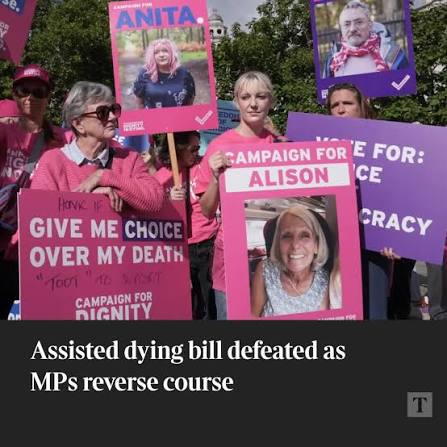
That is the uncomfortable divide at the heart of one of Parliament’s most consequential moral arguments which culminated in a decisive defeat against ardent supporters of the proposal becoming law. Supporters of assisted dying begin with a straightforward proposition. A mentally competent adult facing an incurable and terminal illness should have some control over how their life ends.

AD: Capeesh Restaurant
If medicine can no longer prevent death but can prolong suffering, forcing someone to endure the final stages of their illness against their wishes can itself amount to an injustice, according to strong supporters in favour of assistant dying. There is considerable force in that argument, but opponents are asking a different question.
They are asking whether the state can create a legal right to assisted death without creating new opportunities for pressure, coercion or exploitation- all of the aforemetioned factors of which constitutes considerations presently obstructing the implementation of an assistant dying law, and for logically plausible reasons too.
Other countries have crossed the line
Assisted dying is already lawful in countries including Canada, the Netherlands and Belgium, while different forms of medical assistance in dying operate in jurisdictions such as Oregon and Australia. Their existence undermines the argument that legalisation automatically produces an uncontrolled killing regime.

AD: Oysterian Sea Food Restaurant And Bar
The Netherlands, for example, has operated a regulated euthanasia system for decades. Doctors must satisfy statutory conditions, including establishing that a patient’s request is voluntary and well considered, that their suffering is unbearable and without prospect of improvement, and that there is no reasonable alternative. An independent doctor must also be consulted. the provisions sounds comprehensive and well thought out, but is not without its shortcomings.
The problem with the above surrounding caveats, is that it is impossible to guarantee that the required criteria cannot be perverted and manipulated by interested parties.
Oregon has permitted terminally ill adults to obtain medication for self-administration since 1997. Its latest official figures show that 400 people died under the law in 2025. The most commonly reported reasons included loss of autonomy, loss of the ability to participate in enjoyable activities and loss of dignity. Ninety-two per cent were receiving hospice care.
Those figures present a powerful challenge to opponents. People are genuinely suffering. Some genuinely want control over the final stage of their lives. And in countries where assisted dying is legal, there is no evidence of the wholesale abuse sometimes predicted before legalisation. But that does not settle Britain’s argument. Because the question is not whether assisted dying can be regulated. It is whether the safeguards will remain sufficient as the principle develops.
The precedent is the real concern
A law does not exist in isolation because parliament passes it, courts interpret it, governments amend it, and present ad future generations apply it.That is particularly important when the law establishes a new principle: that, in defined circumstances, deliberately assisting someone to die can be lawful. The question then becomes where the boundary lies.
The Netherlands provides an illustration of how different that boundary can be. Its legal framework is not confined simply to people with a fixed terminal prognosis. The central test concerns unbearable suffering with no prospect of improvement, subject to the statutory safeguards.
The Dutch system has therefore developed questions around euthanasia involving conditions including psychiatric illness, dementia and multiple age-related disorders. That does not make the Dutch approach wrong. But it demonstrates why Parliament should take the issue of precedent seriously. A law introduced in Britain for people with six months or less to live would establish one boundary.
A future Parliament could ask whether that boundary remains justified. That debate could be entirely legitimate, and could also become politically irresistible.Once society accepts that suffering can justify deliberately ending a person’s life, the argument over what constitutes sufficient suffering becomes considerably harder.
The danger may come from inside the family
There is another concern that deserves more attention than it sometimes receives is that of coercion. Coercion does not necessarily mean somebody ordering a vulnerable person to die, it can be subtle. IN scenarios where an elderly patient may know that their children are struggling to provide care, or a terminally ill person may worry about the cost of treatment., a person may believe they have become an emotional or financial burden.
Nobody will have to say: You should die, the conclusion may be reached prematurely by the person themselves and hasten their own death because of this discomfort. They may similarly be pressured into agreeing to assistant dying where family members conclude they have become to burdensome for them.
That is why the concept of a voluntary decision is so important — and so difficult. Canada’s framework, for example, requires that a request for medical assistance in dying be voluntary and not the result of external pressure. Detecting subtle pressure is not the same as writing a rule against it. A law approving assistant dying will inherently have to imply the voluntary choice of the patient; and this will not always be easy to ascertain.
Yet it would be wrong to suggest that concern about coercion settles the debate, because it does not. There are terminally ill people who make rational, settled and informed decisions about the end of their lives. They may have received palliative care. They may understand their prognosis completely. They may have discussed their decision repeatedly with medical professionals and family members.
They may simply believe that prolonging life is no longer in their interests, and for such people, the refusal to legalise assisted dying can itself appear coercive. The state is effectively saying: We accept your right to refuse treatment, but we do not accept your right to take the final step.
Advocates of assistant dying argue that autonomy should not disappear simply because a person is dying. And countries where assisted dying is legal provide evidence that regulated systems can operate without the apocalyptic consequences sometimes predicted. That evidence must be taken seriously.
Britain therefore faces two competing dangers
The first is denying choice to people who genuinely want it. The second is creating a legal mechanism that can be used, deliberately or inadvertently, against people who are vulnerable.Neither danger can simply be dismissed. A responsible British law would therefore need more than a signature and a medical assessment.
It would need rigorous tests of capacity and independent scrutiny of whether a request was genuinely voluntary. Professionals trained to recognise coercive control, domestic abuse and financial pressure, will also need to be actively involved in every case, but even they can make serious errors of judgement. Proper access to palliative care so that nobody chooses death because adequate care was unavailable.
A most important requirement would be a system capable of investigating suspicious cases rather than assuming that every apparently voluntary death was necessarily so.The principle should be simple: A person should never choose death because they have been made to believe that living has become an unacceptable burden.
That is where Britain’s caution has legitimacy, although the opposite principle is equally important. The case for assistant dying can be powerfully argued when we think that a dying person should not be denied autonomy merely because the law is afraid of what somebody else might do. That is where the case for assisted dying remains powerful.
The international experience does not provide a simple answer, but rather ,supplies competing evidence. It shows that assisted dying can be regulated and that the boundaries of such laws matter enormously. Britain therefore has a choice that is more complicated than simply following the Netherlands, Canada or Oregon — or rejecting them. t must decide what principle it wants its own law to embody.
Is assisted dying fundamentally about the individual’s right to control death? Or is it about the state’s duty to protect life when vulnerability makes genuine choice difficult to establish? Perhaps the answer has to be both. But if Parliament eventually crosses the line, it must understand that the line will not remain fixed forever.
The most important question is not whether Britain can give people a legal right to die. Other countries have already demonstrated that it can. The question is whether Britain can create that right without creating a precedent that future generations — or those closest to the vulnerable — can use in ways Parliament never intended. That is the legitimate fear behind Britain’s caution.And it is a fear that deserves to be confronted, not caricatured.
Countries which have legalised assisted dying have not adopted one uniform model. Their different approaches to eligibility, medical involvement and safeguards are precisely why the question of precedent and where Parliament draws the line is so important.

AD: Heritage And Restaurant Lounge Bar