
By Theodore Brown-
PLYMOUTH, Massachusetts — The line between courtroom drama and public spectacle has become sharply defined in the Lindsay Clancy murder trial: the jury is not part of the show.
Judge William Sullivan made that clear again on Wednesday after a 56-year-old woman was arrested outside the Plymouth courthouse and charged with aggravated intimidation of a juror, following allegations that she photographed or filmed jurors as they left the building.

AD: Capeesh Restaurant
Most significantly, Sullivan already had an order in place prohibiting anyone from photographing or filming members of the jury. The order was issued before the alleged incident and applies while the case is pending. It also bars conduct including following, contacting, harassing or tampering with jurors.
On Wednesday morning, as deliberations in the Clancy case entered a fifth day, Sullivan delivered a pointed warning to those inside the courtroom.
“Everybody should be well aware that the order and that statute is being enforced,” he said,

AD: Oysterian Sea Food Restaurant And Bar
The warning came hours after Dawn Light, of Sutton, Massachusetts, appeared in court and pleaded not guilty to a charge of aggravated intimidation of a juror or witness.
The timing could hardly have been more consequential. The 12 jurors deciding Clancy’s fate had already told Sullivan on Tuesday that, after hours of deliberation, they were unable to reach a unanimous decision. Rather than immediately ending their deliberations, the judge instructed them to continue trying. They returned Wednesday with the case still unresolved.
Against that backdrop, authorities say Light was discovered in a restricted area near the courthouse, sitting inside a vehicle positioned so that jurors could be seen as they exited the building.
Police say Light told officers she was waiting to see Lindsay Clancy leave the courthouse and denied that she had been filming people. But after consenting to a search of her cellphone, investigators initially found nothing relevant, prosecutors said. A subsequent examination of deleted material allegedly uncovered images or video of people leaving the courthouse who were later identified as jurors That allegation is at the centre of the prosecution’s case against Light.
Her lawyer, Jennifer White, offered a sharply different explanation in court. She said her client had wanted to photograph Clancy, not members of the jury, and described what happened as a misunderstanding. “This is a complete misunderstanding, Your Honour,” White said.
After the arraignment, Light was confronted by reporters gathered outside the courthouse. Asked why she wanted to see Clancy, she replied: “To see Lindsay.”
The exchange captures something of the extraordinary fascination surrounding the trial,-a case that has drawn national attention and a steady stream of spectators, supporters and journalists to Plymouth.The Clancy trial has been one of the most emotionally charged U.S cases in recent years.
Prosecutors say fascination cannot excuse conduct that threatens the integrity of a criminal proceeding. The charge Light faces is governed by Massachusetts General Laws Chapter 268, Section 13B, the state’s statute concerning intimidation of witnesses, jurors and people providing information in connection with criminal proceedings.
The law makes it a crime to wilfully or recklessly engage in specified conduct intended to impede, obstruct or interfere with a criminal proceeding, including conduct directed at protected jurors or witnesses. The aggravated form of the offence carries significantly greater potential punishment when the underlying proceeding involves a crime punishable by life imprisonment.
The Clancy case falls into that category because Clancy faces three murder charges carrying the possibility of life imprisonment if she is convicted. Prosecutors are pointing to the combination of circumstances: the alleged presence in a restricted location, the position of the vehicle, the alleged recording of jurors ,and the fact that a judicial order already prohibited.
. The fact the order was already part of the rules surrounding the high-profile proceedings. captures the legal problem facing Light. The purpose of the order was to erect a protective wall around jurors whose identities and movements have been shielded from the enormous public interest in the case.
On Wednesday, Sullivan went further than simply reminding the courtroom about the order. He questioned the jurors individually and privately about whether anything they had seen or experienced had affected their ability to remain impartial. The questions could not be heard by reporters or members of the public, and the judge did not disclose their answers. precaution underscores what is at stake.
The jurors have listened for more than three weeks to emotionally charged testimony about the deaths of Clancy’s three children, Cora, Dawson and Callan. They have heard competing medical assessments of Clancy’s mental health, including evidence about postpartum psychosis and other psychiatric problems.
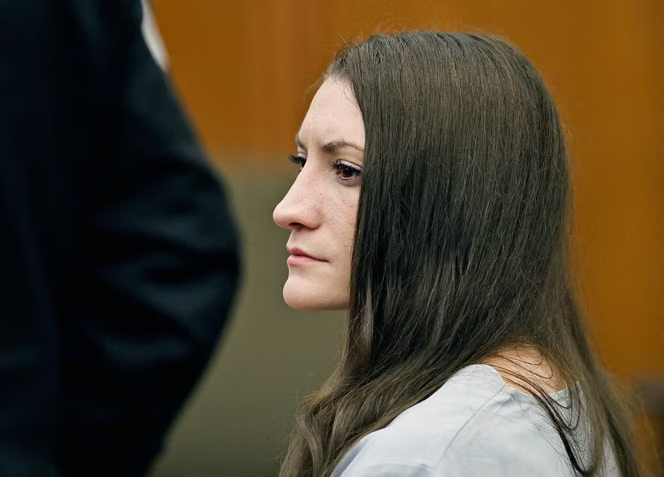
Clancy, 36, does not dispute that she strangled the children in January 2023. Her defence argues that she was suffering from a severe mental disorder and was not criminally responsible for her actions. Prosecutors have argued that despite her mental-health difficulties, she understood what she was doing and was criminally responsible.
The jury’s eventual decision could determine whether Clancy spends the rest of her life in prison, faces another form of criminal punishment or is found not criminally responsible because of mental illness. That makes the jury’s independence fundamental.
The panel has already signalled how difficult the decision has become. After four days of deliberation, jurors told Sullivan they could not reach a unanimous verdict. The judge asked them to keep working, and deliberations resumed for a fifth day. The alleged recording incident has therefore arrived at a moment when the court is already confronting the possibility of a deadlocked jury.
Light’s arrest does not automatically mean the Clancy trial will collapse. Sullivan’s private questioning of the jurors was aimed, at least in part, at determining whether the incident had affected their ability to remain impartial. The contents of those conversations have not been made public.
Meanwhile, Light has been released under strict conditions. Prosecutors sought $50,000 in cash bail. The request was denied. She has instead been ordered to stay away from the courthouse and from people connected with the Clancy proceedings, and restrictions have been imposed concerning the dissemination of photographs or video associated with the case. She is due back in court on October 15.

AD: Heritage And Restaurant Lounge Bar