
By Gavin Mackintosh-
Thousands of students across England, Wales and Northern Ireland are celebrating their GCSE results after a year of hard work, with this year’s figures showing a largely stable national picture, a small rise in the proportion achieving the highest grades and a narrowing gap between boys and girls.
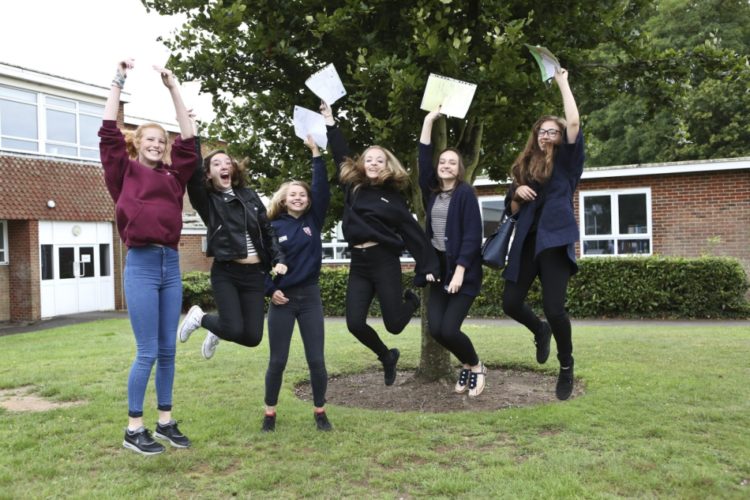
Results day on Thursday, August 20, brought scenes of excitement and relief at schools across the country as pupils collected the grades that will determine their next steps, whether that means staying on for A-levels, moving into vocational education, starting an apprenticeship or entering employment.

AD: Capeesh Restaurant
National figures published by the Joint Council for Qualifications show that 22.0% of GCSE entries across England, Wales and Northern Ireland received a grade 7 or above, equivalent to an A or A*, compared with 21.9% in 2025. The increase is small, but it means the proportion securing the highest grades remains above the 2019 pre-pandemic figure of 20.8%.
At the other end of the grading scale, however, the picture is less encouraging. The proportion of entries achieving at least a grade 4, generally regarded as a standard pass, slipped from 67.4% last year to 67.3% in 2026. That brings the overall pass rate back to approximately its pre-pandemic level and highlights the continuing difficulty some pupils face in securing the grades needed to progress. That said, a standard pass is still a pass, and therefore not as bad as may appear, considering the number of pupils not confident enough to participate in the GCSE exams every year.
The statistics for at least a pass, also includes students who attained a strong pass of grade 5, five of which would allow them to elevate their academic level to the A level course, which is quite rigorous. The statistics also include higher grades, like a 6, which is equivalent to a B grade, representing good, and the higher grades in the A bracket comprising 7, 8, and 9.

AD: Oysterian Sea Food Restaurant And Bar
The results also reveal a persistent difference between the performance of girls and boys, although the gap has narrowed to its smallest level in many years. Across the UK figures, 24.4% of girls’ GCSE entries achieved grade 7 or above, compared with 19.6% of boys’ entries. At grade 4 or above, the corresponding figures were 70.2% for girls and 64.4% for boys.
The narrowing gap is one of the most significant features of this year’s results. Girls continue to outperform boys overall, particularly in subjects such as English, but the difference is no longer as wide as it has been in previous years. In 2024, for example, 24.7% of girls’ entries achieved grades 7 to 9, compared with 19.0% of boys’ entries, producing a 5.7 percentage-point difference. This year’s top-grade gap is around 4.8 percentage points in the JCQ figures.
The overall statistics also conceal some striking differences between individual subjects. Boys continued to perform particularly strongly in mathematics, where almost one in four achieved grades 7 to 9. Girls, meanwhile, maintained an advantage in English. The mathematics results were especially notable, with 22.3% of entries achieving top grades, while the overall grade 4 pass rate stood at 57.2%, down from 58.2% in 2025. English language also saw its pass rate fall, from 59.7% last year to 59.5% this year.
The celebrations for many students will be accompanied by difficult decisions. Students who achieve the required grades will be able to move forward into sixth form, college, apprenticeships or other training, while those who fall short of the grade 4 threshold in English or maths may face another examination attempt.
The issue of resits has become one of the most contentious aspects of the GCSE system. In England, students who do not achieve a grade 4 in English and maths are generally required to continue studying those subjects after the age of 16. The latest figures show how difficult it can be for older students to improve their results. Among students aged 17 and over, pass rates were dramatically lower than those for 16-year-olds, prompting renewed calls for alternative qualifications and different routes to literacy and numeracy.
Education Secretary Lucy Powell has signalled plans to reform the system, arguing that some young people are being trapped in repeated GCSE resits without gaining qualifications that reflect their abilities or prepare them effectively for employment. The government is considering Level 1 “stepping-stone” qualifications in English and maths as an alternative pathway for some students.
Another major feature of this year’s results is the continuing regional divide. London recorded the strongest performance, with 28.6% of GCSE entries achieving grade 7 or above, compared with just 17.7% in the North East. The gap of 10.9 percentage points is the widest recorded since comparable regional data began in 2010.
The figures will inevitably fuel debate about educational inequality, particularly because regional differences often intersect with household income, school resources and wider social conditions. The West Midlands also performed below the national average, with 18.3% of entries achieving grade 7 or above and 62.4% achieving grade 4 or above.
Behind the national statistics are hundreds of thousands of individual stories. For students who opened envelopes or logged into results portals on Thursday morning, the numbers represent years of revision, uncertainty and anticipation. Some will be celebrating exceptional performances; others will be relieved simply to have secured the grades they needed. Preparing adequately for GCSE exams, even for the most capable, requires many months of flat out revision, with many students preparing well for the exams over a two year period.
This year’s GCSE results present a mixed picture. The proportion of top grades has edged upwards, girls remain ahead overall but the gender gap is narrowing, while the standard pass rate has slipped and major differences between regions remain entrenched. English and maths continue to pose particular challenges, especially for students required to resit them.
The immediate focus for successful students will be on what comes next. GCSE results remain an important milestone, but they are only the beginning of the next stage of education and working life. As schools celebrate their pupils’ achievements, this year’s figures also leave policymakers with a familiar challenge: how to ensure that success is not determined by gender, geography or a student’s ability to navigate a system that does not always provide an alternative route when conventional examinations prove difficult.

AD: Heritage And Restaurant Lounge Bar