
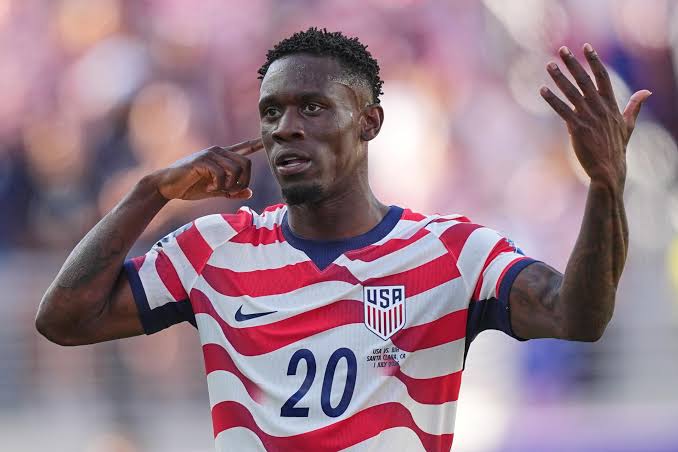
United States forward Folarin Balogun has been cleared to play in a critical knockout-stage match after FIFA lifted his one-game suspension following a controversial red card decision, a move that has triggered widespread debate over football governance, disciplinary consistency and potential external influence on the sport’s highest governing body.
The decision, announced just hours before the U.S. Men’s National Team’s Round of 16 match against Belgium, reverses what had been an automatic suspension for violent conduct during a group-stage victory over Bosnia and Herzegovina. Balogun had been shown a red card after a VAR review determined he had stepped on an opponent’s ankle during a challenge, which under normal FIFA disciplinary rules carries an automatic one-match ban.
However, FIFA’s disciplinary committee invoked Article 27 of its code, allowing for the suspension to be deferred under exceptional circumstances, effectively making Balogun available for selection while the red card remains on his record under a probationary framework.

AD: Capeesh Restaurant
According to reports, FIFA justified the decision by stating that its judicial bodies have discretion in cases where disciplinary measures may be adjusted or suspended, though such action is extremely rare during major tournaments. The ruling has immediately reshaped expectations for the United States team, which gains back its leading scorer at a crucial stage of the competition. Balogun has scored three goals in the tournament so far, establishing himself as one of the breakout performers of the World Cup.
His availability is seen as a major boost for a U.S. side attempting to reach its first quarterfinal since 2002. But the decision has also ignited a political and sporting controversy that extends far beyond the pitch. Reports from multiple outlets, indicate that the reversal followed direct communications between U.S. President Donald Trump and FIFA President Gianni Infantino, raising questions about whether external political pressure influenced the disciplinary outcome. FIFA has denied any improper influence, insisting that the ruling was made independently under existing regulations.
Belgium, the United States’ opponent in the upcoming knockout match, has reacted with strong criticism, describing the decision as inconsistent with established disciplinary standards. European football officials, including UEFA representatives, have also condemned the ruling, warning that it could undermine the credibility of tournament officiating and set a precedent for future disciplinary reversals during competition. UEFA has called the move “unjustifiable” and “incomprehensible,” according to reports.

AD: Oysterian Sea Food Restaurant And Bar
Under normal FIFA disciplinary regulations, a straight red card automatically results in a one-match suspension, with limited exceptions for appeals or increased sanctions. In Balogun’s case, however, FIFA’s judicial committee determined that Article 27 of the disciplinary code allowed for the suspension of enforcement in extraordinary circumstances, a provision rarely used at World Cup level.
FIFA officials concluded that the incident involving Balogun may have been influenced by VAR interpretation issues, particularly the use of slow-motion replay in assessing intent and severity.
This interpretation led the committee to suspend the enforcement of the automatic ban while placing the player under a one-year probationary period, meaning any further disciplinary infringement could reactivate the suspended punishment.
FIFA has maintained that its disciplinary committee acted within its authority and that the decision does not erase the red card from Balogun’s record. Instead, the sanction is effectively deferred, allowing the player to continue competing unless further infractions occur within the probation window. This legal distinction has become a central point of contention among football analysts, who argue that the ruling blurs the line between enforcement and discretion in tournament play.
Belgium’s football association reportedly attempted to challenge the decision, but FIFA’s appeal committee rejected the request on procedural grounds, stating that the opposing federation lacked standing to contest the ruling. This has further fuelled criticism from European officials, who argue that the decision process lacked transparency and undermined competitive fairness during a knockout-stage tournament.
The controversy has also reopened broader debates about VAR usage in disciplinary decisions, particularly the reliance on slow-motion replays that critics argue can distort intent and exaggerate contact. Supporters of the ruling, however, claim that FIFA’s intervention corrects an overly harsh interpretation of a challenge that was not malicious in nature.
The lifting of Balogun’s suspension has become one of the most debated decisions of the tournament, drawing reactions from governing bodies, coaches, players and political figures. It has led the criticism, calling the ruling “unprecedented” and warning that it risks damaging trust in football’s regulatory framework. European officials have argued that automatic suspensions exist precisely to prevent subjective interference in disciplinary outcomes.
UEFA strongly condemned FIFA’s decision to overturn Folarin Balogun’s one-match suspension, stating that the governing body had “crossed a red line” and warning that such intervention undermines the consistency required for fair competition in international football.
Football depends on the uniform application of rules and said that when disciplinary standards are applied inconsistently, the integrity of the game is placed at risk, with the organisation emphasising that decisions of this nature could create unequal treatment of players in similar situations. UEFA described the ruling as a breach of established disciplinary principles, stressing that automatic red-card suspensions are not meant to be discretionary and warning that altering sanctions during a tournament could damage confidence in officiating standards and the credibility of competition governance.
Meanwhile, reactions within the United States have been more supportive, with U.S. Soccer officials welcoming the ruling and emphasising that due process was followed. Players within the squad reportedly expressed surprise at the reversal but acknowledged that Balogun’s availability significantly strengthens their attacking options heading into a decisive knockout match.
Public reaction has been sharply divided. Some analysts view the decision as a pragmatic correction of an overly punitive red card, while others see it as evidence of inconsistent governance and potential political influence in football administration. The timing of the ruling, coming just hours before a high-stakes match, has intensified scrutiny and added to concerns about transparency in FIFA’s disciplinary procedures.
Despite the controversy, FIFA has defended the independence of its disciplinary committee and rejected claims of external pressure influencing the decision. The governing body has stated that its priority remains ensuring fair competition while applying its rules flexibly in exceptional circumstances.
The United States prepares for its match against Belgium, Balogun’s reinstatement shifts the sporting narrative back onto the field, where his performance is expected to play a decisive role.The debate surrounding his eligibility is likely to persist long after kickoff, with questions about precedent, fairness and governance now firmly attached to one of the most contentious disciplinary decisions of the tournament.

AD: Heritage And Restaurant Lounge Bar