
By Theodore Brown-
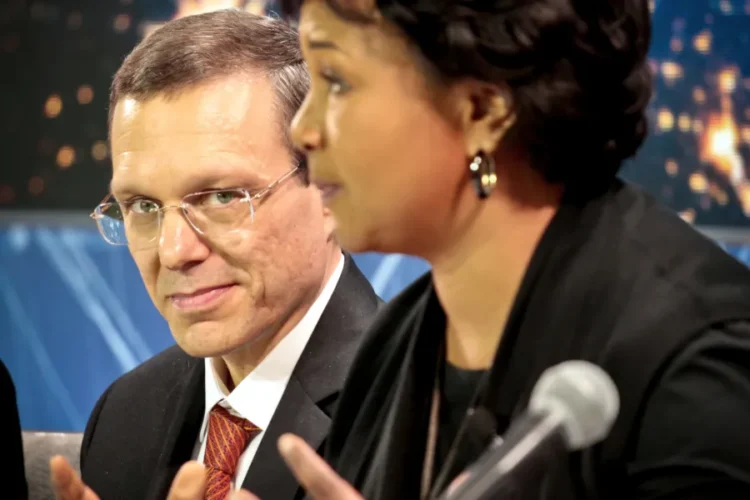
In a move that has stunned both scientific institutions and national security circles, the White House has appointed a controversial Harvard astrophysicist to lead a newly formed council dedicated to investigating unidentified anomalous phenomena (UAPs), commonly known as UFOs.
The decision, announced this week, marks one of the most high-profile government engagements with the UFO question in decades, blending rigorous defense oversight with a figure long associated with speculative ideas about extraterrestrial intelligence. The appointee, Harvard astronomer Avi Loeb, has built a career straddling the boundary between mainstream astrophysics and bold theoretical claims about interstellar objects potentially representing artificial technology.

AD: Capeesh Restaurant
According to reports, Loeb will now head a scientific advisory arm under a new White House-backed framework focused on UAPs and national security risks associated with unexplained aerial activity .
Officials say the council is not designed to confirm extraterrestrial life but to impose structure on how data about unexplained aerial sightings is collected, interpreted, and shared across agencies. Yet the symbolism of the appointment has already overshadowed its bureaucratic framing.
The White House initiative builds on years of growing institutional acknowledgement that UAPs deserve systematic investigation rather than dismissal. The Pentagon’s All-domain Anomaly Resolution Office (AARO), established in 2022, has been central to this shift, tasked with reviewing sightings across air, sea, and space domains for potential security threats or unknown technologies .

AD: Oysterian Sea Food Restaurant And Bar
Public fascination has intensified following multiple congressional hearings and successive waves of Pentagon declassification efforts that have brought decades of UAP reports into the public domain. While these releases have expanded the historical record of unexplained aerial sightings, official assessments including those from the Pentagon’s All-domain Anomaly Resolution Office have repeatedly stated that no verified evidence of extraterrestrial origin has been found.
Against this backdrop, Loeb’s appointment signals less a break from policy than an acceleration of an existing trajectory one where UFOs are treated as anomalies requiring analysis rather than ridicule or denial. Avi Loeb, a former chair of Harvard’s astronomy department and a leading theoretical astrophysicist known for his work on black holes and cosmology, has built a distinguished academic career at one of the world’s top institutions.
His public profile shifted significantly after he and colleagues proposed that the interstellar object ‘Oumuamua observed passing through the solar system in 2017 could represent an artificial object or “lightsail” of possible technological origin rather than a natural asteroid. This hypothesis generated intense scientific debate and criticism, while also propelling Loeb into broader public discourse on extraterrestrial possibilities.
That hypothesis, published through academic and public channels, triggered both fascination and criticism. While some colleagues praised his willingness to explore unconventional explanations, others accused him of stretching inference beyond available evidence.
Loeb has consistently argued that scientific progress often depends on entertaining unpopular possibilities long before they become provable. In recent years, he has expanded that argument into broader calls for systematic UAP observation networks, including sensor arrays and multi-instrument sky monitoring systems.
The scientific landscape around UAP research has also evolved. NASA has quietly increased its engagement with anomalous aerial data through independent study teams, acknowledging that while no confirmed extraterrestrial evidence exists, data quality and classification barriers remain persistent challenges . Within this shifting environment, Loeb’s appointment is being interpreted less as an endorsement of alien theories and more as a gamble on intellectual diversity in analysing ambiguous data.
Some defense analysts argue that elevating a figure known for speculative cosmology risks blurring the line between evidence-based analysis and theoretical extrapolation. One former intelligence official described the decision as “a symbolic gesture that may outpace the data itself.” Supporters of the theory counter that scientific breakthroughs often emerge from exactly this tension. They point to historical cases where initially fringe ideas continental drift, meteorite origins, or cosmic expansion were once dismissed before becoming foundational scientific knowledge.
Loeb himself has remained cautious in public remarks following his appointment. In a brief statement, he emphasised that “the goal is not to assume extraordinary conclusions, but to ensure extraordinary phenomena are not ignored due to institutional bias.”
The formation of the new council also reflects a broader political shift toward transparency in government handling of unidentified aerial phenomena. In recent years, bipartisan interest in the topic has surged, driven by military pilots’ testimonies, leaked sensor data, and growing public demand for disclosure.
This year alone, the United States released additional batches of UAP-related government files through official channels, including historical military reports and video documentation. While none confirmed extraterrestrial origins, the material reignited debate over unexplained flight behaviours and sensor limitations. A report on the most recent disclosures noted that the materials span decades of sightings but remain largely inconclusive, with analysts divided between labelling them as atmospheric anomalies, classified technology, or sensor artifacts .
Meanwhile, congressional hearings and public forums have increasingly treated UAPs as legitimate topics of national security discussion rather than fringe speculation. A recent high-profile gathering of policymakers and whistleblowers in Washington underscored the growing normalisation of the issue in political discourse .
The new White House council is expected to coordinate with existing defense structures such as AARO, NASA research initiatives, and intelligence agencies to consolidate fragmented datasets. Officials have described it as a “coordination mechanism rather than a conclusion engine,” emphasizsng process over interpretation.
However, even this procedural framing cannot fully contain public imagination. Online communities, media commentators, and advocacy groups have already begun interpreting the appointment as a potential turning point in the decades-long UFO debate.
Loeb’s involvement adds further complexity. While he has repeatedly stated that no verified evidence of extraterrestrial visitation exists, he has also argued that the scientific community should remain open to investigating unexplained signals without prejudice. His research group has proposed global sensor networks capable of capturing high-resolution, multi-modal atmospheric data for future analysis.
Some scientists see this as a constructive expansion of observational capability. Others worry it risks channelling resources toward low-probability hypotheses at the expense of more grounded astrophysical research. The institutional direction is clear that unidentified aerial phenomena are no longer being treated as purely speculative curiosities. Instead, they are being folded into the broader ecosystem of national defence, aerospace monitoring, and scientific inquiry.
One senior policy adviser summarised, the goal is not to answer whether we are alone in the universe, but to ensure that anything operating in our skies known or unknown is accounted for with clarity and rigour. The skies themselves have not changed but the institutions observing them, and the people tasked with interpreting what they reveal, are now under a level of public scrutiny that feels both intensified and inescapably visible.

AD: Heritage And Restaurant Lounge Bar