
By Kenneth Williams-
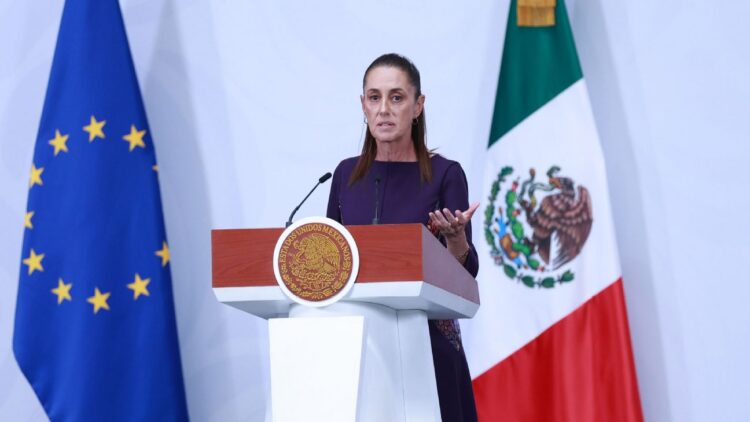
Mexican President Claudia Sheinbaum has said her government sees “no issue” with hosting Iran’s national football team during the 2026 FIFA World Cup, after the squad’s planned training base in the United States was shifted to Mexico amid growing geopolitical tensions surrounding the tournament.
The decision places Mexico at the center of an increasingly delicate diplomatic and sporting debate as preparations intensify for the first men’s World Cup jointly hosted by the United States, Mexico and Canada.

AD: Capeesh Restaurant
While Iran’s national team is still scheduled to play all three of its group-stage matches on U.S. soil, the squad will now reportedly stay and train in the Mexican border city of Tijuana rather than in Arizona, as originally planned.
Speaking during a press conference in Mexico City on Monday, Sheinbaum said FIFA had approached her government after U.S. authorities expressed reluctance to allow the Iranian team to remain in the country between matches. According to Sheinbaum, FIFA asked whether the delegation could instead stay overnight in Mexico during the competition.
“And we said, ‘Yes, no problem. We have no issue with that,’” the president said, according to reports from Reuters and the Associated Press.

AD: Oysterian Sea Food Restaurant And Bar
The arrangement highlights the complicated political backdrop facing the 2026 tournament, which is expected to become the largest World Cup in history, featuring 48 teams and matches spread across North America.
Iran’s participation has attracted intense scrutiny in recent months because of worsening relations between Tehran and Washington following renewed military conflict involving Iran, Israel and the United States earlier this year.
Iran’s football federation confirmed over the weekend that the team’s World Cup base camp had been moved from the United States to Mexico. Officials cited logistical concerns, visa complications and security considerations as major reasons behind the decision.
The Iranian squad is expected to stay in Tijuana, a city directly on the U.S.-Mexico border that offers easier travel access to Los Angeles and Seattle, where Iran’s group-stage matches are scheduled to take place. The team will reportedly use facilities connected to Club Tijuana, known as Xolos, while based near Estadio Caliente.
Iran is set to face New Zealand in Inglewood, California, on June 15, Belgium on June 21, also in the Los Angeles area, and Egypt in Seattle on June 26. Despite all matches being held inside the United States, Mexico’s role in hosting the team off the field is likely to become one of the most politically sensitive issues surrounding the tournament.
FIFA Faces Diplomatic Balancing Act
FIFA now finds itself navigating one of the most complex geopolitical situations in recent World Cup history. The governing body has repeatedly emphasised that football should remain politically neutral, yet international tensions have increasingly intersected with global sporting events.
Iran had previously sought assurances from FIFA regarding visas, travel access and security arrangements for players, coaches and officials traveling to North America for the tournament. Earlier this month, Iranian Football Federation president Mehdi Taj said his organisation would meet FIFA officials to discuss guarantees related to the team’s participation.
Concerns escalated after reports emerged that some Iranian officials faced difficulties obtaining visas to attend FIFA-related meetings in North America. One Iranian delegation was reportedly unable to participate in a pre-World Cup event in Canada because of travel complications.
Although the U.S. State Department has publicly stated that Iranian participation in the tournament remains welcome, American officials have so far avoided directly commenting on the accommodation dispute described by Mexican authorities.
The situation has fueled broader questions about whether geopolitics could disrupt the tournament itself. Earlier this year, Iranian officials reportedly explored the possibility of relocating some of the team’s World Cup matches from the United States to Mexico because of security fears and diplomatic uncertainty. FIFA ultimately rejected those proposals, insisting that the competition schedule would remain unchanged.
With Mexico, agreeing to host the Iranian squad reflects both practical and diplomatic considerations. Sheinbaum’s government has sought to position the country as a reliable and cooperative World Cup partner while also maintaining Mexico’s longstanding foreign policy tradition of engagement rather than exclusion.
Political analysts say the move also allows Mexico to project itself as a stabilising regional actor at a time when tensions between Washington and Tehran continue to shape international headlines.
Mexico has historically maintained more open diplomatic channels with Iran than the United States has, and officials in Mexico City appear eager to avoid becoming embroiled in broader geopolitical disputes linked to the tournament.
Security experts warn that hosting Iran’s team could create logistical and diplomatic challenges for tournament organisers. Border crossings, transportation arrangements and protection protocols may require additional coordination between Mexican and U.S. authorities throughout the competition.
The issue has also raised concerns among some American lawmakers and commentators who argue that the United States should impose stricter conditions on delegations connected to governments under sanctions or involved in ongoing conflicts. Others, however, argue that excluding teams or limiting participation would undermine the integrity of international sport.
World Cup Preparations Continue Amid Uncertainty
Despite the controversy, preparations for the 2026 World Cup continue at full pace across North America. Mexico is set to host matches in Mexico City, Guadalajara and Monterrey, while the United States will stage the majority of games, including the final. Canada will host matches in Toronto and Vancouver.
Mexico City’s iconic Estadio Azteca is expected to become the first stadium in history to host matches in three separate men’s World Cups, further elevating Mexico’s role in the tournament. Officials have invested heavily in infrastructure, transport and security planning ahead of the month-long competition.
However, organisers are increasingly confronting challenges that extend far beyond football. Immigration policies, border security, diplomatic tensions and political unrest have all emerged as potential flashpoints before a single ball has been kicked.
The Iran accommodation dispute is only the latest issue to test coordination between the three host nations. Earlier this month, Sheinbaum also faced pressure from teachers’ unions threatening strikes that could disrupt transportation and public services during the tournament period.
Meanwhile, FIFA continues to face questions about how global conflicts could affect players, fans and national delegations traveling across borders during the event. The tournament’s unique multinational format means teams, supporters and officials will regularly move between countries with differing visa systems, security policies and political considerations.
Iran’s team has already begun preparations in Turkey, where players are training while also processing visa paperwork for entry into North America. Iranian officials say the Mexico arrangement should simplify travel logistics and reduce uncertainty surrounding the squad’s stay during the competition.
Mexican officials insist the decision to host Iran’s team should not be viewed through a political lens. Sheinbaum has framed the issue as a straightforward matter of hospitality and tournament cooperation, arguing that Mexico had no reason to deny FIFA’s request.
Whether that stance remains uncontested in the months leading up to kickoff may depend on how relations between Tehran and Washington evolve. Though, Mexico appears ready to provide Iran with a temporary football home even as political tensions continue to shadow the world’s biggest sporting event.

AD: Heritage And Restaurant Lounge Bar