
By Tim Parsons-
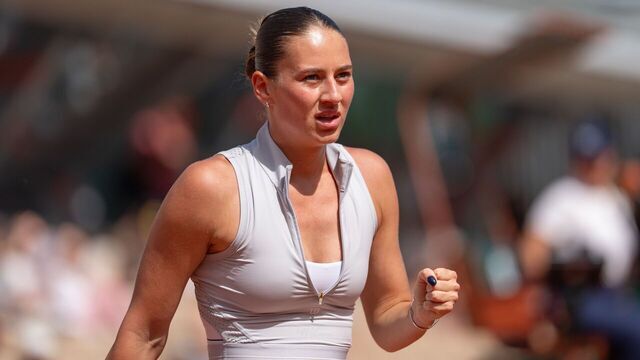
Ukrainian tennis star Marta Kostyuk battled through emotion and personal anguish at Roland Garros on Sunday, advancing to the second round of the French Open just hours after learning that a Russian missile strike had landed dangerously close to her family home in Kyiv.
The 23-year-old defeated Spain’s Oksana Selekhmeteva 6-2, 6-3 on Court Simonne-Mathieu in Paris, but the result became secondary to the deeply personal trauma she carried onto the court. Kostyuk later revealed that a missile had struck roughly 100 meters from her parents’ home during a wave of attacks across Ukraine, leaving her shaken before one of the year’s biggest matches. (AP News)

AD: Capeesh Restaurant
According to reports , Kostyuk’s mother, sister and elderly relatives were inside the area during the attack but escaped unharmed. The Ukrainian player said she spent much of the morning crying after receiving photographs showing the destruction near her family’s apartment building.When Kostyuk walked onto the red clay at Roland Garros, she appeared composed outwardly, but emotion surfaced immediately after the final point. Fighting back tears during her on-court interview, she described the psychological toll of competing while worrying about loved ones living in an active war zone. “This was one of the toughest matches I’ve ever had to play,” Kostyuk said afterward.
The emotional moment became one of the defining scenes from the opening day of the French Open, overshadowing many of the tournament’s early storylines.While temperatures in Paris climbed above 30 degrees Celsius and top players including Novak Djokovic and Alexander Zverev advanced comfortably, much of the attention shifted toward Kostyuk’s post-match remarks and the ongoing war that continues to affect Ukrainian athletes competing internationally.
Kostyuk has become one of the most outspoken voices in tennis regarding Russia’s invasion of Ukraine. Since the war began in 2022, she and fellow Ukrainian players including Elina Svitolina and Lesia Tsurenko have repeatedly used major tournaments to draw attention to the conflict and criticize the international sports community’s response.

AD: Oysterian Sea Food Restaurant And Bar
At Roland Garros, Kostyuk again refused to participate in the traditional post-match handshake with her opponent, a stance she has consistently maintained against Russian and Belarusian players or athletes with ties to those nations. Selekhmeteva, though representing Spain in Paris, was born in Russia and previously competed under the Russian flag.
The war’s emotional weight was visible throughout Kostyuk’s press conference. At one point, she reportedly displayed photographs on her phone showing the damaged residential building near her family’s home. Journalists inside the media room described a visibly distressed athlete struggling to balance professional obligations with fears for her family’s safety.
Kostyuk’s performance in Paris came during the strongest stretch of her professional career. The Ukrainian entered the French Open riding a 13-match clay-court winning streak after capturing titles in Rouen and Madrid earlier this spring.
Her breakthrough victory at the 2026 Madrid Open elevated her into the top 15 of the WTA rankings and reinforced her emergence as one of the most dangerous players on clay courts entering Roland Garros.
Yet the war has repeatedly interrupted moments of sporting success for Ukrainian athletes. Nearly every tournament appearance carries emotional complications tied to events unfolding thousands of miles away. Air raid alerts, missile strikes and fears for relatives back home have become part of the psychological burden many Ukrainian competitors now navigate daily.
Kostyuk acknowledged after Sunday’s match that she briefly struggled to focus once she learned details of the attack in Kyiv. She said she felt physically ill before taking the court but never seriously considered withdrawing from the tournament.
The attack near her family home formed part of another large-scale Russian missile and drone assault targeting Ukrainian cities over the weekend.
Ukrainian officials said multiple civilians were killed and dozens injured nationwide as air defense systems attempted to intercept incoming strikes. International leaders condemned the attacks, which occurred amid continued deadlock in diplomatic efforts to end the war.
For Ukrainian athletes abroad, such developments often create a painful emotional disconnect. Many continue competing on the international stage while simultaneously monitoring emergency updates from home.
Kostyuk said the constant anxiety has changed the way Ukrainian players experience professional tennis. The normal rhythms of training, travel and competition are frequently interrupted by concerns over whether family members remain safe. “There is never really peace mentally,” she said in comments reported.
Her resilience Sunday resonated strongly with spectators inside Roland Garros. Fans applauded warmly as she exited the court, while social media quickly filled with messages of support from tennis followers and fellow athletes around the world.
The French Open itself has increasingly become a politically sensitive environment since the start of the war. Tournament organizers have repeatedly faced scrutiny over participation rules involving Russian and Belarusian players, while Ukrainian competitors have used press conferences and interviews to keep attention focused on the conflict.
Kostyuk has often been central to those discussions. Earlier in her career, she drew headlines for calling on tennis governing bodies to adopt stronger positions regarding Russian participation in international events. While sanctions and flag restrictions were introduced, Ukrainian players have continued arguing that the sport’s response has not gone far enough.
Despite the emotional strain, Kostyuk’s tennis continues improving dramatically. Her aggressive baseline game and athletic movement have made her one of the breakout performers of the 2026 season. Analysts entering Roland Garros identified her as a potential dark-horse contender capable of making a deep run on clay.
Her opening-round victory demonstrated both her form and her mental endurance. Even amid immense emotional distraction, she controlled the match confidently, winning in straight sets in just over an hour.
Kostyuk’s appearance at the French Open represented something larger than sport. Athletes from Ukraine have increasingly become international symbols of resilience during the war, carrying the emotional weight of national representation far beyond competition itself.
Kostyuk has embraced that responsibility, frequently speaking about the importance of keeping global attention on Ukraine even as the conflict enters its fourth year.
She acknowledged Sunday that international focus on the war has diminished over time, a reality she described as frustrating and painful for Ukrainians watching the destruction continue daily.
The visibility of Grand Slam tournaments gives players like Kostyuk one of the world’s largest sporting platforms. Every press conference, interview and televised match becomes an opportunity to remind international audiences that the war remains ongoing. That burden, however, comes with emotional cost.
Kostyuk admitted she felt overwhelmed before the match after seeing images from Kyiv and speaking with family members. Yet she said the resilience shown by Ukrainians living through the conflict inspired her to continue competing despite the emotional exhaustion.
Her determination reflected a broader pattern among Ukrainian athletes who have continued appearing at global events while their homeland remains under attack. Whether in tennis, boxing, soccer or the Olympics, many have framed competition itself as an act of national defiance.
Sunday’s scenes in Paris illustrated that intersection powerfully. One moment featured the familiar rituals of elite tennis roaring crowds, clay-court rallies and Grand Slam pressure. The next involved a young athlete fighting tears while discussing missile strikes near her childhood home. Kostyuk now advances to the second round carrying both momentum and emotional weight. Her pursuit of a major title remains alive, but so too does the reality waiting beyond the stadium gates and television cameras.
A few hours in Paris, tennis provided temporary escape. But as Kostyuk made painfully clear Sunday, the war in Ukraine is never truly far away.

AD: Heritage And Restaurant Lounge Bar