
By Theodore Brown-
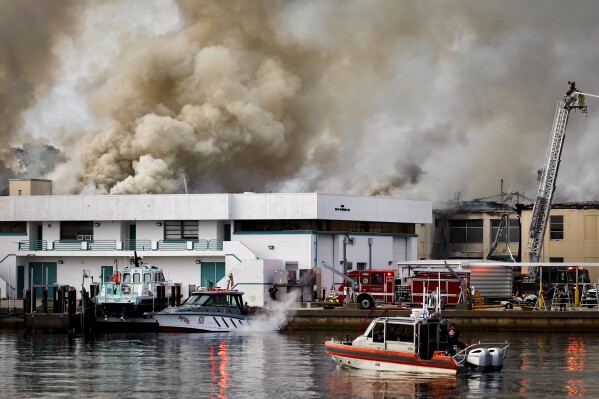
A devastating fire tore through a laboratory building at the University of South Florida, leaving the facility largely destroyed and forcing emergency evacuations as thick plumes of smoke rose over the campus.
The blaze, which broke out on Saturday evening at the university’s St. Petersburg campus, is now under investigation as officials begin assessing the scale of damage and its impact on scientific research and academic operations.

AD: Capeesh Restaurant
Authorities say firefighters worked through the night to contain the flames, which engulfed the marine science laboratory building and may have rendered it a total loss. No injuries were reported, and officials confirmed that no hazardous materials were released during the incident, alleviating immediate public safety concerns.
The fire prompted swift evacuations as emergency alerts warned people to avoid the area. Witnesses described dramatic scenes, with towering smoke visible for miles and flames consuming sections of the ageing structure. Fire crews from dozens of units responded, underscoring the severity of the incident and the challenge of bringing it under control.
University President Moez Limayem said the full extent of the destruction is still being evaluated, but early indications point to significant losses. Recovery teams are now working alongside the College of Marine Science to identify critical research materials that may still be salvaged once the site is deemed safe.

AD: Oysterian Sea Food Restaurant And Bar
The destroyed facility housed advanced marine science research, and its loss is expected to have far-reaching consequences for both faculty and students. The laboratory was a key hub for scientific work, and early reports suggest that years if not decades of research may have been compromised or entirely lost in the fire.
Officials have begun relocating classes and exams that were scheduled to take place in the building, as the university works to minimize disruption to academic activities. However, the impact on ongoing research projects could be more difficult to address, particularly for experiments requiring specialised equipment or long-term data collection.
The laboratory’s age may also have contributed to its vulnerability. Some officials noted that the building, constructed decades ago, may not have had the same level of modern fire prevention systems found in newer facilities. While this has not been confirmed as a factor, it has added another layer to the ongoing investigation.
The fire’s intensity was such that parts of the structure reportedly collapsed as firefighters battled the blaze, further complicating efforts to contain it and increasing the likelihood of total destruction. Despite these challenges, emergency responders were able to prevent the fire from spreading to nearby buildings, including student housing, which officials said could have led to a far more dangerous situation.
Investigators are now working to determine the cause of the fire, with early indications pointing to the possibility of a lightning strike during storms in the area at the time. While officials have not confirmed this as the definitive cause, it remains one of several lines of inquiry being explored.
Fire officials emphasized that the investigation is still in its early stages and that it may take time to reach a conclusive finding. In the meantime, attention has shifted toward recovery and rebuilding efforts, with university leadership pledging to restore the facility and support affected students and researchers.
University President Moez Limayem said the institution is committed to rebuilding “stronger than ever,” emphasising the importance of restoring facilities that support what he described as world-class students, faculty, and research programs.
The destroyed marine science laboratory had served as a central hub for advanced research, housing specialised equipment and long-running scientific projects, reinforcing the university’s status as a national leader in marine science.
The fire, which officials and faculty described as “total devastation,” has threatened the loss of years if not decades of academic work, underscoring the scale of disruption to both education and innovation.
Recovery efforts begin, university officials are working to relocate classes and research activities, but the destruction of such a critical facility represents not only a physical setback but a significant blow to the academic community that relied on it.
The incident has also raised broader questions about infrastructure resilience and emergency preparedness on university campuses, particularly for facilities housing sensitive equipment and critical research. Institutions across the country invest heavily in scientific advancement, the destruction of a major lab serves as a stark reminder of the vulnerabilities that can accompany such work.
The focus remains on assessing the damage, supporting those affected, and beginning the long process of recovery. Investigators continue their work, the university community and the wider scientific field will be watching closely for answers about how the fire started and how similar incidents can be prevented in the future.
In the immediate aftermath, officials at the University of South Florida have shifted their attention toward stabilising operations across the affected campus, ensuring that students and staff are able to continue their academic work with as little disruption as possible.
Temporary arrangements for lectures, laboratory sessions, and research continuity are being coordinated, with priority given to programmes most directly impacted by the destruction of the building.
Structural engineers and fire investigators are conducting detailed site examinations to determine the full extent of the damage. Early assessments suggest that the intensity of the blaze caused severe compromise to the building’s framework, making parts of it unsafe to enter. This has complicated efforts to retrieve equipment, samples, and research data, much of which may already be lost.
Despite these challenges, recovery teams are working carefully to salvage anything that can still be preserved, particularly materials linked to long-term scientific studies.
Attention is also turning toward the broader implications for campus safety and infrastructure resilience. Universities with advanced research facilities, particularly those housing sensitive equipment and environmental data, are increasingly being urged to reassess fire prevention systems and emergency preparedness protocols.
The incident has prompted renewed discussion about whether older laboratory buildings are adequately protected against modern risks, including electrical faults, extreme weather events, and equipment-related hazards.
Within the academic community, the fire has resonated far beyond the university itself. Researchers in marine science and related disciplines have expressed concern about the potential loss of unique datasets and ongoing experiments that cannot easily be replicated.
Collaborative projects involving multiple institutions may also be affected, particularly those relying on shared infrastructure or long-term environmental monitoring.
Officials have indicated that determining the cause of the fire will be a complex process requiring forensic analysis, weather data review, and examination of electrical and structural systems. Any findings are expected to inform not only internal policy changes at the university but also wider safety standards across research institutions.
The priority remains supporting students, faculty, and researchers as they navigate the disruption. Counselling services, academic accommodations, and research contingency planning are being expanded to help the university community adjust to the loss.
While rebuilding efforts are still in their earliest stages, there is a shared understanding that recovery will be long-term, requiring both financial investment and institutional coordination.
The fire has underscored the vulnerability of critical research infrastructure and the importance of preparedness in safeguarding scientific work. Answers are sought, the incident is likely to influence future planning not only at the University of South Florida but across the broader academic and scientific landscape.

AD: Heritage And Restaurant Lounge Bar