
By Aaron Miller-
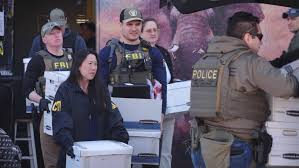
Federal agents armed with court-authorised search warrants swept across Minnesota in America, this week, intensifying a sprawling investigation into alleged fraud involving publicly funded social programs. The coordinated raids spanning more than 20 locations underscore the state’s growing prominence as the focal point of a national crackdown on misuse of taxpayer funds.
According to federal authorities, at least 22 search warrants were executed across Minneapolis and surrounding areas, targeting a network of businesses and service providers suspected of exploiting childcare, healthcare, and pandemic-era aid programs.

AD: Capeesh Restaurant
The operation involved multiple agencies, including the FBI and Homeland Security Investigations, and represents one of the largest enforcement actions in the state since earlier fraud scandals drew national attention.
Officials stressed that the raids are part of an ongoing financial crimes investigation and are not connected to immigration enforcement, despite occurring in a politically charged environment shaped by recent federal operations in the state.
The breadth of the investigation highlights longstanding concerns about vulnerabilities in public assistance programs. Authorities say the latest raids focused on organisations connected to childcare services, autism treatment programs, and food aid initiatives areas that have previously been linked to large-scale fraud schemes in Minnesota.

AD: Oysterian Sea Food Restaurant And Bar
In several locations, agents were seen removing documents, computers, and financial records, signalling an effort to build cases that could lead to further indictments. While officials have not disclosed specific names of targets, reports indicate that both commercial properties and private residences were included in the search warrants.
The investigation builds on earlier high-profile cases, most notably the “Feeding Our Future” scandal, which involved the alleged diversion of hundreds of millions of dollars intended to provide meals to low-income children. Federal prosecutors have already secured more than 60 convictions linked to that scheme and related fraud cases since 2022.
Recent developments suggest the scope of suspected fraud may extend even further. Authorities have pointed to schemes involving fraudulent enrollment in autism therapy programs and misuse of Medicaid-funded services, with some cases allegedly generating millions of dollars in illicit gains.
The Justice Department has responded by expanding resources dedicated to investigating fraud in federally funded programs, including the creation of specialised task forces.
Vice President JD Vance, who is leading a federal anti-fraud initiative, has emphasised a “relentless” approach to uncovering wrongdoing, reflecting a broader policy shift toward aggressive enforcement.
Political Tensions and Community Impact
The renewed focus on Minnesota has reignited political tensions at both the state and national levels. Governor Tim Walz has expressed support for efforts to combat fraud while also cautioning against politicizing the investigation or unfairly targeting specific communities.
A significant point of contention has been the apparent concentration of raids on businesses linked to the Somali-American community. Federal officials have not confirmed any ethnic targeting, but reports indicate that many of the searched sites are connected to that community, raising concerns among local leaders about potential bias and stigmatization.
Community advocates argue that while fraud must be addressed, broad enforcement actions risk undermining trust and harming legitimate service providers. Some policymakers have pointed to the scale of alleged fraud as justification for sweeping measures, framing the issue as one of protecting public resources.
The raids also come in the wake of earlier federal operations in Minnesota, including controversial immigration enforcement efforts that sparked protests and legal challenges. Although officials have repeatedly stated that the current investigation is unrelated, the overlap in timing and geography has contributed to public unease.
Further complicating the situation are estimates suggesting that fraud losses in Minnesota could reach into the billions of dollars across multiple programs, making the state a central focus of national enforcement priorities.
Officials have emphasised that it remains active and far from concluded, with further legal action likely as evidence gathered during the raids is reviewed. Reporting from notes that authorities are already scrutinising financial records and operational practices tied to childcare and social service providers, a process that typically precedes additional charges and court proceedings.
The same reporting highlights that state and federal officials have begun tightening oversight mechanisms freezing payments, reviewing compliance systems, and considering new legislative safeguards signalling that the case could have wide-ranging implications.
The outcome may influence how governments design, monitor, and enforce public assistance programs, potentially reshaping anti-fraud policy at both the state and national level.
Minnesota remains at the center of a rapidly evolving story, where allegations of financial misconduct intersect with broader debates over governance, accountability, and the limits of federal authority.
What began as a series of targeted investigations into suspected fraud within publicly funded programs has expanded into a wider examination of how billions of dollars in aid are distributed, monitored, and enforced. The scale and frequency of recent federal actions suggest that authorities view the issue not as isolated wrongdoing, but as indicative of deeper structural vulnerabilities within the system.
At the heart of the debate is a fundamental question about oversight. Public assistance programs particularly those expanded during the COVID-19 pandemic were designed to deliver aid quickly to vulnerable populations.
That urgency, however, may have come at the expense of rigorous safeguards. Investigators now appear to be working through complex financial trails, examining whether gaps in oversight were exploited by networks capable of operating across multiple sectors, including childcare, healthcare, and food distribution programs.
The situation has also reignited long-standing tensions between state and federal authorities. While federal agencies have taken an increasingly assertive role in investigating and prosecuting fraud, state officials are facing scrutiny over their own regulatory systems and whether warning signs were missed.
This dynamic has created a delicate balancing act: cooperation is essential for effective enforcement, yet disagreements over responsibility and jurisdiction continue to surface in public discourse.
The human and political dimensions of the case are becoming more pronounced. Community leaders and advocacy groups have raised concerns about how enforcement actions are carried out, particularly when they affect specific communities or industries.
There is growing awareness that while rooting out fraud is necessary, the methods used can have broader social consequences, potentially undermining trust in public institutions or discouraging legitimate providers from participating in essential programs.
Looking ahead, the implications of the investigation are likely to extend far beyond Minnesota. Policymakers across the country are watching closely, as the findings could influence how future aid programs are structured and supervised. Calls for reform are already emerging, with proposals ranging from enhanced auditing systems to stricter eligibility verification and increased interagency coordination.
In this sense, Minnesota has become more than just the site of a high-profile investigation. It is now a testing ground for how governments respond to large-scale fraud risks in an era of expansive public spending.
The outcomes both in the courtroom and in the policy arena could help define the next generation of accountability measures, shaping how public funds are protected while ensuring that those in need continue to receive timely and effective support.

AD: Heritage And Restaurant Lounge Bar