
By Gabriel Princewill-
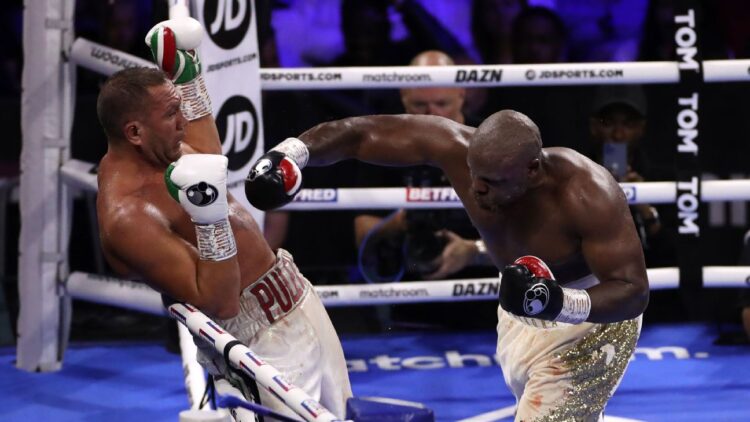
Deontay Wilder won a hard fought slugfest against veteran heavyweight Londoner, Derek Chisora at the O2 on Saturday night.
Wilder, long cast as a fading destroyer in the shadow of past wars, stood centre ring after twelve chaotic rounds and declared, with a mix of defiance and conviction, that he is “back” — and not merely to participate, but to “clean up” the heavyweight division.

AD: Capeesh Restaurant
It was a statement forged in violence, contradiction, and something far more complicated than the usual narrative of redemption. Across from him stood Derek Chisora, the iron-chinned London veteran fighting what many believed would be his final bout, and the two men delivered a contest that veered wildly between brutality and bizarre tenderness. By the end, Wilder had edged a split decision victory in what was widely described as a “slugfest for the ages,” denying Chisora a fairytale farewell.
Right from the opening bell, there was no sense of feeling out, no cautious probing typical of elite heavyweights. Instead, the fight erupted almost immediately into disorder. Chisora charged forward, whipping hooks with reckless abandon, energising a partisan London crowd that roared with every swing. So frenetic was the start, that his own coach briefly entered the ring in the opening round to separate the fighters — a moment that set the tone for the chaos that would follow.

AD: Oysterian Sea Food Restaurant And Bar
Wilder, taller and more measured, initially attempted to impose distance, flicking out his jab and circling away from Chisora’s bull-like rushes. But this was not the calculating Wilder of old title defences. This was a man drawn into a brawl, trading heavy artillery in tight spaces, his vaunted right hand repeatedly cocked and ready but not always unleashed.
There were fleeting but unmistakable moments when the old menace surfaced. In the middle rounds, Wilder began to find rhythm, his punches straighter, more economical. In round eight, he finally dropped Chisora, a moment that seemed to signal the beginning of the end. Yet even here, controversy intruded: a point deduction followed amid the confusion, and the momentum fractured as quickly as it had formed.
The fight refused to settle into any predictable pattern. Instead, it escalated as Chisora, battered but unbowed, surged again in the championship rounds, drawing Wilder into exchanges that seemed to teeter on the brink of mutual destruction.
In the eleventh, both men appeared to score knockdowns in a sequence so chaotic that even officials struggled to interpret what they had witnessed — trips, pushes, or genuine collapses under fire.
Still, amid the violence, there came one of the most surreal moments in recent heavyweight memory. Cameras caught Wilder speaking to his opponent in the midst of battle, telling Chisora, “I love you… I’m sorry.”
After the fight, Wilder would expand on this extraordinary admission. He revealed that he had, at times, held back his punches out of concern for Chisora’s well being — a confession that both humanised and complicated his performance. “I held back a couple of times,” he said, explaining that he was thinking about Chisora’s family and long career.
It was, depending on perspective, either an act of compassion or a troubling deviation from professional instinct. Critics have already questioned whether easing off in such a high-stakes contest undermines the integrity of the sport. Many see it as evidence of a fighter who has evolved — mentally, emotionally, perhaps even spiritually — after years of punishing battles.
What was beyond dispute was the majority verdict in a fight that captured the imagination of the viewing public. A split decision victory for Wilder, his second consecutive win and a crucial step in reasserting relevance in a division that has, in recent years, moved on without him.
“I’m back,” Wilder insisted afterward, his voice carrying equal parts warning and promise. “I’m here to clean up the heavyweight division.”
Those words land differently in 2026 than they might have at the height of his reign. Once the fearsome WBC champion with a knockout ratio bordering on myth, Wilder has since endured setbacks — most notably his trilogy with Tyson Fury, which redefined both fighters’ legacies. Their first bout ended in a dramatic draw, while the rematch saw Fury dominate and stop Wilder, exposing vulnerabilities that many believed had permanently altered the American’s trajectory.
Their final fight saw Fury destroy the former undefeated America in a scintillating war that included four knockdowns of the two extremely resilient behemoths.
Heavyweight boxing has always been a theatre of resurgence. Power, after all, is the great equaliser, and Wilder still possesses perhaps the most devastating right hand in the sport. Even against Chisora, in a fight where he claimed to have restrained himself, he scored knockdowns and repeatedly demonstrated that a single punch remains capable of changing everything.
The timing of Wilder’s declaration is particularly significant because the division itself is once again in flux. This weekend, Tyson Fury is scheduled to return to the ring, another reminder that the heavyweight landscape is being reshaped in real time.
Fury’s presence looms over any discussion of Wilder’s future. Their rivalry is unfinished in a broader sense — not necessarily in terms of contracted bouts, but in narrative weight. Fury proved he could outbox and overwhelm Wilder; Wilder, however, proved he could hurt Fury in ways few others have. That tension remains unresolved in the imagination of fans and promoters alike.
Should Fury emerge victorious in his upcoming bout, the calls for another chapter — however unlikely — may grow louder. And Wilder, newly resurgent and once again active, is positioning himself as a man ready to answer.
But the path back to a world title is far from straightforward. The modern heavyweight division is deeper and more dynamic than during Wilder’s initial reign. Champions and contenders alike bring a blend of size, skill, and tactical sophistication that demands more than raw power.
Against Chisora, Wilder showed both promise and limitation. His conditioning held over twelve hard rounds, and his durability — often questioned after past defeats — appeared intact. Yet there were also signs of erosion: moments where he was drawn into unnecessary exchanges, where defensive lapses allowed Chisora to land, and where the fight slipped from his control.
Wilder will likely need more than emotional declarations and sporadic bursts of brilliance. He will need consistency — the ability to dictate pace, manage distance, and impose his will over elite opponents who will not simply march forward into danger.
And yet, it would be unwise to dismiss him. Heavyweight history is littered with comebacks that seemed improbable until they happened. Fighters with lesser power, lesser resilience, and lesser belief have found their way back to championship glory. Wilder, for all his flaws, retains a weapon that no opponent can afford to ignore.
There is also the psychological dimension. By his own account, Wilder has emerged from a period of personal and professional rebuilding, crediting a renewed sense of purpose for his return. That intangible — the belief that one is not finished — can be as decisive as any technical adjustment.
The fight with Chisora, chaotic as it was, served a purpose beyond the scorecards. It reminded the boxing world that Wilder is still dangerous, still unpredictable, and still capable of commanding attention. It also revealed a more complex figure: a fighter who can apologise mid-fight, who can speak of love even as he trades punches, and who can simultaneously claim restraint while pursuing dominance.
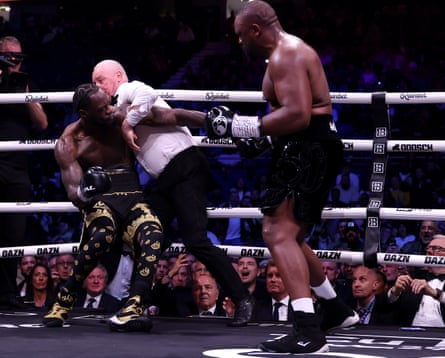
Referee Mark Bates attempts to pull apart Deontay Wilder and Derek Chisora. Photograph: Richard Pelham/Getty Images
As the crowd filtered out of the O2 Arena, the echoes of that strange, compelling contest lingered. Chisora, bloodied but unbowed, had given everything in what may have been his final stand. Wilder, victorious but introspective, had reclaimed a foothold in a division that had begun to forget him.
The question now is not whether Wilder is “back” — the evidence suggests that he is, at least in a competitive sense. The real question is what “back” actually means.
Whether it is a return to title contention, a final run at glory, or simply a last, defiant chapter in a career already defined by extremes, is anybody’s guess. Unbeaten heavyweight king, Olegsander Usyk currently remains the man to beat, with top contenders like the explosive Moses Itauma waiting in the wings to join the race for dominance.
With Tyson Fury stepping back into the spotlight this weekend, the heavyweight division is once again aligning itself around familiar names and unfinished stories. Wilder has inserted himself back into that conversation with force, drama, and no small amount of ambiguity.
If he is to regain a heavyweight title, he will need to refine the chaos that defined his latest victory, harnessing it without being consumed by it. He will need to prove that the restraint he spoke of was a choice, not a necessity — and that when the moment demands it, he can still unleash the full, terrifying potential that once made him champion.
Wilder standing under the lights, arms raised, declaring his return after a fight that was as messy as it was memorable. In heavyweight boxing, that is often enough to begin again.

AD: Heritage And Restaurant Lounge Bar
-
Share On
- Categories
- Date