
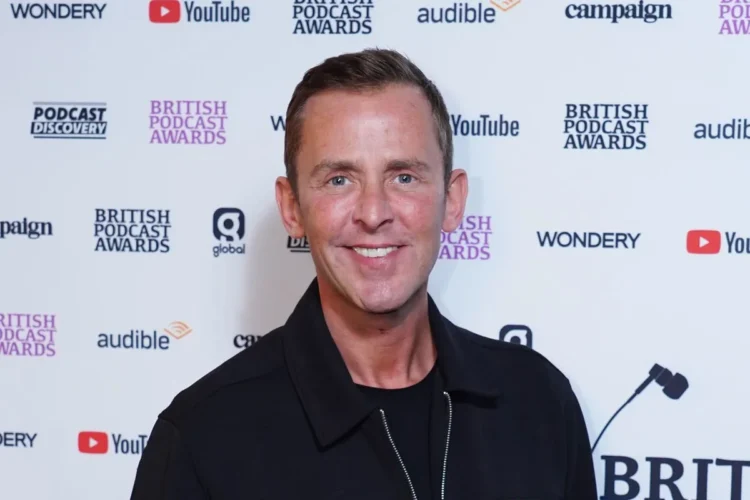
By Gabriel Princewill-
The sudden dismissal of Scott Mills appears to have been triggered by allegations of sexual assault against an under aged boy over 10 years ago, it has today been revealed.
An investigation conducted by police in 2016 was eventually dropped in 2019, due to insufficient evidence. The news sent shockwaves through British broadcasting, raising urgent questions about accountability, institutional response, and why serious allegations—first investigated nearly a decade ago—have only now resulted in the dj’s removal from the airwaves.

AD: Capeesh Restaurant
The BBC confirmed on Monday that Mills had been dismissed, offering limited detail beyond stating that the decision related to concerns about misconduct. The initial lack of transparency only intensified suspicion around the matter.
The broadcaster last night declined to explain the nature of the misconduct to The Eye Of Media , and today also did not state why an investigation almost a decade ago, has only just led to the abrupt firing of the veteran DJ.
The broadcaster’s spokesperson presented its generic statement that “while we do not comment on matters relating to individuals, we can confirm Scott Mills is no longer contracted and has left the BBC”.

AD: Oysterian Sea Food Restaurant And Bar
According to the Metropolitan Police, an investigation was launched in December 2016 following a referral from another police force. The inquiry centred on allegations of serious sexual offences against a teenage boy, with the alleged incidents said to have taken place between 1997 and 2000. As part of that investigation, a man in his 40s at the time was interviewed under caution in July 2018.
Despite the seriousness of the allegations, the case did not proceed to prosecution. The Crown Prosecution Service concluded in May 2019 that the evidential threshold required to bring charges had not been met, and the case was formally closed.
This outcome is not uncommon in historical cases, where evidential challenges—ranging from the passage of time to lack of corroborating material—can make it difficult to secure a conviction even where allegations are grave.
The investigation itself remained largely out of the public eye, effectively, lying dormant for several years. It appears to be against this backdrop that the BBC’s decision to remove Mills from his role must now be understood.
Mills, 53, had only recently assumed one of the most high-profile positions in British radio, taking over the Radio 2 breakfast show in 2025 from Zoe Ball. His appointment marked the culmination of a long and successful career within the BBC, spanning decades and multiple flagship programmes. Known for his affable on-air persona and strong listener following, Mills had become one of the corporation’s most recognisable voices.
His departure, however, was abrupt. Last Tuesday, he signed off his programme with a routine “back tomorrow,” giving no indication of the developments about to unfold. By the following day, he had been replaced on air by Gary Davies, with no immediate explanation offered to listeners. It was only later that confirmation of his dismissal emerged, leaving audiences and industry observers to piece together the reasons behind the decision.
Transparency And Institutional Pressure-Why Now?
The central question that should dominate discussions about this shocking revelation is why the BBC chose to act now, years after both the alleged offences and the subsequent police investigation. The gap between the closure of the criminal case in 2019 and Mills’ dismissal in 2026 is particularly striking, and would likely prompt widespread speculation about what may have changed in the interim.
One plausible explanation lies in the evolving standards of accountability within major institutions. In the years since the investigation concluded, the media landscape has undergone a profound shift, with increased emphasis on safeguarding, ethical conduct, and reputational risk.
Organisations like the BBC are now under far greater pressure to respond decisively to allegations, even historical ones—particularly when they involve vulnerable individuals such as minors.
Also conceivable is the role of new information, the conduct of internal reviews, or renewed scrutiny. Large organisations frequently revisit past cases in light of updated policies or external developments.
Another factor that may account for the late action of the broadcaster may be the distinction between criminal liability and employment standards. The decision by the Crown Prosecution Service not to pursue charges does not necessarily equate to a finding that no wrongdoing occurred. Rather, it reflects a judgement that the available evidence was insufficient to meet the high threshold required for a criminal conviction.
Employers, by contrast, operate under different standards, often making decisions based on risk, conduct policies, and public trust rather than legal proof beyond reasonable doubt. .The decision by the Crown Prosecution Service not to bring charges in 2019 would, in the past, likely have marked the end of the matter from an institutional perspective
Today, however, the calculus is different. The threshold for employment decisions—particularly in a public-facing organisation—is not the same as the threshold for criminal prosecution.
Employers are increasingly guided by considerations of trust, duty of care, and reputational risk. In the wake of heightened public awareness around safeguarding, especially involving minors, organisations may feel compelled to act even in the absence of a conviction. For the BBC, whose credibility rests heavily on public confidence, the stakes are especially high..
In this context, the BBC’s move can be seen as part of a broader trend in which organisations take pre-emptive or reputationally driven action in response to allegations, even where those allegations have not resulted in prosecution. For a publicly funded broadcaster with a mandate to uphold high editorial and ethical standards, the stakes are particularly high.
There is also the question of leadership and institutional memory. Changes in senior management, governance structures, or internal culture can significantly influence how historical issues are handled. A case that may not have prompted dismissal under one leadership team could be viewed very differently under another, especially in an era of heightened sensitivity to safeguarding concerns.
However, while these factors offer possible explanations, it is important to avoid drawing unwarranted conclusions. The available information confirms that Mills was investigated and that no charges were brought. Beyond that, many details remain unclear, especially as neither Mills nor the BBC has provided a full account of the circumstances leading to his dismissal. As such, any inference about guilt or the precise motivations behind the decision must be treated with caution.
What can be said with certainty is that the case illustrates the increasingly complex interplay between legal processes, media scrutiny, and institutional responsibility. It highlights how allegations—particularly those involving minors—can have long-lasting implications, resurfacing years later with significant professional consequences even in the absence of criminal proceedings.
The latest episode represents another challenging moment in its ongoing efforts to balance transparency, fairness, and public accountability. It undoubtedly raises difficult questions for audiences about trust, due process, and the standards to which public figures should be held.
And for the wider media industry, the matter is a wake up call that the past is rarely settled. In an age of renewed scrutiny and shifting expectations, historical allegations can return with force, reshaping careers and reputations long after the events in question and the investigations that followed have formally concluded.

AD: Heritage And Restaurant Lounge Bar