
By Kenneth Smith-
In an extraordinary twist in global football politics, FIFA president Gianni Infantino has revealed that United Statespresident Donald Trump personally assured him that Iran’s national football team is “welcome” to participate in the upcoming 2026 FIFA World Cup, despite escalating geopolitical conflict involving the two nations.
The announcement, made in the build‑up to one of sport’s most anticipated tournaments, comes at a time of heightened tensions following recent military action and conflicting public statements from officials in Tehran.

AD: Capeesh Restaurant
The 2026 World Cup co‑hosted by the United States, Mexico and Canada from June 11 to July 19 is shaping up to be one of the most politically charged editions in the event’s history. Iran’s placement in Group G sees them slated to face Belgium, Egypt and New Zealand in matches across major U.S. cities, including Los Angeles and Seattle.
But the question of whether the Iranian team would actually set foot on U.S. soil has been hotly debated for weeks, with contrasting narratives emerging from world leaders, sports authorities and Iranian officials.
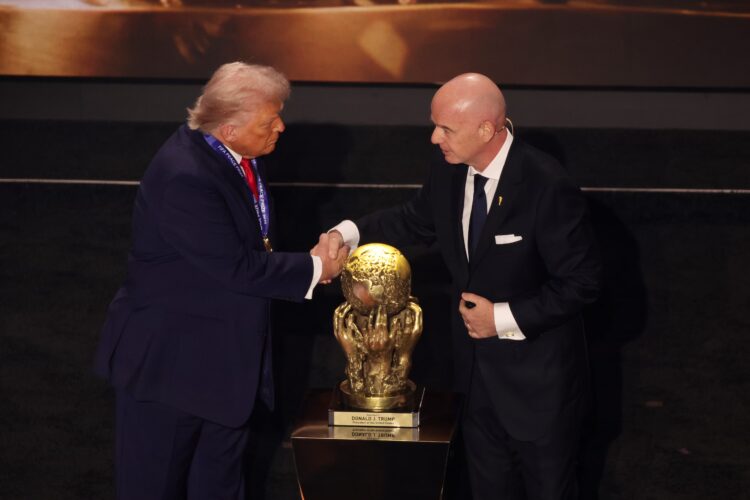
In a public statement late Tuesday, Gianni Infantino confirmed that he met with President Trump to discuss preparations for the global tournament and the place of the Iranian side in the competition. According to Infantino’s recounting of the Oval Office conversation, the U.S. president “reiterated that the Iranian team is, of course, welcome to compete in the tournament in the United States.”

AD: Oysterian Sea Food Restaurant And Bar
Infantino took to social media to share his gratitude toward Trump’s backing, calling the World Cup an event with the power to “bring people together now more than ever” and thanking the president “for his support, as it shows once again that Football Unites the World.”
However, this reassurance from the White House comes amid a backdrop of diplomatic strain. Only weeks earlier, Trump was quoted saying he “really doesn’t care” whether Iran takes part in the tournament, remarks that underscored the uncertain official stance on Iran’s place in the competition.
Infantino’s relationship with Trump including the 2025 award of FIFA’s inaugural Peace Prize to the U.S. president, a gesture widely seen as controversial within football circles adds another layer of intrigue to this development.
Critics have argued that FIFA’s decision to align closely with Trump may have been designed to secure political cover for hosting a tournament in the powerhouse nation that is also entangled in Middle East conflict dynamics.
French political scientist Raphael Le Magoariec, who studies geopolitics in sport, has suggested that Gianni Infantino’s relationship with Trump is driven by strategic considerations around the tournament.
He argued that Infantino’s approach is largely pragmatic and tied to ensuring the success of the World Cup hosted in the United States. One analyst close to football governance even described FIFA’s strategy as rational because the organisation believes it “needs Trump for [the World Cup] to go well.
Some journalists have also criticised Infantino for “cosying up” to Trump despite claiming football should remain above politics, arguing that the governing body appears eager to maintain favour with the leader of the country hosting most of the 2026 World Cu
Yet the broader international response has been mixed. While Infantino and his team maintain that planning for the tournament remains on track with all qualified teams expected to take part, questions linger about the human dimension of the issue particularly for Iranian players, dozens of whom have been caught between sporting ambition and national security concerns.
The backdrop to these assurances is a conflict that has dramatically shifted global attention. After U.S. and Israeli air strikes on Iran beginning on February 28, tensions have flared across the region, with Tehran responding militarily and diplomatic relations reaching new lows.
The strikes included the death of Ayatollah Ali Khamenei, Iran’s supreme leader, an event that sharply escalated hostilities between Tehran and Washington’s allies.
Iran’s response has been unambiguous on at least one point: cancellation. Ahmad Donyamali, Iran’s sports minister, said on state television that under no circumstances in his view can the national team participate in the World Cup under such conditions, arguing that the safety of Iranian athletes could not be guaranteed on U.S. soil. His remarks appeared to rule out competition as things currently stand, a direct contradiction to FIFA and White House messaging.
This stark divergence between the diplomatic assurances given by Trump and Infantino and Iran’s public stance cautioning against participation illustrates the complexity of sport intersecting with international politics. Iranian officials have framed their withdrawal as a moral and security imperative, not just a logistical challenge, citing the recent loss of life and ongoing hostilities as fundamental obstacles.
Compounding the situation are reports of Iranian athletes seeking alternative futures. Six members of Iran’s women’s national team were granted humanitarian visas in Australia over safety concerns, although one later chose to return home. These human stories add personal stakes to what otherwise might appear to outsiders as a purely geopolitical squabble.
Despite these challenges, FIFA’s leadership has been publicly adamant that the World Cup must go ahead in full, resisting calls for postponement or reconfiguration of the tournament schedule.
Heimo Schirgi, FIFA’s chief operating officer, told media outlets that the size and importance of the World Cup make postponement unthinkable, and that the organisation hopes “everyone who has qualified” will participate.
Even with such reassurances, the practicalities of Iran’s participation remain hazy. Its matches are scheduled across U.S. venues including Inglewood and Seattle locations that would require special diplomatic exceptions for visas and security guarantees that, under normal circumstances, would be routine. In this case, however, they are anything but ordinary.
Facing the prospect of possibly encountering Iran on the field, U.S. fans and commentators have reacted with a mix of enthusiasm and incredulity, reflecting broader societal divisions about politics and sport. Some see the prospect as a powerful symbol of peace and engagement; others view it as a risky proposition that could inflame tensions further.
Ultimately, the question of Iran’s presence in the 2026 World Cup encapsulates an age‑old tension in international sport: can a global event truly rise above geopolitics, or is it inherently shaped by the conflicts of its time?
With less than one hundred days to go until kickoff, the world football fans and global citizens alike will be watching closely to see whether Trump’s assurances translate into action on the pitch.
The 2026 World Cup, already shaping up as a spectacle of unprecedented scale with matches across the United States, Canada, and Mexico, now carries an additional layer of geopolitical tension that could overshadow even the most dramatic moments of sport.
While the tournament is a celebration of skill, passion, and the unity that football uniquely inspires. For others, it has become a stage where the fault lines of international politics are on full display, forcing fans, players, and organisers to navigate a delicate balancing act between sport and diplomacy.
The presence or absence of Iran’s national team will resonate far beyond stadiums, serving as a litmus test for whether sport can genuinely transcend global conflict. Iranian athletes have trained for years with the hope of showcasing their talent on football’s biggest stage, yet the safety and political implications of participating in the U.S. remain unresolved.
Any decision will likely carry symbolic weight: if Iran competes, it could be seen as a small but powerful bridge toward engagement, emphasising the unifying potential of global events. Conversely, a withdrawal could highlight the limits of diplomacy in the face of entrenched hostilities, casting a shadow over FIFA’s claim that football is a force for inclusion and international dialogue.
With fans pour into stadiums, tune in across television networks, and follow the unfolding drama online, the world will not only witness goals and saves but also a larger, more complex narrative: the intersection of sportsmanship, political power, and the human desire for connection.
In this tense countdown to kickoff, every match, every fan chant, and every camera shot carries more than just athletic significance it becomes part of a broader story about whether the beautiful game can live up to its promise as a universal bridge in a divided world.

AD: Heritage And Restaurant Lounge Bar